
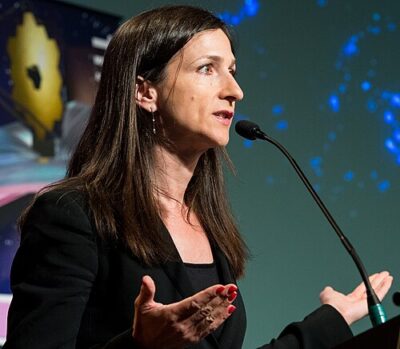
Sara Seager
Sara Seager is a Canadian astronomer and planetary scientist. Born July 21, 1971, in Toronto. Educated at University of Toronto and Harvard University. Awards include MacArthur Fellows Program, Helen B. Warner Prize for Astronomy and Sackler Prize for Physics.
Facts
33 facts · 1 confirmed by two sources · 18 cited · 14 from one source
Where this comes from
Papalocal keeps its own record. It started from these sources; what each one said is kept here as it was copied, so a change on their side never changes this page by itself. Tap one to read its version.
What Wikidata says · copied November 15, 2026 · revision 2563821533
- Described as
- Canadian astronomer and planetary scientist
- Other names
- S. Seager
- Born
- July 21, 1971 · 2 references
- Born in
- Toronto
- Citizen of
- United States (2010–) · 1 reference; Canada
- Occupation
- astronomer; physicist · 1 reference; astrophysicist; university teacher; biologist · 1 reference
- Worked for
- Institute for Advanced Study (1999–2002) · 1 reference; Carnegie Science (2002–2006) · 1 reference; Massachusetts Institute of Technology (2007–) · 2 references
- Education
- University of Toronto; Harvard University · 1 reference
- Member of
- National Academy of Sciences (2015–) · 1 reference; American Academy of Arts and Sciences
- Awards
- MacArthur Fellows Program (2013) · 1 reference; Helen B. Warner Prize for Astronomy (2007) · 1 reference; Sackler Prize for Physics (2012); Nature's 10 (2011) · 1 reference; Officer of the Order of Canada (2020) · 1 reference; Fellow of the American Association for the Advancement of Science (2011) · 1 reference; Magellanic Premium (2021) · 1 reference; Kavli Prize in Astrophysics (2024) · 1 reference
- Field
- astronomy · 1 reference; astrophysics · 1 reference; aviation · 1 reference; astronautics · 1 reference; research and development · 1 reference; astrobiology
- Lived in
- Concord · 1 reference
- Website
- http://seagerexoplanets.mit.edu/; https://www.saraseager.com/
- Wikipedias with a page
- 32
Wikidata item Q7421764 (wikidata.org/wiki/Q7421764), public domain (CC0). Copied November 15, 2026.
What Wikipedia says · copied November 15, 2026 · revision 1384712289
Sara Seager (born July 21, 1971) is a Canadian-American astronomer and planetary scientist. As of October 1, 2026 she is the North Star Distinguished Professor at her alma mater the University of Toronto, in the Canadian Institute for Theoretical Astrophysics (CITA), having previously spent 20 years as a professor at the Massachusetts Institute of Technology. Seager is known for her work on extrasolar planets and their atmospheres. She is the author of two textbooks on these topics, and has been recognized for her research by Popular Science, Discover Magazine, Nature, and TIME Magazine. Seager was awarded a MacArthur Fellowship in 2013 citing her theoretical work on detecting chemical signatures on exoplanet atmospheres and developing low-cost space observatories to observe planetary transits.
- Born, in its opening lines
- July 21, 1971
From the Wikipedia article “Sara Seager” (en.wikipedia.org/wiki/Sara_Seager), by its contributors, under CC BY-SA 4.0 (creativecommons.org/licenses/by-sa/4.0/). Copied November 15, 2026; not changed.
Confirmed Two sources agree. Cited One source, and it names where it got it. One source One source, without a reference of its own. Sources disagree The sources disagree. We show the best-supported value and keep theirs below.
