
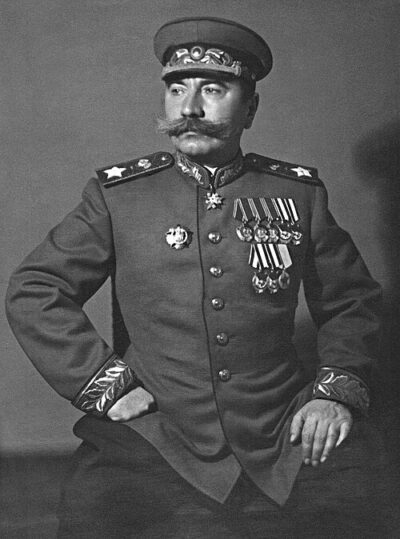
Semyon Budyonny
Semyon Budyonny was a Soviet marshal. Born April 13, 1883, in Budyonnovskaya. Died October 26, 1973, in Moscow. Positions held include member of the Presidium of the Supreme Soviet of the USSR (1938–) and deputy of the Supreme Soviet of the Soviet Union (1938–1973). Educated at Cavalry Officer School and M.V. Frunze Military Academy. Awards include Order of Lenin (6 times), Medal "For the Victory over Germany in the Great Patriotic War 1941–1945" and Order of the Red Banner (6 times).
Facts
43 facts · 1 confirmed by two sources · 3 cited · 38 from one source · 1 where the sources disagree
What’s different
- Born: we show April 13, 1883 (Sources disagree). Wikipedia says April 25, 1883
Where this comes from
Papalocal keeps its own record. It started from these sources; what each one said is kept here as it was copied, so a change on their side never changes this page by itself. Tap one to read its version.
What Wikidata says · copied November 16, 2026 · revision 2567935305
- Described as
- Soviet marshal (1883-1973)
- Other names
- Semyon Mikhailovich Budyonny, Semyon Mikhailovich Budyonnyy, Simón Mijáilovich Budionny, Buddeny
- Born
- April 13, 1883 · 1 reference
- Died
- October 26, 1973 · 4 references
- Born in
- Budyonnovskaya
- Died in
- Moscow · 2 references
- Buried in
- Kremlin Wall Necropolis
- Citizen of
- Russian Empire; Soviet Union
- Occupation
- politician; military officer · 1 reference; writer; soldier · 1 reference
- Positions held
- member of the Presidium of the Supreme Soviet of the USSR (1938–); deputy of the Supreme Soviet of the Soviet Union (1938–1973)
- Political party
- Communist Party of the Soviet Union (1919–)
- Education
- Cavalry Officer School (1907–1908); M.V. Frunze Military Academy (–1932)
- Member of
- Central Committee of the Communist Party of the Soviet Union; Central Executive Committee of the Soviet Union; All-Russian Central Executive Committee
- Awards
- Order of Lenin (6 times) (1935, 1939, 1943, 1945, 1953, 1958); Medal "For the Victory over Germany in the Great Patriotic War 1941–1945"; Order of the Red Banner (6 times) (1919, 1923, 1930, 1941, 1944, 1948); Hero of the Soviet Union (3 times) (1958, 1963, 1968); Jubilee Medal "XX Years of the Workers' and Peasants' Red Army"; Order of Suvorov, 1st class (1944); Medal "For the Defence of Odessa"; Medal "For the Defence of Sevastopol"; Medal "For the Defence of Moscow"; Medal "For the Defence of the Caucasus"; Medal "For the Victory over Japan"; Gold Star medal (3 times) (1958, 1963, 1968); Jubilee Medal "Twenty Years of Victory in the Great Patriotic War 1941–1945"; Jubilee Medal "In Commemoration of the 100th Anniversary of the Birth of Vladimir Ilyich Lenin"; Jubilee Medal "30 Years of the Soviet Army and Navy"
- Spouse
- Maria Budyonnaya
- Children
- Nina Budyonnaya; Mikhail Budyonny; Sergey Budyonny
- Father
- Mikhail Budyonny
- Mother
- Melania Budyonnaya
- Military branch
- cavalry
- Military rank
- Marshal of the Soviet Union (1935–) · 1 reference; non-commissioned officer · 1 reference
- Wikipedias with a page
- 60
Wikidata item Q242474 (wikidata.org/wiki/Q242474), public domain (CC0). Copied November 16, 2026.
What Wikipedia says · copied November 16, 2026 · revision 1384416342
Semyon Mikhailovich Budyonny (Russian: Семён Миха́йлович Будённый, romanized: Semyon Mikháylovich Budyonnyy, IPA: [sʲɪˈmʲɵn mʲɪˈxajləvʲɪdʑ bʊˈdʲɵnːɨj] ; 25 April [O.S. 13 April] 1883 – 26 October 1973) was a Russian and Soviet cavalryman, military commander during the Russian Civil War, Polish–Soviet War and World War II, and politician, who was a close political ally of Soviet leader Joseph Stalin.
Born to a poor peasant family from the Don Cossack region in southern Russia, Budyonny was drafted into the Imperial Russian Army in 1903. He served with distinction in a dragoon regiment during the First World War, earning all four classes of the Cross of St. George. When the Russian Civil War broke out Budyonny founded the Red Cavalry, which played an important role in the Bolshevik victory; Budyonny became renowned and was the subject of several popular songs. In 1922 he also became commander of all the troops in the north Caucasian military district. While serving as inspector of the Red Army's cavalry (1924–37) and commander of the Moscow military district (1937–40), as a political ally of Joseph Stalin, he became one of the original five Marshals of the Soviet Union. He was one of the two most senior army commanders that survived the Great Purge and in post at the time of German invasion of the USSR in 1941. After the Soviet forces under Budyonny's command were routed in the battles of Kiev and Uman, he was removed from frontline command. He received the blame for many of Stalin's military strategic errors in the early part of World War II, but he was retained in the Soviet high command. In 1953 he resumed his post of inspector of the cavalry.
Budyonny was a staunch proponent of horse cavalry. During the Great Purge, he testified against Mikhail Tukhachevsky's efforts to create an independent tank corps, claiming that it was so inferior to cavalry and illogical that it amounted to "wrecking" (sabotage). After being told of the importance of the tank in the coming war in 1939, he remarked, "You won't convince me. As soon as war is declared, everyone will shout, 'Send for the Cavalry!'"
- Born, in its opening lines
- April 25, 1883
- Died, in its opening lines
- October 26, 1973
From the Wikipedia article “Semyon Budyonny” (en.wikipedia.org/wiki/Semyon_Budyonny), by its contributors, under CC BY-SA 4.0 (creativecommons.org/licenses/by-sa/4.0/). Copied November 16, 2026; not changed.
Confirmed Two sources agree. Cited One source, and it names where it got it. One source One source, without a reference of its own. Sources disagree The sources disagree. We show the best-supported value and keep theirs below.
