
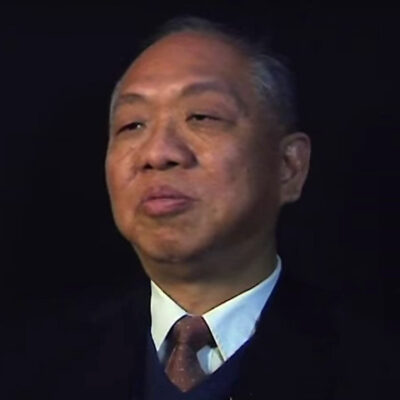
Shing-Tung Yau
Shing-Tung Yau is an American mathematician from Hong Kong. Born April 4, 1949, in Shantou. Educated at University of California, Berkeley and Pui Ching Middle School. Awards include Fields medal, Guggenheim Fellowship and MacArthur Fellows Program.
Facts
46 facts · 1 confirmed by two sources · 17 cited · 28 from one source
Where this comes from
Papalocal keeps its own record. It started from these sources; what each one said is kept here as it was copied, so a change on their side never changes this page by itself. Tap one to read its version.
What Wikidata says · copied November 13, 2026 · revision 2568409290
- Described as
- American mathematician from Hong Kong
- Other names
- S.-T. Yau
- Born
- April 4, 1949 · 4 references
- Born in
- Shantou · 4 references
- Citizen of
- United States (1990–) · 2 references; British Hong Kong (–1990) · 1 reference
- Occupation
- mathematician · 4 references; professor · 2 references; scientist · 3 references; university teacher · 1 reference
- Worked for
- Harvard University; Stanford University; University of California, Berkeley; University of California, San Diego · 1 reference; Stony Brook University · 1 reference; Zhejiang University · 1 reference
- Education
- University of California, Berkeley; Pui Ching Middle School; Chung Chi College; The Chinese University of Hong Kong · 1 reference
- Member of
- Accademia Nazionale dei Lincei (2005–) · 1 reference; American Mathematical Society (2012–) · 2 references; National Academy of Sciences; Chinese Academy of Sciences; Academia Sinica; Russian Academy of Sciences; American Academy of Arts and Sciences; Committee of 100
- Awards
- Fields medal (1982); Guggenheim Fellowship (1982) · 1 reference; MacArthur Fellows Program (1984); Oswald Veblen Prize in Geometry (1981); National Medal of Science (1997); Humboldt Prize (1991); Humboldt Research Fellowship; Wolf Prize in Mathematics (2010) · 1 reference; Crafoord Prize in Mathematics (1994) · 1 reference; Fellow of the American Mathematical Society (2013) · 2 references; honorary doctor of the Zhejiang University (2003) · 1 reference; honorary doctor of the Chinese University of Hong Kong; Crafoord Prize · 1 reference; John J. Carty Award for the Advancement of Science (1981) · 1 reference; Shaw Prize (2023) · 1 reference
- Field
- differential geometry · 1 reference; mathematics · 1 reference
- Siblings
- Stephen Shing-Toung Yau
- Lived in
- United States; Greater Boston (1987–)
- Wikipedias with a page
- 41
Wikidata item Q334760 (wikidata.org/wiki/Q334760), public domain (CC0). Copied November 13, 2026.
What Wikipedia says · copied November 13, 2026 · revision 1373686289
Shing-Tung Yau (Chinese: 丘成桐; pinyin: Qiū Chéngtóng; Jyutping: jau1 sing4 tung4; born April 4, 1949) is a Chinese American mathematician and educator. He is the first ethnic Chinese Fields medalist and director of the Yau Mathematical Sciences Center at Tsinghua University and professor emeritus at Harvard University. Until 2022, Yau was the William Caspar Graustein Professor of Mathematics at Harvard, at which point he moved to Tsinghua.
Yau was born in Shantou in 1949, moved to Hong Kong at a young age, and then moved to the United States in 1969. He was awarded the Fields Medal in 1982, in recognition of his contributions to partial differential equations, the Calabi conjecture, the positive energy theorem, and the Monge–Ampère equation. Yau is considered one of the major contributors to the development of modern differential geometry and geometric analysis.
The impact of Yau's work are also seen in the mathematical and physical fields of convex geometry, algebraic geometry, enumerative geometry, mirror symmetry, general relativity, and string theory, while his work has also touched upon applied mathematics, engineering, and numerical analysis.
- Born, in its opening lines
- April 4, 1949
From the Wikipedia article “Shing-Tung Yau” (en.wikipedia.org/wiki/Shing-Tung_Yau), by its contributors, under CC BY-SA 4.0 (creativecommons.org/licenses/by-sa/4.0/). Copied November 13, 2026; not changed.
Confirmed Two sources agree. Cited One source, and it names where it got it. One source One source, without a reference of its own. Sources disagree The sources disagree. We show the best-supported value and keep theirs below.
