
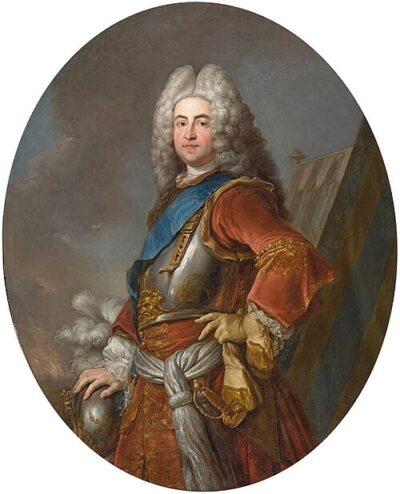
Stanisław Poniatowski
Stanisław Poniatowski was a Castellan of Kraków. Born September 15, 1676, in Chojnik, Lesser Poland Voivodeship. Died August 29, 1762, in Ryki. Positions held include voivode of Masovia (1731–1752), castellan of Kraków (1752–1762) and Polish elector. Educated at Jagiellonian University.
Facts
33 facts · 2 confirmed by two sources · 8 cited · 23 from one source
Where this comes from
Papalocal keeps its own record. It started from these sources; what each one said is kept here as it was copied, so a change on their side never changes this page by itself. Tap one to read its version.
What Wikidata says · copied November 18, 2026 · revision 2568947815
- Described as
- Castellan of Kraków (1676-1762)
- Born
- September 15, 1676 · 4 references
- Died
- August 29, 1762 · 3 references
- Born in
- Chojnik, Lesser Poland Voivodeship
- Died in
- Ryki · 2 references
- Buried in
- Ryki
- Citizen of
- Polish–Lithuanian Commonwealth
- Occupation
- diplomat; writer · 1 reference; politician · 2 references
- Positions held
- voivode of Masovia (1731–1752); castellan of Kraków (1752–1762); Polish elector; Regimentarz; Grand Treasurer of the Grand Duchy of Lithuania (1722–1731) · 1 reference; starosta of Przemyśl; Artillery General of the Crown (1708) · 1 reference
- Education
- Jagiellonian University
- Member of
- Freemasonry · 1 reference
- Spouse
- Konstancja Czartoryska · 1 reference; Teresa Woyna Jasieniecka · 3 references
- Children
- Stanisław August Poniatowski; Kazimierz Poniatowski · 1 reference; Aleksander Poniatowski · 1 reference; Ludwika Maria Poniatowska; Izabella Poniatowska; Andrzej Poniatowski; Michał Jerzy Poniatowski · 1 reference; Franciszek Poniatowski
- Father
- Franciszek Poniatowski
- Mother
- Helena Poniatowska
- Siblings
- Zofia Agnieszka Poniatowska
- Religion
- Catholic Church
- Military rank
- general
- Wikipedias with a page
- 22
Wikidata item Q46217 (wikidata.org/wiki/Q46217), public domain (CC0). Copied November 18, 2026.
What Wikipedia says · copied November 18, 2026 · revision 1375080722
Stanisław Poniatowski (15 September 1676 – 29 August 1762) was a Polish military commander, diplomat, and noble. Throughout his career, Poniatowski served in various military offices, and was a general in both the Swedish and Polish–Lithuanian militaries. He also held numerous civil positions, including those of podstoli of Lithuania and Grand Treasurer of the Lithuanian army in 1722, voivode of the Masovian Voivodeship in 1731, regimentarz of the Crown Army in 1728, and castellan of Kraków in 1752. Throughout his lifetime, he served in many starost positions.
Poniatowski was involved in Commonwealth politics, and was a prominent member of the Familia, a faction led by the Czartoryski family. On a number of occasions he was in service of Stanisław I Leszczyński, the principal rival of Augustus II for the throne of Poland. Having served under Leszczyński as a military officer and envoy during the Great Northern War, Poniatowski later embraced the Russian-supported Augustus. Subsequently, during the War of the Polish Succession, he returned, with the majority of the Familia, to his earlier allegiance. He later effected a reconciliation with Augustus III, and eventually became one of the new king's chief advisors.
Poniatowski's fifth son, Stanisław August Poniatowski, reigned as the last king of Poland from 1764 until 1795, when he abdicated as a result of the Third Partition of Poland by Russia, Prussia, and Austria. His grandson, Prince Józef Antoni Poniatowski, was a Polish general and later a Marshal of the First French Empire, serving under Napoleon I.
- Born, in its opening lines
- September 15, 1676
- Died, in its opening lines
- August 29, 1762
From the Wikipedia article “Stanisław Poniatowski (1676–1762)” (en.wikipedia.org/wiki/Stanisław_Poniatowski_(1676–1762)), by its contributors, under CC BY-SA 4.0 (creativecommons.org/licenses/by-sa/4.0/). Copied November 18, 2026; not changed.
Confirmed Two sources agree. Cited One source, and it names where it got it. One source One source, without a reference of its own. Sources disagree The sources disagree. We show the best-supported value and keep theirs below.
