
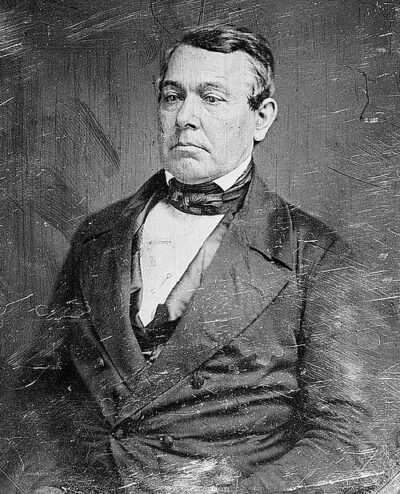
Thomas Corwin
Thomas Corwin was an American politician. Born July 29, 1794, in Bourbon County. Died December 18, 1865, in Washington, D.C.. Positions held include United States representative (2 times) (1831–1861), United States Secretary of the Treasury (1850–1853) and Ohio state representative (1821–1823).
Facts
26 facts · 2 confirmed by two sources · 9 cited · 15 from one source
Where this comes from
Papalocal keeps its own record. It started from these sources; what each one said is kept here as it was copied, so a change on their side never changes this page by itself. Tap one to read its version.
What Wikidata says · copied November 16, 2026 · revision 2568694549
- Described as
- American politician (1794-1865)
- Other names
- The Wagon Boy, Tom Corwin
- Born
- July 29, 1794 · 3 references
- Died
- December 18, 1865 · 3 references
- Born in
- Bourbon County
- Died in
- Washington, D.C. · 1 reference
- Buried in
- Lebanon Cemetery
- Citizen of
- United States
- Occupation
- politician · 1 reference; lawyer · 1 reference; diplomat; ambassador · 1 reference; governor · 1 reference; jurist · 1 reference; finance minister · 1 reference
- Positions held
- United States representative (2 times) (1831–1861); United States Secretary of the Treasury (1850–1853); Ohio state representative (1821–1823); Governor of Ohio (1840–1842); United States Ambassador to Mexico; United States senator (1845–1850) · 1 reference; senator · 1 reference
- Political party
- Whig Party; Republican Party
- Worked for
- United States Department of the Treasury
- Father
- Matthias Corwin
- Siblings
- Jesse Corwin; Matthias Corwin
- Wikipedias with a page
- 20
Wikidata item Q879077 (wikidata.org/wiki/Q879077), public domain (CC0). Copied November 16, 2026.
What Wikipedia says · copied November 16, 2026 · revision 1384125848
Thomas Corwin (July 29, 1794 – December 18, 1865), also known as Tom Corwin, The Wagon Boy, and Black Tom was a politician from the state of Ohio. He represented Ohio in both houses of Congress and served as the 15th governor of Ohio and the 20th U.S. secretary of the treasury. After affiliating with the Whig Party, he joined the Republican Party in the 1850s. Corwin is best known for his sponsorship of the proposed Corwin Amendment, which was presented in an unsuccessful attempt to avoid the oncoming American Civil War.
Corwin was born in Bourbon County, Kentucky, but he grew up in Lebanon, Ohio. After serving as a wagon boy in the War of 1812, he established a legal practice in Lebanon. He became a prosecuting attorney and won election to the Ohio House of Representatives. He served in the United States House of Representatives from 1830 to 1840, resigning from Congress to take office as Ohio's governor. He was defeated for re-election in 1842 but was elected by the state legislature to the United States Senate in 1844. As a Senator, he became a prominent opponent of the Mexican–American War. He resigned from the Senate to become Secretary of the Treasury under President Millard Fillmore.
Corwin returned to the United States House of Representatives in 1859. He led the House of Representatives' effort to end the secessionist crisis that arose following the 1860 elections. Corwin sponsored a constitutional amendment that would have forbidden the federal government from outlawing slavery, even through further constitutional amendments. Though several states ratified the amendment, it did not prevent the outbreak of the civil war. Corwin resigned from Congress in March 1861 to become the United States Ambassador to Mexico. He held that position until 1864 and died the following year.
- Born, in its opening lines
- July 29, 1794
- Died, in its opening lines
- December 18, 1865
From the Wikipedia article “Thomas Corwin” (en.wikipedia.org/wiki/Thomas_Corwin), by its contributors, under CC BY-SA 4.0 (creativecommons.org/licenses/by-sa/4.0/). Copied November 16, 2026; not changed.
Confirmed Two sources agree. Cited One source, and it names where it got it. One source One source, without a reference of its own. Sources disagree The sources disagree. We show the best-supported value and keep theirs below.
