
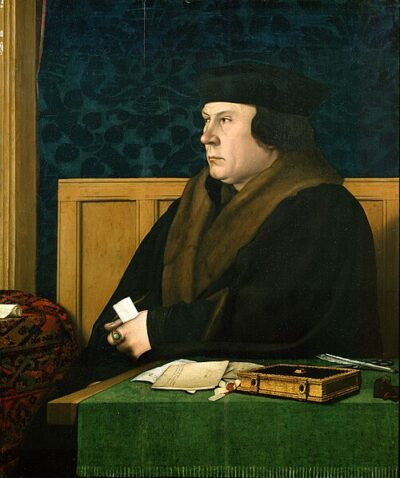
Thomas Cromwell
Thomas Cromwell was an English statesman and politician. Born 1485, in Putney. Died July 28, 1540, in Tower Hill. Positions held include Member of the 1523 Parliament (1523), Lord Great Chamberlain (1540) and Lord Privy Seal (1536–1540). Educated at Gray's Inn. Awards include Order of the Garter.
Facts
33 facts · 2 confirmed by two sources · 10 cited · 21 from one source
Where this comes from
Papalocal keeps its own record. It started from these sources; what each one said is kept here as it was copied, so a change on their side never changes this page by itself. Tap one to read its version.
What Wikidata says · copied November 16, 2026 · revision 2568065624
- Described as
- English statesman and politician (1485–1540)
- Other names
- Thomas Cromwell, 1st Baron Cromwell, Sir Thomas Cromwell, Thomas Cromwell, 1st Earl of Essex, 1st Earl of Essex Thomas Cromwell, Thomas Cromwell, Earl of Essex, Baron Cromwell, Earl of Essex Thomas Cromwell
- Born
- 1485 · 13 references
- Died
- July 28, 1540 · 3 references
- Born in
- Putney · 1 reference
- Died in
- Tower Hill
- Buried in
- Church of St Peter ad Vincula, Tower Hamlets
- Cause of death
- decapitation · 1 reference
- Citizen of
- Kingdom of England
- Occupation
- politician · 1 reference; judge; lawyer
- Positions held
- Member of the 1523 Parliament (1523) · 1 reference; Lord Great Chamberlain (1540); Lord Privy Seal (1536–1540); Master of the Rolls (1534–1536); Chancellor of the Exchequer (1533–1540); Member of the 1529-36 Parliament (1529–) · 1 reference; Member of the 1536 Parliament (1536–) · 1 reference; Master of the Jewel Office (1532–1536); Dean of Wells (1537–1540); Secretary of State of England (1534–1540)
- Education
- Gray's Inn · 1 reference
- Member of
- English Reformation Parliament
- Awards
- Order of the Garter · 1 reference
- Spouse
- Elizabeth Wyckes (1513–) · 3 references
- Children
- Gregory Cromwell, 1st Baron Cromwell · 3 references; Anne Cromwell; Grace Cromwell; Jane Cromwell · 1 reference
- Father
- Walter Cromwell · 3 references
- Mother
- Katherine Glossop, of Wirkesworth, Derbs · 2 references
- Siblings
- Catherine Cromwell · 1 reference
- Religion
- Catholic Church; Anglicanism
- Wikipedias with a page
- 51
Wikidata item Q294435 (wikidata.org/wiki/Q294435), public domain (CC0). Copied November 16, 2026.
What Wikipedia says · copied November 16, 2026 · revision 1381635646
Thomas Cromwell, 1st Earl of Essex (; c. 1485 – 28 July 1540) was an English statesman and lawyer who served as chief minister to King Henry VIII from 1534 until mid-1540, at which time he was beheaded on Henry's orders, a loss the King would later regret.
Cromwell was one of the most powerful proponents of the English Reformation. As the King's chief secretary, he instituted new administrative procedures that transformed the workings of government. He helped to engineer an annulment of the King's marriage to Catherine of Aragon so that Henry could lawfully marry Anne Boleyn. Henry had failed to obtain the approval of Pope Clement VII for the annulment in 1533, so Parliament endorsed the King's claim to be Supreme Head of the Church of England — thus giving him the authority to annul his own marriage. Cromwell subsequently charted an evangelical and reformist course for the new Church of England from his unique posts of Vicegerent in Spirituals and Vicar General (the two titles refer to the same position).
During his rise to power, Cromwell made many enemies, including Henry's second queen Anne Boleyn, with his fresh ideas and lack of inherited nobility. He played a prominent role in her downfall and execution on charges of treason in 1536. He fell from power in 1540, despite being created Earl of Essex that year, after arranging the King's short-lived fourth marriage to the German princess Anne of Cleves. The marriage was a disaster for Cromwell, ending in an annulment six months later. Cromwell was arraigned under an act of attainder (32 Hen. 8. c. 62) and was executed for treason and heresy on Tower Hill on 28 July 1540. The King later expressed regret at the loss of his chief minister, and his reign never recovered from the incident.
- Born, in its opening lines
- c. 1485
- Died, in its opening lines
- July 28, 1540
From the Wikipedia article “Thomas Cromwell” (en.wikipedia.org/wiki/Thomas_Cromwell), by its contributors, under CC BY-SA 4.0 (creativecommons.org/licenses/by-sa/4.0/). Copied November 16, 2026; not changed.
Confirmed Two sources agree. Cited One source, and it names where it got it. One source One source, without a reference of its own. Sources disagree The sources disagree. We show the best-supported value and keep theirs below.
