
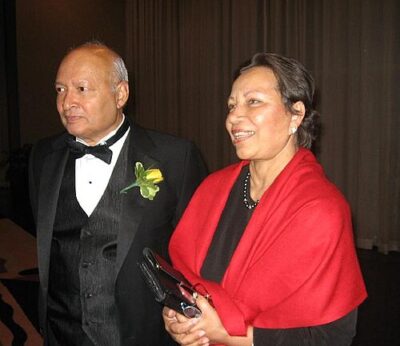
Thomas Kailath is an American engineer. Born June 7, 1935, in Pune. Educated at Savitribai Phule Pune University and Massachusetts Institute of Technology. Awards include Guggenheim Fellowship, IEEE James H. Mulligan, Jr. Education Medal and IEEE Medal of Honor.
Facts
43 facts · 1 confirmed by two sources · 29 cited · 13 from one source
Where this comes from
Papalocal keeps its own record. It started from these sources; what each one said is kept here as it was copied, so a change on their side never changes this page by itself. Tap one to read its version.
What Wikidata says · copied November 19, 2026 · revision 2568605642
- Described as
- American engineer
- Born
- June 7, 1935 · 1 reference
- Born in
- Pune · 1 reference
- Citizen of
- United States
- Occupation
- electrical engineer · 1 reference; mathematician · 1 reference; academic · 1 reference; university teacher · 1 reference
- Worked for
- Stanford University · 1 reference
- Education
- Savitribai Phule Pune University; Massachusetts Institute of Technology; St. Vincent's High School
- Member of
- Royal Society of London (2009–) · 1 reference; Institute of Electrical and Electronics Engineers; National Academy of Sciences (2000–) · 1 reference; American Academy of Arts and Sciences (1994–) · 1 reference; Royal Academy of Engineering of Spain (2003–) · 1 reference; National Academy of Engineering (1984–) · 1 reference; Indian National Science Academy; Society for Industrial and Applied Mathematics (2009–) · 1 reference; American Mathematical Society (2017–) · 2 references; Institute of Mathematical Statistics (1975–) · 1 reference
- Awards
- Guggenheim Fellowship (1969) · 1 reference; IEEE James H. Mulligan, Jr. Education Medal (1995) · 1 reference; IEEE Medal of Honor (2007) · 1 reference; National Medal of Science (2012) · 1 reference; Padma Bhushan in Science & Engineering (2009); BBVA Foundation Frontiers of Knowledge Award (2009) · 1 reference; IEEE Fellow; Fellow of the Society for Industrial and Applied Mathematics (2009) · 1 reference; Fellow of the American Mathematical Society (2018) · 2 references; Foreign Member of the Royal Society (2009) · 1 reference; Fellow of the Institute of Mathematical Statistics (1975) · 1 reference; Claude E. Shannon Award (2000) · 1 reference; IEEE Jack S. Kilby Signal Processing Medal (2006) · 1 reference; John R. Ragazzini Education Award (1986) · 1 reference; Fellow of the American Association for the Advancement of Science (2023) · 1 reference
- Field
- mathematics; electrical engineering · 1 reference; information technology · 1 reference; communication technology · 1 reference
- Lived in
- United States · 1 reference
- Website
- http://web.stanford.edu/~tkailath/cgi-bin/index.php · 1 reference; https://profiles.stanford.edu/thomas-kailath
- Wikipedias with a page
- 14
Wikidata item Q3353479 (wikidata.org/wiki/Q3353479), public domain (CC0). Copied November 19, 2026.
What Wikipedia says · copied November 19, 2026 · revision 1373988171
Thomas Kailath (born June 7, 1935) is an Indian-American electrical engineer, information theorist, control engineer, entrepreneur and the Hitachi America Professor of Engineering emeritus at Stanford University. Professor Kailath has authored several books, including the well-known Linear Systems.
Kailath was elected as a member of the US National Academy of Engineering in 1984 for outstanding contributions in prediction, filtering, and signal processing, and for leadership in engineering. Kailath is listed as an ISI highly cited researcher and is generally recognized as one of the preeminent figures of twentieth-century electrical engineering.
- Born, in its opening lines
- June 7, 1935
From the Wikipedia article “Thomas Kailath” (en.wikipedia.org/wiki/Thomas_Kailath), by its contributors, under CC BY-SA 4.0 (creativecommons.org/licenses/by-sa/4.0/). Copied November 19, 2026; not changed.
Confirmed Two sources agree. Cited One source, and it names where it got it. One source One source, without a reference of its own. Sources disagree The sources disagree. We show the best-supported value and keep theirs below.
