
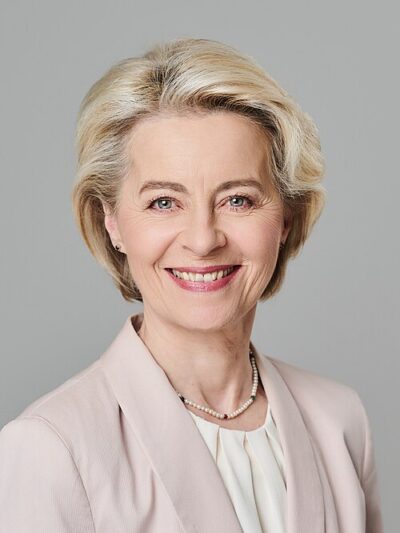
Ursula von der Leyen
Ursula von der Leyen is a President of the European Commission since 2019. Born October 8, 1958, in Ixelles. Positions held include Federal Minister of Defence (2013–2019), Federal Minister for Education, Family Affairs, Senior Citizens, Women and Youth (2005–2009) and Federal Minister of Labour and Social Affairs (2009–2013). Educated at Hannover Medical School and University of Göttingen. Awards include language adulterator award (2 times), BigBrotherAwards (2 times) and Knight Grand Cross of the Order for Merits to Lithuania.
Facts
53 facts · 1 confirmed by two sources · 22 cited · 30 from one source
Where this comes from
Papalocal keeps its own record. It started from these sources; what each one said is kept here as it was copied, so a change on their side never changes this page by itself. Tap one to read its version.
What Wikidata says · copied November 16, 2026 · revision 2568220719
- Described as
- President of the European Commission since 2019
- Other names
- Ursula Gertrud von der Leyen, Ursula Gertrud Albrecht, Ursula Albrecht, Zensursula, Ursula Von der Leyen, Rose Ladson, Ursula Leyen
- Born
- October 8, 1958 · 9 references
- Born in
- Ixelles · 1 reference
- Name at birth
- Ursula Gertrud Albrecht
- Citizen of
- Germany · 1 reference
- Occupation
- physician · 1 reference; politician · 1 reference; equestrian
- Positions held
- Federal Minister of Defence (2013–2019) · 1 reference; Federal Minister for Education, Family Affairs, Senior Citizens, Women and Youth (2005–2009); Federal Minister of Labour and Social Affairs (2009–2013); member of the German Bundestag (2009–2019) · 1 reference; member of the Landtag of Lower Saxony (2003–2005); President of the European Commission (2019–) · 3 references; minister of social affairs (2003–2005)
- Political party
- Christian Democratic Union (1990–)
- Worked for
- Hannover Medical School (2 times) (1988–2002)
- Education
- Hannover Medical School; University of Göttingen · 1 reference; University of Münster; London School of Economics and Political Science; European School, Brussels I
- Member of
- European Union Parliamentary Group in the German Bundestag · 1 reference; Europa-Union Deutschland; First Merkel cabinet; Second Merkel cabinet; Third Merkel cabinet; Fourth Merkel cabinet
- Sport
- equestrian sport
- Awards
- language adulterator award (2 times) (2014, 2021) · 1 reference; BigBrotherAwards (2 times) (2009, 2017) · 1 reference; Knight Grand Cross of the Order for Merits to Lithuania; Order of Prince Yaroslav the Wise, 1st class (2022) · 1 reference; BBC 100 Women (2022) · 1 reference; Time 100 (2022) · 1 reference; National Order of Mali · 1 reference; Order of Saint Panteleimon (2024) · 1 reference; honorary doctor of the University of Toulouse (2023) · 1 reference; Charlemagne Prize (2025) · 1 reference; Order of Europe (2026) · 1 reference
- Spouse
- Heiko von der Leyen (1986–) · 1 reference
- Children
- David von der Leyen · 1 reference; Sophie von der Leyen · 1 reference; Maria Donata von der Leyen · 1 reference; Victoria von der Leyen · 1 reference; Johanna von der Leyen · 1 reference; Egmont von der Leyen · 1 reference; Gracia von der Leyen · 1 reference
- Father
- Ernst Albrecht · 2 references
- Mother
- Adele Albrecht · 1 reference
- Siblings
- Hans-Holger Albrecht · 1 reference
- Lived in
- Beinhorn; Berlaymont building · 1 reference
- Height
- 1.61 m (5 ft 3 in) · 1 reference
- Wikipedias with a page
- 120
Wikidata item Q60772 (wikidata.org/wiki/Q60772), public domain (CC0). Copied November 16, 2026.
What Wikipedia says · copied November 16, 2026 · revision 1385115539
Ursula Gertrud von der Leyen (née Albrecht; born 8 October 1958) is a German politician and physician who has served as President of the European Commission since 2019. She served in the German federal government between 2005 and 2019, holding positions in Angela Merkel's cabinet, most recently as Federal Minister for Defence. She is a member of the centre-right Christian Democratic Union (CDU) and its affiliated European political party, the European People's Party (EPP). On 7 March 2024, the EPP elected her as its Spitzenkandidat to lead the campaign for the 2024 European Parliament elections. She was re-elected to head the Commission in July 2024.
Von der Leyen was born and raised in Brussels, Belgium, to German parents. Her father, Ernst Albrecht, was one of the first European civil servants. She was brought up bilingually in German and French, and moved to Germany in 1971 when her father became involved in German politics. She graduated from the London School of Economics in 1978, and in 1987, she acquired her medical licence from Hanover Medical School. After marrying fellow physician Heiko von der Leyen, she lived for four years in the United States with her family in the 1990s. After returning to Germany she became involved in local politics in the Hanover region in the late 1990s, and she served as a cabinet minister in the state government of Lower Saxony from 2003 to 2005.
In 2005, von der Leyen joined the federal cabinet, first as Minister for Family Affairs and Youth from 2005 to 2009, then taking on the role of Minister for Labour and Social Affairs from 2009 to 2013, and finally serving as Minister for Defence from 2013 to 2019, the first woman to do so. When she left office, she was the only minister to have served continuously in Merkel's cabinet since Merkel became chancellor. She served as a deputy leader of the CDU from 2010 to 2019, and was regarded as a leading contender to succeed Merkel as the chancellor of Germany and as the favourite to become the secretary general of NATO after Jens Stoltenberg. British defence secretary Michael Fallon described her in 2019 as "a star presence" in the NATO community and "the doyenne of NATO ministers for over five years". In 2023, she was again regarded as the favourite to take the role.
On 2 July 2019, von der Leyen was proposed by the European Council as the candidate for president of the European Commission. She was then elected by the European Parliament on 16 July; she took office on 1 December, becoming the first woman to hold the office. Her tenure has been marked by the COVID-19 pandemic, the European Green Deal, the Russo-Ukrainian war, as well as American threats to annex Greenland. In November 2022 she announced that her commission would work to establish an International Criminal Tribunal for the Russian Federation. The EU–US Agreement on Reciprocal, Fair, and Balanced Trade, announced in August 2025, exposed her to criticism from France and Germany.
On 18 July 2024, von der Leyen was re-elected as Commission President by the European Parliament with an absolute majority of 401 members of the European Parliament out of 720; strengthened by around 30 votes compared to her election in 2019. She was named the most powerful woman in the world by Forbes in 2022, 2023, 2024, and 2025.
- Born, in its opening lines
- October 8, 1958
From the Wikipedia article “Ursula von der Leyen” (en.wikipedia.org/wiki/Ursula_von_der_Leyen), by its contributors, under CC BY-SA 4.0 (creativecommons.org/licenses/by-sa/4.0/). Copied November 16, 2026; not changed.
Confirmed Two sources agree. Cited One source, and it names where it got it. One source One source, without a reference of its own. Sources disagree The sources disagree. We show the best-supported value and keep theirs below.
