
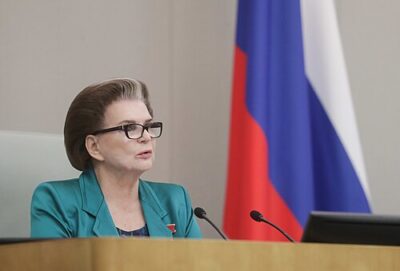
Valentina Tereshkova
Valentina Tereshkova is a Russian cosmonaut and pilot, first woman to have flown in space. Born March 6, 1937, in Bolshoye Maslennikovo. Positions held include member of the State Duma (2011–), deputy of the Supreme Soviet of the Soviet Union (1966–1989) and member of the Presidium of the Supreme Soviet of the USSR (1974–1989). Educated at Zhukovsky Air Force Engineering Academy. Awards include Pilot-Cosmonaut of the USSR, Hero of the Soviet Union and Order of Karl Marx.
Facts
60 facts · 1 confirmed by two sources · 10 cited · 49 from one source
Where this comes from
Papalocal keeps its own record. It started from these sources; what each one said is kept here as it was copied, so a change on their side never changes this page by itself. Tap one to read its version.
What Wikidata says · copied November 16, 2026 · revision 2568219011
- Described as
- Russian cosmonaut and pilot, first woman to have flown in space (born 1937)
- Other names
- Valentina Vladimirovna Tereshkova
- Born
- March 6, 1937 · 8 references
- Born in
- Bolshoye Maslennikovo · 1 reference
- Name at birth
- Валентина Владимировна Терешкова
- Citizen of
- Soviet Union · 2 references; Russia
- Occupation
- astronaut · 1 reference; politician · 2 references; military personnel · 1 reference; engineer · 1 reference; aircraft pilot · 1 reference; university teacher; military officer · 1 reference
- Positions held
- member of the State Duma (2011–); deputy of the Supreme Soviet of the Soviet Union (1966–1989) · 1 reference; member of the Presidium of the Supreme Soviet of the USSR (1974–1989); people's deputy of union of socialist soviet republics (1989–1991); Member of the Yaroslavl Oblast Duma (2008–2011) · 1 reference
- Political party
- Communist Party of the Soviet Union (1960–1991); United Russia (2008–); Our Home – Russia (1995–2003); Russian Party of Life (2003–2008)
- Worked for
- Krasny Perekop Factory; Vostok 6; Supreme Soviet of the Soviet Union; Presidium of the Supreme Soviet; Union of Soviet Societies for Friendship and Cultural Relations with Foreign Countries; Yaroslavl Oblast Duma; State Duma
- Education
- Zhukovsky Air Force Engineering Academy (–1969) · 1 reference
- Member of
- Central Committee of the Communist Party of the Soviet Union; World Peace Council (1966–); 7th State Duma of the Russian Federation; 6th State Duma of the Russian Federation; 8th State Duma of the Russian Federation; 9th State Duma of the Russian Federation
- Awards
- Pilot-Cosmonaut of the USSR (1963); Hero of the Soviet Union (1963); Order of Karl Marx (1963); Order of the October Revolution (1971); Order of the Red Banner of Labour (1987); Order of Friendship of Peoples; Order of Bernardo O'Higgins (1972); Order of the Sun of Peru (1974); Order of Alexander Nevsky (2013); Order of Lenin (2 times) (1963, 1981); Order of Honour (2003); Order of Friendship (2011); Order of Georgi Dimitrov (1963); Order of the Cross of Grunwald, 1st class (1963); Order of Klement Gottwald (1963)
- Field
- politician · 1 reference; astronautics · 1 reference; political activity · 1 reference; military service · 1 reference; politics · 1 reference
- Spouse
- Andriyan Nikolayev (1963–1982); Yuliy Shaposhnikov (1999)
- Children
- Elena Tereshkova · 1 reference
- Military rank
- lieutenant general (2025); lieutenant general (Russia) (2025) · 1 reference
- Wikipedias with a page
- 132
Wikidata item Q44371 (wikidata.org/wiki/Q44371), public domain (CC0). Copied November 16, 2026.
What Wikipedia says · copied November 16, 2026 · revision 1381719809
Valentina Vladimirovna Tereshkova (born 6 March 1937) is a Russian engineer, politician, and former Soviet cosmonaut. She was the first woman in space, having flown a solo mission on Vostok 6 on 16 June 1963. She orbited the Earth 48 times, spent almost three days in space, and is the only woman to have been on a solo space mission. She is the last surviving Vostok programme cosmonaut. At just twenty-six years old at the time of her spaceflight, she remains the youngest and first woman to orbit Earth. During her cosmonaut career, Tereshkova entered the political arena, serving in the Supreme Soviet from 1966 to 1989. Since 2011, she serves as a Member of the State Duma.
Before her selection for the Soviet space programme, Tereshkova was a textile factory worker and an amateur skydiver. She joined the Air Force as part of the Cosmonaut Corps and was commissioned as an officer after completing her training. After the dissolution of the first group of female cosmonauts in 1969, Tereshkova remained in the space programme as a cosmonaut instructor. She later graduated from the Zhukovsky Air Force Engineering Academy and re-qualified for spaceflight, but never went to space again. She retired from the Air Force in 1997, attaining the rank of major general.
Tereshkova was a prominent member of the Communist Party of the Soviet Union, holding various political offices. This includes, in addition to the Supreme Soviet, serving as Member of its Presidium from 1974 to 1989. She remained politically active following the collapse of the Soviet Union, but twice lost elections to the national State Duma, in 1995 and 2003. In 2008, she was to her regional parliament, the Yaroslavl Oblast Duma, before running again for the State Duma in 2011, this time successfully as a member of the ruling United Russia party. She was re-elected in 2016, 2021 and 2026. Tereshkova has the federal state civilian service rank of 1st class Active State Councillor of the Russian Federation. In 2020, she successfully proposed lifting the term limit for President Vladimir Putin. In 2022, she voted to recognise the breaking away of the Donetsk and Lugansk regions from Ukraine, for which she was placed on the international sanctions list of various countries.
- Born, in its opening lines
- March 6, 1937
From the Wikipedia article “Valentina Tereshkova” (en.wikipedia.org/wiki/Valentina_Tereshkova), by its contributors, under CC BY-SA 4.0 (creativecommons.org/licenses/by-sa/4.0/). Copied November 16, 2026; not changed.
Confirmed Two sources agree. Cited One source, and it names where it got it. One source One source, without a reference of its own. Sources disagree The sources disagree. We show the best-supported value and keep theirs below.
