
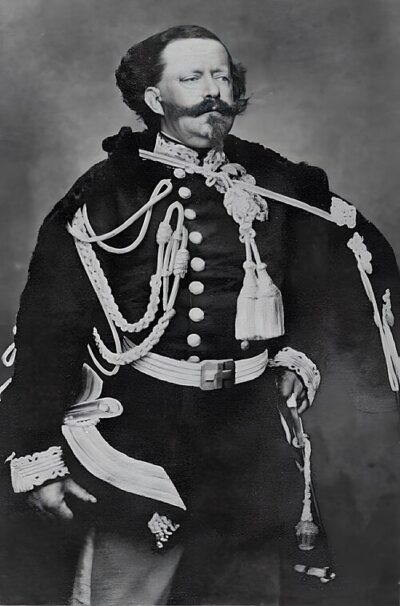
Victor Emmanuel II of Italy
Victor Emmanuel II of Italy was a King of Sardinia (1849–1861) and King of Italy. Born March 14, 1820, in Turin. Died January 9, 1878, in Rome. Positions held include Monarch of Italy (1861–1878), King of Sardinia and Duke of Savoy (1839–1861) and Head of the House of Savoy. Awards include Knight of the Order of the Golden Fleece, Médaille militaire and Order of Saint Alexander Nevsky.
Facts
48 facts · 2 confirmed by two sources · 7 cited · 38 from one source · 1 where the sources disagree
What’s different
- Buried in: we show Pantheon (Sources disagree). Wikidata also lists Tomb of Victor Emmanuel II
Where this comes from
Papalocal keeps its own record. It started from these sources; what each one said is kept here as it was copied, so a change on their side never changes this page by itself. Tap one to read its version.
What Wikidata says · copied November 16, 2026 · revision 2559699260
- Described as
- King of Sardinia (1849–1861) and King of Italy (1861–1878)
- Other names
- Vittorio Emmanuele II of Italy, Vittorio Emanuele Maria Alberto Eugenio Ferdinando Tommaso di Savoia, Victor Emanuel II, Vittorio Emmanuele II
- Born
- March 14, 1820 · 7 references
- Died
- January 9, 1878 · 6 references
- Born in
- Turin
- Died in
- Rome
- Buried in
- Pantheon · 1 reference; Tomb of Victor Emmanuel II · 1 reference
- Cause of death
- disease
- Name at birth
- Vittorio Emanuele Maria Alberto Eugenio Ferdinando Tommaso di Savoia
- Citizen of
- Kingdom of Italy (1861–)
- Occupation
- monarch; sovereign · 1 reference
- Positions held
- Monarch of Italy (1861–1878); King of Sardinia and Duke of Savoy (1839–1861); Head of the House of Savoy
- Member of
- Victor Emmanuel II of Sardinia and Queen Adelaide
- Awards
- Knight of the Order of the Golden Fleece; Médaille militaire; Order of Saint Alexander Nevsky; Order of St. Andrew; Grand Master of the Order of the Most Holy Annunciation; Civil Order of Savoy; Order of the Garter; Knight of the Order of Saint Joseph; Royal Order of the Seraphim; Order of the Elephant; Royal Order of Kamehameha I; Grand Master of the Order of Saints Maurice and Lazarus; Honorary Doctorate from the National Autonomous University of Mexico; Commemorative medal of the 1859 Italian Campaign · 1 reference; Order of the Black Eagle · 1 reference
- Spouse
- Archduchess Adelaide of Austria (1842–) · 1 reference; Rosa Vercellana (1869–) · 1 reference
- Children
- Umberto I of Italy; Princess Maria Clotilde of Savoy; Amadeo I of Spain; Prince Oddone, Duke of Montferrat; Maria Pia of Savoy; Donato Etna; Carlo Alberto di Savoia-Carignano, Principe di Savoia · 1 reference; Vittorio Emanuele di Savoia-Carignano · 1 reference; Vittorio Emanuele di Savoia-Carignano, Principe di Savoia · 1 reference; Vittoria Guerrieri · 1 reference; Emmanuel Guerrieri de Mirafiori · 1 reference; Emanuela Maria Alberta Vittoria di Roverbella · 1 reference
- Father
- Carlo Alberto I of Sardinia
- Mother
- Maria Theresa of Austria
- Siblings
- Prince Ferdinand, Duke of Genoa
- Religion
- Catholicism
- Military rank
- general
- Wikipedias with a page
- 81
Wikidata item Q168691 (wikidata.org/wiki/Q168691), public domain (CC0). Copied November 16, 2026.
What Wikipedia says · copied November 16, 2026 · revision 1383154244
Victor Emmanuel II (Italian: Vittorio Emanuele II; full name: Vittorio Emanuele Maria Alberto Eugenio Ferdinando Tommaso di Savoia; 14 March 1820 – 9 January 1878) was King of Sardinia (also informally known as Piedmont–Sardinia) from 23 March 1849 until 17 March 1861, when he assumed the title of King of Italy and became the first king of an independent, united Italy since the 6th century, a title he held until his death in 1878. Borrowing from the old Latin title Pater Patriae of the Roman emperors, the Italians gave him the epithet of "Father of the Fatherland" (Italian: Padre della Patria).
Born in Turin as the eldest son of Charles Albert, Prince of Carignano, and Maria Theresa of Austria, Victor Emmanuel fought in the First Italian War of Independence (1848–1849) before being made King of Sardinia following his father's abdication. He appointed Camillo Benso, Count of Cavour, as his Prime Minister, and he consolidated his position by suppressing the republican left. In 1855, he sent an expeditionary corps to side with French and British forces during the Crimean War; the deployment of Italian troops to Crimea, and the gallantry shown by them in the Battle of the Chernaya (16 August 1855) and in the siege of Sevastopol led the Kingdom of Sardinia to be among the participants at the peace conference at the end of the war, where it could address the issue of the Italian unification to other European powers. This allowed Victor Emmanuel to ally himself with Napoleon III, Emperor of France. France then supported Sardinia in the Second Italian War of Independence, resulting in the liberation of Lombardy from Austrian rule; as payment for the help, Victor Emmanuel ceded Savoy and Nice to France.
Victor Emmanuel supported the Expedition of the Thousand (1860–1861) led by Giuseppe Garibaldi, which resulted in the rapid fall of the Kingdom of the Two Sicilies in southern Italy; however, Victor Emmanuel halted Garibaldi when he appeared ready to attack Rome, still under the Papal States, as it was under French protection. In 1860, Tuscany, Modena, Parma, and Romagna decided to side with Sardinia, and Victor Emmanuel then marched victoriously in the Marche and Umbria after the victorious Battle of Castelfidardo over the Papal forces. This led to his excommunication from the Catholic Church. He subsequently met Garibaldi at Teano, receiving from him the control of southern Italy and becoming the first King of Italy on 17 March 1861.
In 1866, the Third Italian War of Independence allowed Italy to annex Veneto. In 1870, Victor Emmanuel also took advantage of the Prussian victory over France in the Franco-Prussian War to conquer the Papal States after the French withdrew. He entered Rome on 20 September 1870 and set up the new capital there on 2 July 1871. He died in Rome in 1878, soon after his excommunication had been lifted, and was buried in the Pantheon. The Italian national Victor Emmanuel II Monument in Rome, containing the Altare della Patria, was built in his honour.
- Born, in its opening lines
- March 14, 1820
- Died, in its opening lines
- January 9, 1878
From the Wikipedia article “Victor Emmanuel II” (en.wikipedia.org/wiki/Victor_Emmanuel_II), by its contributors, under CC BY-SA 4.0 (creativecommons.org/licenses/by-sa/4.0/). Copied November 16, 2026; not changed.
Confirmed Two sources agree. Cited One source, and it names where it got it. One source One source, without a reference of its own. Sources disagree The sources disagree. We show the best-supported value and keep theirs below.
