
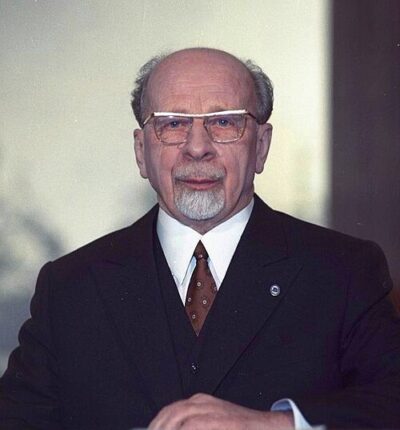
Walter Ulbricht
Walter Ulbricht was a German communist politician and dictator. Born June 30, 1893, in Leipzig. Died August 1, 1973, in Groß Dölln. Positions held include member of the Landtag of Saxony, member of the Reichstag of the Weimar Republic and member of the Volkskammer. Educated at International Lenin School. Awards include Hero of the Soviet Union, Order of Lenin and Order of the Red Banner of Labour.
Facts
37 facts · 2 confirmed by two sources · 9 cited · 26 from one source
Where this comes from
Papalocal keeps its own record. It started from these sources; what each one said is kept here as it was copied, so a change on their side never changes this page by itself. Tap one to read its version.
What Wikidata says · copied November 16, 2026 · revision 2569170193
- Described as
- German communist politician and dictator (1893–1973)
- Other names
- Walter Ernst Paul Ulbricht
- Born
- June 30, 1893 · 11 references
- Died
- August 1, 1973 · 12 references
- Born in
- Leipzig · 3 references
- Died in
- Groß Dölln
- Buried in
- The Socialists' Memorial
- Cause of death
- stroke
- Name at birth
- Walter Ernst Paul Ulbricht
- Citizen of
- East Germany
- Occupation
- politician · 2 references; resistance fighter; communist · 1 reference; joiner · 1 reference
- Positions held
- member of the Landtag of Saxony; member of the Reichstag of the Weimar Republic; member of the Volkskammer; Chairman of the State Council (1960–1973); Chairman of the National Defence Council of the GDR (1960–1971) · 1 reference
- Political party
- Social Democratic Party of Germany (1912–1917); Independent Social Democratic Party of Germany (1917–1920); Communist Party of Germany (1920–1946); National Committee for a Free Germany (1943–1945)
- Education
- International Lenin School
- Awards
- Hero of the Soviet Union (1963) · 1 reference; Order of Lenin; Order of the Red Banner of Labour; Order of the Nile; Order of Friendship of Peoples; Order of the October Revolution (1968) · 1 reference; Fritz Heckert Medal; Order of the Patriotic War, 1st class; Order of the Patriotic War, 2nd class; Hero of Labour (3 times) (1953, 1958, 1963) · 1 reference; Patriotic Order of Merit · 1 reference; Order of Karl Marx · 1 reference
- Spouse
- Lotte Ulbricht · 1 reference
- Children
- Beate Ulbricht
- Religion
- atheism
- Wikipedias with a page
- 76
Wikidata item Q2628 (wikidata.org/wiki/Q2628), public domain (CC0). Copied November 16, 2026.
What Wikipedia says · copied November 16, 2026 · revision 1385560561
Walter Ernst Paul Ulbricht (; German: [ˈvaltɐ ˈʔʊlbʁɪçt]; 30 June 1893 – 1 August 1973) was a German communist politician. Ulbricht played a leading role in the creation of the Weimar-era Communist Party of Germany (KPD) and later in the early development and establishment of the German Democratic Republic. As the First Secretary of the Communist Socialist Unity Party from 1950 to 1971, he was the chief decision-maker in East Germany. From President Wilhelm Pieck's death in 1960, he was also the East German head of state until his own death in 1973. As the leader of a significant Communist satellite, Ulbricht had a degree of bargaining power with the Kremlin that he used effectively. For example, he demanded the building of the Berlin Wall in 1961 when the Kremlin was reluctant.
Ulbricht began his political life during the German Empire, when he joined first the Social Democratic Party of Germany (SPD) in 1912 later joining the anti-World War I Independent Social Democratic Party of Germany (USPD) in 1917. The following year, he deserted the Imperial German Army and took part in the German Revolution of 1918. He joined the Communist Party of Germany in 1920 and became a leading party functionary, serving in its Central Committee from 1923 onward. After the Nazi takeover of Germany in 1933 and the Nazi-led investigation into his role in ordering the 1931 murder of police captains Paul Anlauf and Franz Lenck, Ulbricht lived in Paris and Prague from 1933 to 1937 and in the Soviet Union from 1937 to 1945.
After the end of World War II, Ulbricht re-organized the German Communist Party in the Soviet occupation zone along Stalinist lines. He played a key role in the forcible merger of the KPD and SPD into the Socialist Unity Party of Germany (SED) in 1946. He became the First Secretary of the SED and effective leader of the recently established East Germany in 1950. The Soviet Army occupation force violently suppressed the uprising of 1953 in East Germany on 17 June 1953, while Ulbricht hid in the Soviet Army headquarters in Berlin-Karlshorst. East Germany joined the Soviet-controlled Warsaw Pact upon its founding in 1955. Ulbricht presided over the total suppression of civil and political rights in the East German state, which functioned as a communist-ruled dictatorship from its founding in 1949 onward.
The nationalization of East German industry under Ulbricht failed to raise the standard of living to a level comparable to that of West Germany. The result was massive emigration, with hundreds of thousands of people fleeing the country to the west every year in the 1950s. When Soviet Premier Nikita Khrushchev gave permission for a wall to stop the outflow in Berlin, Ulbricht had the Berlin Wall built in 1961, which triggered a diplomatic crisis but succeeded in curtailing emigration. The failures of Ulbricht's New Economic System and Economic System of Socialism from 1963 to 1970 led to his forcible retirement for "health reasons" and replacement as First Secretary in 1971 by Erich Honecker with Soviet approval. Ulbricht remained the symbolic head of state for two more years, suffering from declining health until dying of a stroke in August 1973.
- Born, in its opening lines
- June 30, 1893
- Died, in its opening lines
- August 1, 1973
From the Wikipedia article “Walter Ulbricht” (en.wikipedia.org/wiki/Walter_Ulbricht), by its contributors, under CC BY-SA 4.0 (creativecommons.org/licenses/by-sa/4.0/). Copied November 16, 2026; not changed.
Confirmed Two sources agree. Cited One source, and it names where it got it. One source One source, without a reference of its own. Sources disagree The sources disagree. We show the best-supported value and keep theirs below.
