
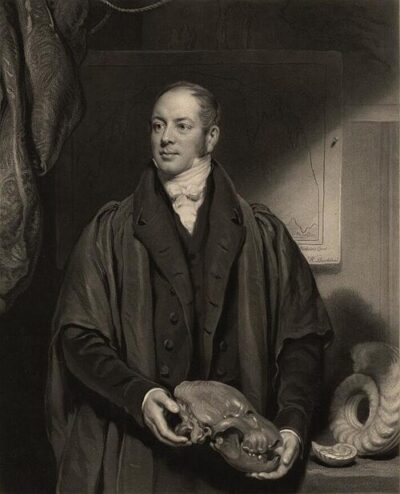
William Buckland
William Buckland was an English clergyman, geologist and palaeontologist. Born March 12, 1784, in Axminster. Died August 14, 1856, in Islip. Positions held include President of the Geological Society of London (1824–1826), Dean of Westminster (1845–1856) and President of the British Science Association (1832–1833). Educated at Corpus Christi College (2 times) and Winchester College. Awards include Fellow of the Royal Society, Copley Medal and Fellow of the Geological Society of London.
Facts
39 facts · 2 confirmed by two sources · 7 cited · 30 from one source
Where this comes from
Papalocal keeps its own record. It started from these sources; what each one said is kept here as it was copied, so a change on their side never changes this page by itself. Tap one to read its version.
What Wikidata says · copied November 16, 2026 · revision 2554665778
- Described as
- English clergyman, geologist and palaeontologist (1784-1856)
- Other names
- Buckand, Buckland
- Born
- March 12, 1784 · 4 references
- Died
- August 14, 1856 · 1 reference
- Born in
- Axminster
- Died in
- Islip
- Cause of death
- tuberculosis
- Citizen of
- England
- Occupation
- curator; paleontologist · 1 reference; physicist; geologist · 1 reference; botanist · 1 reference; theologian · 1 reference; pastor · 1 reference
- Positions held
- President of the Geological Society of London (1824–1826) · 1 reference; Dean of Westminster (1845–1856); President of the British Science Association (1832–1833) · 1 reference
- Worked for
- University of Oxford; Westminster Abbey; Ashmolean Museum
- Education
- Corpus Christi College (2 times) (1801–1808); Winchester College; Blundell's School
- Member of
- Royal Society of London; German Academy of Sciences Leopoldina; Linnean Society of London; American Academy of Arts and Sciences
- Awards
- Fellow of the Royal Society; Copley Medal (1822) · 1 reference; Fellow of the Geological Society of London; Fellow of the American Academy of Arts and Sciences; Wollaston Medal (1848) · 1 reference
- Field
- paleontology; geology · 1 reference; theology; Megalosaurus; coprolite
- Spouse
- Mary Buckland
- Children
- Francis Trevelyan Buckland
- Religion
- Anglicanism
- Wikipedias with a page
- 50
Wikidata item Q312389 (wikidata.org/wiki/Q312389), public domain (CC0). Copied November 16, 2026.
What Wikipedia says · copied November 16, 2026 · revision 1380929354
William Buckland DD, FRS (12 March 1784 – 14 August 1856) was an English theologian, geologist and palaeontologist.
His work in the early 1820s proved that Kirkdale Cave in North Yorkshire had been a prehistoric hyena den, for which he was awarded the Copley Medal. It was praised as an example of how scientific analysis could reconstruct events in the distant past. He pioneered the use of fossilised faeces in reconstructing ecosystems, coining the term coprolites. Buckland also wrote the first full account of a fossil dinosaur, which he named Megalosaurus in 1824. He also discovered the so-called Red Lady of Paviland, one of the first discovered human skeletons now recognised as coming from the Upper Palaeolithic.
Buckland followed the Gap Theory in interpreting the biblical account of Genesis as two widely separated episodes of creation. It had emerged as a way to reconcile the scriptural account with discoveries in geology suggesting the earth was very old. Early in his career Buckland believed he had found evidence of the biblical flood, but later saw that the glaciation theory of Louis Agassiz gave a better explanation, and played a significant role in promoting it.
Buckland served as Dean of Westminster from 1845 until his death in 1856.
- Born, in its opening lines
- March 12, 1784
- Died, in its opening lines
- August 14, 1856
From the Wikipedia article “William Buckland” (en.wikipedia.org/wiki/William_Buckland), by its contributors, under CC BY-SA 4.0 (creativecommons.org/licenses/by-sa/4.0/). Copied November 16, 2026; not changed.
Confirmed Two sources agree. Cited One source, and it names where it got it. One source One source, without a reference of its own. Sources disagree The sources disagree. We show the best-supported value and keep theirs below.
