
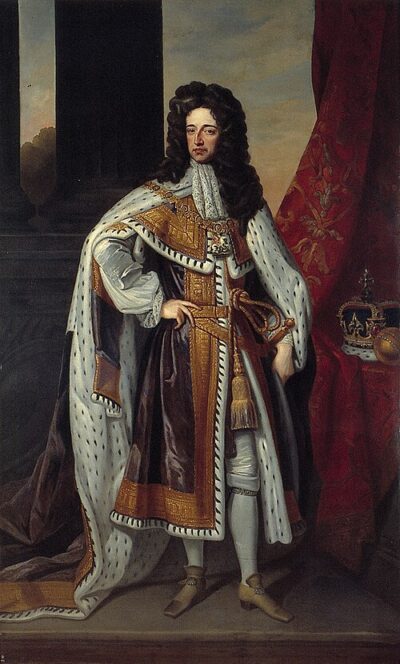
William III of England
William III of England was a King of England, Scotland, and Ireland from 1689 to 1702. Born November 14, 1650, in Binnenhof. Died March 8, 1702, in Kensington Palace. Positions held include Prince of Orange (1650–1702), Monarch of England (1694–1702) and Monarch of Scotland (1694–1702). Educated at Eton College and Leiden University. Awards include Knight of the Garter and Knight Companion of the Order of the Thistle.
Facts
37 facts · 1 confirmed by two sources · 10 cited · 24 from one source · 2 where the sources disagree
What’s different
- Born: we show November 14, 1650 (Sources disagree). Wikipedia says November 4, 1650
- Died in: we show Kensington Palace (Sources disagree). Wikidata also lists London
Where this comes from
Papalocal keeps its own record. It started from these sources; what each one said is kept here as it was copied, so a change on their side never changes this page by itself. Tap one to read its version.
What Wikidata says · copied November 16, 2026 · revision 2568007218
- Described as
- King of England, Scotland, and Ireland from 1689 to 1702 (1650–1702)
- Other names
- William II and III, William II of Scotland, William III and II, King William, William, William III Henry of Orange, King of Great Britain, Stadholder, Prince of Orange and King of England and Scotland William III, King Billy, William of Orange, William III of Orange, William III
- Born
- November 14, 1650 · 5 references
- Died
- March 8, 1702 · 3 references
- Born in
- Binnenhof · 2 references
- Died in
- Kensington Palace · 3 references; London · 2 references
- Buried in
- Westminster Abbey
- Cause of death
- pneumonia
- Citizen of
- Dutch Republic; Kingdom of England
- Occupation
- politician; monarch
- Positions held
- Prince of Orange (1650–1702); Monarch of England (1694–1702); Monarch of Scotland (1694–1702); King of Ireland (1694–1702); King of England (jure uxoris) (1689–1694); king of Scotland (jure uxoris) (1689–1694); King of Ireland (Iure uxoris) (1689–1694); stadtholder (1672–1702); Lord High Admiral (1689)
- Education
- Eton College; Leiden University · 1 reference
- Member of
- William and Mary
- Awards
- Knight of the Garter (1689) · 1 reference; Knight Companion of the Order of the Thistle (1688)
- Field
- governance · 1 reference; politics · 1 reference; military art · 1 reference
- Spouse
- Mary II of England (1677–) · 2 references
- Children
- child1 Stuart · 1 reference; child2 Stuart · 1 reference; child3 Stuart · 1 reference
- Father
- William II, Prince of Orange · 2 references
- Mother
- Mary Henrietta, Princess Royal · 2 references
- Religion
- Protestantism; Reformed Christianity
- Military rank
- general
- Lived in
- South Holland
- Wikipedias with a page
- 90
Wikidata item Q129987 (wikidata.org/wiki/Q129987), public domain (CC0). Copied November 16, 2026.
What Wikipedia says · copied November 16, 2026 · revision 1384906662
William III and II (William Henry; Dutch: Willem Hendrik; 4 November 1650 – 8 March 1702), also known as William of Orange, was the sovereign Prince of Orange from birth, Stadtholder of Holland, Zeeland, Utrecht, Guelders, and Overijssel in the Dutch Republic from 1672, and King of England, Scotland, and Ireland from 1689 until his death in 1702. He ruled England, Scotland, and Ireland with his wife, Queen Mary II, until her death in 1694; their joint reign is known as that of William and Mary.
William was the only child of William II, Prince of Orange, and Mary, Princess Royal, the daughter of King Charles I of England, Scotland, and Ireland. His father died before his birth, making William III the prince of Orange from birth. In 1677, he married his first cousin Mary, the elder daughter of his maternal uncle James, Duke of York (later King James II).
When the Catholic French king Louis XIV attacked the Dutch Republic in 1672, William rose to power and became Louis's greatest obstacle. He made it his life's mission to oppose Louis and waged many campaigns against Louis's armies. He reorganised the Dutch army, restoring its effectiveness after the disasters of the Rampjaar and transforming it into one of the most experienced and professional forces in Europe. Convinced that the expansionist policies of Louis XIV threatened the European balance of power, William devoted much of his career to resisting French hegemony.
Many Protestants heralded William as a champion of their faith. In 1685, his Catholic uncle and father-in-law, James, became king of England, Scotland, and Ireland. James's reign was unpopular with British Protestants, who opposed James's use of rule by decree, Catholic emancipation, and a Catholic succession to the throne. Supported by a group of influential English political and religious leaders, William invaded England with a Dutch force in November 1688. He landed at the south-western English port of Brixham and James was deposed shortly afterward. After occupying London he was swiftly offered the crown alongside his wife Mary. The event would be known as the Glorious Revolution, leading to the adoption of the English Bill of Rights.
During the early years of his reign, William was occupied abroad with the Nine Years' War (1688–1697), leaving Mary to govern the three kingdoms. She died in 1694. In 1696, the Jacobites, a faction loyal to the deposed James, plotted unsuccessfully to assassinate William and restore James to the throne. In Scotland, William's role in ordering the Massacre of Glencoe remains notorious. William's lack of children and the death in 1700 of his nephew the Duke of Gloucester threatened the Protestant succession. The danger was averted by placing William and Mary's cousins, the Protestant House of Hanover, in line to the throne after Mary's sister Anne with the Act of Settlement 1701. Upon his death in 1702, William was succeeded in his kingdoms by Anne and as titular Prince of Orange by his cousin John William Friso.
- Born, in its opening lines
- November 4, 1650
- Died, in its opening lines
- March 8, 1702
From the Wikipedia article “William III of England” (en.wikipedia.org/wiki/William_III_of_England), by its contributors, under CC BY-SA 4.0 (creativecommons.org/licenses/by-sa/4.0/). Copied November 16, 2026; not changed.
Confirmed Two sources agree. Cited One source, and it names where it got it. One source One source, without a reference of its own. Sources disagree The sources disagree. We show the best-supported value and keep theirs below.
