
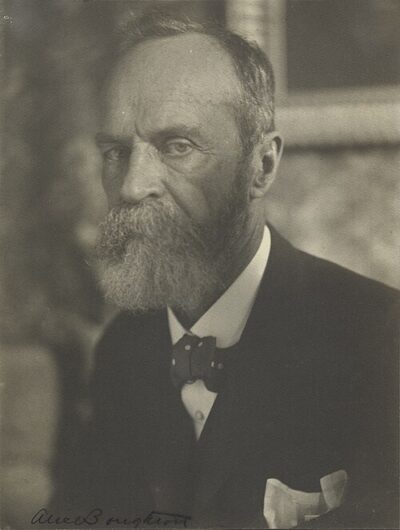
William James
William James was an American philosopher, psychologist, and pragmatist. Born January 11, 1842, in Astor House. Died August 26, 1910, in Chocorua. Positions held include President of the American Psychological Association (2 times) (1894–1904). Known for The Principles of Psychology, The Varieties of Religious Experience and Essays in Radical Empiricism. Educated at Harvard Medical School and Harvard School of Engineering and Applied Sciences.
Facts
36 facts · 2 confirmed by two sources · 12 cited · 22 from one source
Where this comes from
Papalocal keeps its own record. It started from these sources; what each one said is kept here as it was copied, so a change on their side never changes this page by itself. Tap one to read its version.
What Wikidata says · copied November 13, 2026 · revision 2568736096
- Described as
- American philosopher, psychologist, and pragmatist (1842–1910)
- Other names
- W. James
- Born
- January 11, 1842 · 13 references
- Died
- August 26, 1910 · 12 references
- Born in
- Astor House · 1 reference
- Died in
- Chocorua · 1 reference
- Buried in
- Cambridge Cemetery · 1 reference
- Cause of death
- heart failure
- Citizen of
- United States · 1 reference
- Occupation
- philosopher · 1 reference; psychologist · 2 references; university teacher; physician · 1 reference; writer · 1 reference
- Positions held
- President of the American Psychological Association (2 times) (1894–1904) · 1 reference
- Worked for
- Harvard University
- Education
- Harvard Medical School; Harvard School of Engineering and Applied Sciences; Harvard University · 1 reference; Plymouth College
- Member of
- American Academy of Arts and Letters; American Psychological Association; American Academy of Arts and Sciences; Accademia Nazionale dei Lincei (1903–) · 1 reference; Royal Prussian Academy of Sciences; National Academy of Sciences
- Known for
- The Principles of Psychology; The Varieties of Religious Experience; Essays in Radical Empiricism
- Field
- philosophy; psychology · 1 reference
- Spouse
- Alice Gibbens James · 1 reference
- Children
- William James
- Father
- Henry James, Sr. · 1 reference
- Mother
- Mary Walsh James
- Siblings
- Henry James · 1 reference; Alice James · 1 reference
- Religion
- Lutheranism
- Wikipedias with a page
- 125
Wikidata item Q125249 (wikidata.org/wiki/Q125249), public domain (CC0). Copied November 13, 2026.
What Wikipedia says · copied November 13, 2026 · revision 1384982754
William James (January 11, 1842 – August 26, 1910) was an American philosopher and psychologist. The first educator to offer a psychology course in the United States, he is considered to be one of the leading thinkers of the late 19th century, one of the most influential philosophers and is often dubbed the "father of American psychology".
Born into a wealthy family, James was the son of the Swedenborgian theologian Henry James Sr. and the brother of both the prominent novelist Henry James and the diarist Alice James. James trained as a physician and taught anatomy at Harvard, but never practiced medicine. Instead, he pursued his interests in psychology and then philosophy. James wrote widely on many topics, including epistemology, education, metaphysics, psychology, religion, and mysticism. Among his most influential books are The Principles of Psychology, a groundbreaking text in the field of psychology; Essays in Radical Empiricism, an important text in philosophy; and The Varieties of Religious Experience, an investigation of different forms of religious experience, including theories on mind-cure.
Along with Charles Sanders Peirce, James established the philosophical school known as pragmatism, and is also cited as one of the founders of functional psychology. James also developed the philosophical perspective known as radical empiricism. A Review of General Psychology analysis, published in 2002, ranked James as the 14th most eminent psychologist of the 20th century. A survey published in American Psychologist in 1991 ranked James's reputation in second place, after Wilhelm Wundt, who is widely regarded as the founder of experimental psychology. James's work has influenced philosophers and academics such as Hilary Putnam, Richard Rorty, Edmund Husserl, Bertrand Russell, John Dewey, and Ludwig Wittgenstein.
- Born, in its opening lines
- January 11, 1842
- Died, in its opening lines
- August 26, 1910
From the Wikipedia article “William James” (en.wikipedia.org/wiki/William_James), by its contributors, under CC BY-SA 4.0 (creativecommons.org/licenses/by-sa/4.0/). Copied November 13, 2026; not changed.
Confirmed Two sources agree. Cited One source, and it names where it got it. One source One source, without a reference of its own. Sources disagree The sources disagree. We show the best-supported value and keep theirs below.
