
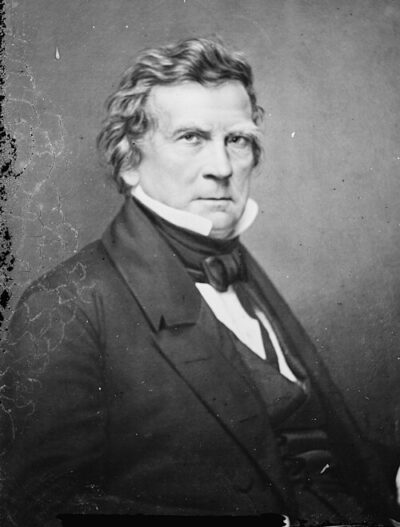
William L. Marcy
William L. Marcy was an American politician. Born December 12, 1786, in Southbridge. Died July 4, 1857, in Ballston Spa. Positions held include Governor of New York (1833–1838), Adjutant General of New York and United States Secretary of War (1845–1849). Educated at Brown University.
Facts
22 facts · 2 confirmed by two sources · 8 cited · 12 from one source
Where this comes from
Papalocal keeps its own record. It started from these sources; what each one said is kept here as it was copied, so a change on their side never changes this page by itself. Tap one to read its version.
What Wikidata says · copied November 15, 2026 · revision 2562945211
- Described as
- American politician (1786-1857)
- Other names
- William Learned Marcy
- Born
- December 12, 1786 · 3 references
- Died
- July 4, 1857 · 3 references
- Born in
- Southbridge
- Died in
- Ballston Spa
- Buried in
- Albany Rural Cemetery · 1 reference
- Citizen of
- United States
- Occupation
- politician · 1 reference; lawyer · 1 reference; diplomat; judge · 1 reference; jurist · 1 reference
- Positions held
- Governor of New York (1833–1838); Adjutant General of New York; United States Secretary of War (1845–1849); United States Secretary of State (1853–1857); United States senator (1831–1833) · 1 reference; senator · 1 reference; defence minister · 1 reference
- Political party
- Democratic-Republican Party; Democratic Party
- Education
- Brown University
- Spouse
- Cornelia Knower
- Wikipedias with a page
- 29
Wikidata item Q389258 (wikidata.org/wiki/Q389258), public domain (CC0). Copied November 15, 2026.
What Wikipedia says · copied November 15, 2026 · revision 1380248235
William Learned Marcy (December 12, 1786 – July 4, 1857) was an American lawyer and politician from New York. He served as a Justice of the New York Supreme Court, Comptroller of New York, Governor of New York, U.S. Senator, U.S. Secretary of War, and U.S. Secretary of State. In the latter office, he negotiated the Gadsden Purchase, the last major acquisition of land in the contiguous United States.
Born in Southbridge, Massachusetts, Marcy established a legal practice in Troy, New York, after graduating from Brown University. He fought in the War of 1812, as an ensign, first lieutenant and captain in the 155th New York Infantry Regiment. Politically, he aligned with the Bucktail faction of the Democratic-Republican Party and became a leading member of the Albany Regency. As the Democratic-Republicans fractured in the 1820s, he became a member of the Democratic Party. Between 1821 and 1831, he successively served as Adjutant General of New York, New York State Comptroller, and as an associate justice of the New York Supreme Court. In 1831, the New York legislature elected Marcy to the U.S. Senate, and he held that position until 1833, when he became the Governor of New York. He served three terms as governor until his defeat in 1838 by the Whig nominee, William Seward.
He served as Secretary of War under James K. Polk from 1845 to 1849, overseeing the Mexican–American War. After leaving the Polk administration, he resumed the practice of law and became a leader of the "Soft" Hunker faction of the New York Democratic Party. He returned to the Cabinet in 1853, serving as Secretary of State under Franklin Pierce. In this role, he resolved a dispute about the status of U.S. immigrants abroad and directed U.S. diplomats to dress in the plain style of an ordinary American rather than the court-dress many had adopted from Europe. He also negotiated a reciprocity treaty with British North America and the 30,000-square-mile (78,000 km2) Gadsden purchase with Mexico, acquiring territory in present-day Arizona and New Mexico. He left office in 1857 and died shortly thereafter.
- Born, in its opening lines
- December 12, 1786
- Died, in its opening lines
- July 4, 1857
From the Wikipedia article “William L. Marcy” (en.wikipedia.org/wiki/William_L._Marcy), by its contributors, under CC BY-SA 4.0 (creativecommons.org/licenses/by-sa/4.0/). Copied November 15, 2026; not changed.
Confirmed Two sources agree. Cited One source, and it names where it got it. One source One source, without a reference of its own. Sources disagree The sources disagree. We show the best-supported value and keep theirs below.
