
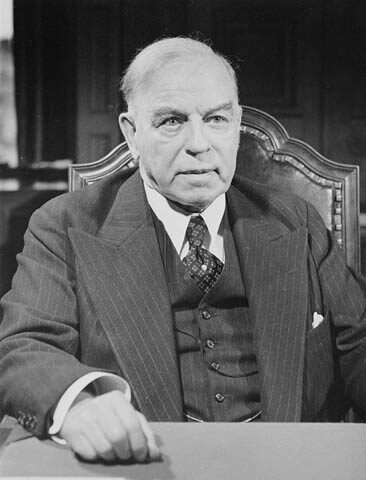
William Lyon Mackenzie King
William Lyon Mackenzie King was the 10th Prime Minister of Canada. Born December 17, 1874, in Kitchener. Died July 22, 1950, in The Farm. Positions held include Prime Minister of Canada (2 times) (1921–1948), Member of the Privy Council of the United Kingdom and Leader of the Liberal Party of Canada (1919–1948). Educated at University College and Harvard University. Awards include Companion of the Order of St Michael and St George, Order of Merit and King George V Silver Jubilee Medal.
Facts
44 facts · 2 confirmed by two sources · 11 cited · 31 from one source
Where this comes from
Papalocal keeps its own record. It started from these sources; what each one said is kept here as it was copied, so a change on their side never changes this page by itself. Tap one to read its version.
What Wikipedia says · copied November 13, 2026 · revision 1383941972
William Lyon Mackenzie King (December 17, 1874 – July 22, 1950) was the tenth prime minister of Canada for three non-consecutive terms from 1921 to 1926, 1926 to 1930, and 1935 to 1948. A Liberal, he was the dominant politician in Canada from the early 1920s to the late 1940s. With a total of 21 years and 154 days in office, he remains the longest-serving prime minister in Canadian history.
King studied law and political economy in the 1890s and later obtained a PhD, the first Canadian prime minister to have done so. In 1900, he became deputy minister of the Canadian government's new Department of Labour. He entered the House of Commons in 1908 before becoming the first federal minister of labour in 1909 under Prime Minister Wilfrid Laurier. After losing his seat in the 1911 federal election, King worked for the Rockefeller Foundation before briefly working as an industrial consultant. Following the death of Laurier in 1919, King won the leadership of the Liberal Party. Taking the helm of a party torn apart by the Conscription Crisis of 1917, he unified both the pro-conscription and anti-conscription factions of the party, leading it to victory in the 1921 federal election.
King established a post-war agenda which lowered wartime taxes and tariffs. He sought to strengthen Canadian autonomy by refusing to support Britain in the Chanak Crisis without Parliament's consent and negotiating the Halibut Treaty with the United States without British interference. His government also passed the Chinese Immigration Act, 1923, which banned most forms of Chinese immigration to Canada. In the 1925 federal election, the Conservatives won a plurality of seats, but the Liberals negotiated support from the Progressive Party and stayed in office as a minority government. In 1926, facing a Commons vote that could force his government to resign, King asked Governor General Lord Byng to dissolve Parliament and call an election. Byng refused and invited the Conservatives to form government, who briefly held office but lost a motion of no confidence. This sequence of events triggered a major constitutional crisis, the King–Byng affair. King and the Liberals won the resulting election. Afterwards, King pursued a more independent foreign policy, including by expanding the Department of External Affairs. His government also introduced old-age pensions based on need. King's slow reaction to the Great Depression led to a defeat at the polls in the 1930 federal election.
In the 1935 federal election, King's Liberal Party returned to power in a landslide victory, defeating R.B. Bennett's Conservative government whose response to the depression was unpopular. King negotiated the 1935 Canada-United States Reciprocal Trade Agreement, nationalized the Bank of Canada, and passed the 1938 National Housing Act to improve housing affordability. His government also established the Canadian Broadcasting Corporation, Trans-Canada Air Lines, and the National Film Board. Days after World War II broke out, King deployed Canadian troops. The Liberals' second landslide victory in the 1940 federal election allowed King to continue leading Canada through the war. Soon after, his government signed the Ogdensburg Agreement with the United States which established the Permanent Joint Board on Defense. King oversaw the internment of Japanese Canadians on the domestic front and delayed introducing overseas conscription until late 1944 to satisfy French Canadians. He also introduced unemployment insurance and family allowances—Canada's first universal welfare program. Following the Allies' victory in 1945, King called a post-war election, in which the Liberals lost their majority government. In his final years in office, King oversaw Canada's entry into the United Nations, partnered Canada with Western nations in the deepening Cold War, introduced Canadian citizenship, and successfully negotiated Newfoundland's entry into Confederation.
King retired from politics in late 1948 and died of pneumonia in July 1950. He is best known for his leadership of Canada throughout the Great Depression and World War II, and he played a major role in developing the Canadian welfare state and establishing Canada's international position as a middle power. Meanwhile, King kept secret his beliefs in spiritualism and the use of mediums to stay in contact with departed associates, particularly with his mother, and allowed his intense spirituality to distort his understanding of Adolf Hitler throughout the late 1930s. Historian Jack Granatstein notes, "the scholars expressed little admiration for King the man but offered unbounded admiration for his political skills and attention to Canadian unity." In multiple surveys, scholars have ranked King among the top three Canadian prime ministers.
- Born, in its opening lines
- December 17, 1874
- Died, in its opening lines
- July 22, 1950
From the Wikipedia article “William Lyon Mackenzie King” (en.wikipedia.org/wiki/William_Lyon_Mackenzie_King), by its contributors, under CC BY-SA 4.0 (creativecommons.org/licenses/by-sa/4.0/). Copied November 13, 2026; not changed.
What Wikidata says · copied November 14, 2026 · revision 2569009574
- Described as
- 10th Prime Minister of Canada (1874–1950)
- Other names
- Mackenzie King
- Born
- December 17, 1874 · 11 references
- Died
- July 22, 1950 · 10 references
- Born in
- Kitchener · 1 reference
- Died in
- The Farm
- Buried in
- Mount Pleasant Cemetery · 1 reference
- Cause of death
- pneumonia
- Name at birth
- William Lyon Mackenzie King
- Citizen of
- Canada
- Occupation
- politician · 1 reference; economist; lawyer · 1 reference; diplomat; diarist; journalist · 1 reference; minister · 1 reference; gentleman · 1 reference
- Positions held
- Prime Minister of Canada (2 times) (1921–1948); Member of the Privy Council of the United Kingdom; Leader of the Liberal Party of Canada (1919–1948); member of the House of Commons of Canada (2 times) (1908–1949) · 1 reference
- Political party
- Liberal Party of Canada
- Worked for
- Harvard University; Rockefeller Foundation · 1 reference
- Education
- University College; Harvard University; University of Chicago; Osgoode Hall Law School
- Member of
- Kappa Alpha Society · 1 reference
- Awards
- Companion of the Order of St Michael and St George; Order of Merit (1947); King George V Silver Jubilee Medal; King George VI Coronation Medal; Grand Cross of the Legion of Honour; Grand Cross of the Order of the Oak Crown; Grand Cordon of the Order of Leopold; Canadian Newsmaker of the Year (1948); Honorary doctorate from University of Toronto; Person of National Historic Significance · 1 reference
- Field
- industrial relations · 1 reference
- Mother
- Isabel Grace Mackenzie
- Religion
- Presbyterianism; Presbyterian Church in Canada · 1 reference
- Lived in
- Kitchener (1874–) · 2 references; Toronto · 2 references
- Wikipedias with a page
- 50
Wikidata item Q128633 (wikidata.org/wiki/Q128633), public domain (CC0). Copied November 14, 2026.
Confirmed Two sources agree. Cited One source, and it names where it got it. One source One source, without a reference of its own. Sources disagree The sources disagree. We show the best-supported value and keep theirs below.
