
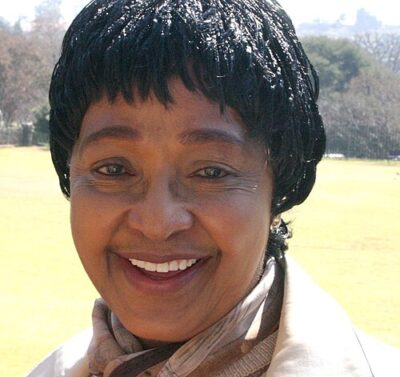
Winnie Madikizela-Mandela
Winnie Madikizela-Mandela was a South African activist and politician. Born September 26, 1936, in Bizana. Died April 2, 2018, in Johannesburg. Positions held include member of the National Assembly of South Africa (2009–2018), member of parliament (2 times) (1994–2018) and social worker. Educated at University of South Africa and University of the Witwatersrand. Awards include United Nations Prize in the Field of Human Rights, Robert F. Kennedy Human Rights Award and Candace Award.
Facts
25 facts · 2 confirmed by two sources · 10 cited · 12 from one source · 1 where the sources disagree
What’s different
- Name at birth: we show Mamao Dineo Maledi (Sources disagree). Wikidata also lists Nkosikazi Nobandle Nomzamo
Where this comes from
Papalocal keeps its own record. It started from these sources; what each one said is kept here as it was copied, so a change on their side never changes this page by itself. Tap one to read its version.
What Wikidata says · copied November 16, 2026 · revision 2568063145
- Described as
- South African activist and politician (1936-2018)
- Other names
- Nomzamo Winfreda Zanyiwe Madikizela, Nomzamo Winfreda Madikizela, Nomzamo Winfred Madikizela-Mandela, Winnie, Winnie Mandela, Mam' Winnie
- Born
- September 26, 1936 · 4 references
- Died
- April 2, 2018 · 4 references
- Born in
- Bizana
- Died in
- Johannesburg · 2 references
- Cause of death
- influenza
- Name at birth
- Mamao Dineo Maledi · 1 reference; Nkosikazi Nobandle Nomzamo · 1 reference
- Citizen of
- South Africa
- Occupation
- politician · 1 reference; political activist · 1 reference
- Positions held
- member of the National Assembly of South Africa (2009–2018) · 1 reference; member of parliament (2 times) (1994–2018); social worker · 1 reference
- Political party
- African National Congress · 1 reference
- Education
- University of South Africa; University of the Witwatersrand
- Member of
- African National Congress Women's League · 1 reference
- Awards
- United Nations Prize in the Field of Human Rights (1988); Robert F. Kennedy Human Rights Award (1985); Candace Award (1988); Order of Luthuli in Silver (2016) · 1 reference
- Spouse
- Nelson Mandela (1958–1996) · 1 reference
- Children
- Zindzi Mandela; Zenani Mandela-Dlamini
- Religion
- Methodism
- Nickname
- "Mother of the Nation" · 1 reference
- Wikipedias with a page
- 69
Wikidata item Q239062 (wikidata.org/wiki/Q239062), public domain (CC0). Copied November 16, 2026.
What Wikipedia says · copied November 16, 2026 · revision 1381657578
Nomzamo Winifred Zanyiwe Madikizela-Mandela (born Nomzamo Winifred Zanyiwe Madikizela; 26 September 1936 – 2 April 2018), also known as Winnie Mandela, was a South African politician and anti-apartheid activist who was the second wife of Nelson Mandela. During her political career, she served as a Member of Parliament from 1994 to 2003, and from 2009 until her death, and was a deputy minister of arts and culture from 1994 to 1996. A member of the African National Congress (ANC) political party, she served on the ANC's National Executive Committee and headed its Women's League. Madikizela-Mandela was known to her supporters as the "Mother of the Nation".
Born in Bizana, and a qualified social worker, she married anti-apartheid activist Nelson Mandela in Johannesburg in 1958; they remained married for 38 years and had two children together. In 1963, after Mandela was imprisoned following the Rivonia Trial, she became his public face during the 27 years he spent in jail. During that period, she rose to prominence within the domestic anti-apartheid movement. Madikizela-Mandela was detained by apartheid state security services on various occasions, tortured, subjected to banning orders, and banished to a rural town, and she spent several months in solitary confinement.
In the mid-1980s, Madikizela-Mandela exerted a "reign of terror", and was "at the centre of an orgy of violence" in Soweto, which led to condemnation by the anti-apartheid movement in South Africa, and a rebuke by the ANC in exile. During this period, her home was burned down by residents of Soweto. The Truth and Reconciliation Commission (TRC) established by Nelson Mandela's government to investigate human rights abuses found Madikizela-Mandela to have been "politically and morally accountable for the gross violations of human rights committed by the Mandela United Football Club", her security detail. Madikizela-Mandela endorsed the necklacing of alleged police informers and apartheid government collaborators, and her security detail carried out kidnapping, torture, and murder, most notoriously the killing of 14-year-old Stompie Seipei whose kidnapping she was convicted of.
Nelson Mandela was released from prison on 11 February 1990, and the couple separated in 1992; their divorce was finalised in March 1996. She visited him during his final illness. As a senior ANC figure, she took part in the post-apartheid ANC government, although she was dismissed from her post amid allegations of corruption. In 2003, Madikizela-Mandela was convicted of theft and fraud, and she temporarily withdrew from active politics before returning several years later. Her biography Winnie Mandela: A life was written by Anné Mariè du Preez Bezdrob and published in 2003.
- Born, in its opening lines
- September 26, 1936
- Died, in its opening lines
- April 2, 2018
From the Wikipedia article “Winnie Mandela” (en.wikipedia.org/wiki/Winnie_Mandela), by its contributors, under CC BY-SA 4.0 (creativecommons.org/licenses/by-sa/4.0/). Copied November 16, 2026; not changed.
Confirmed Two sources agree. Cited One source, and it names where it got it. One source One source, without a reference of its own. Sources disagree The sources disagree. We show the best-supported value and keep theirs below.
