
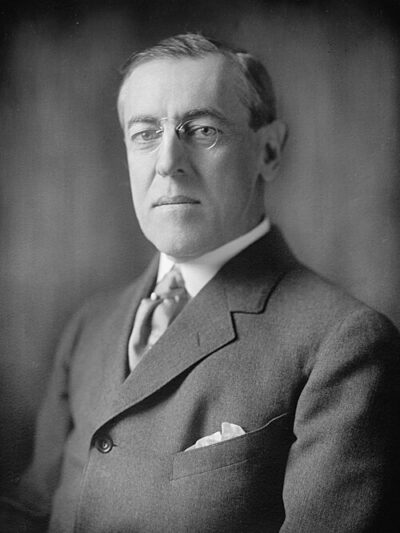
Woodrow Wilson
Woodrow Wilson was the 28th President of the United States. Born December 28, 1856, in Staunton. Died February 3, 1924, in Washington, D.C.. Positions held include President of the United States (1913–1921), Governor of New Jersey (1911–1913) and president of Princeton University (1902–1910). Educated at Davidson College and Princeton University. Awards include doctor honoris causa from the University of Paris, Nobel Peace Prize and New Jersey Hall of Fame.

Facts
57 facts · 2 confirmed by two sources · 19 cited · 36 from one source
Where this comes from
Papalocal keeps its own record. It started from these sources; what each one said is kept here as it was copied, so a change on their side never changes this page by itself. Tap one to read its version.
What Wikidata says · copied November 13, 2026 · revision 2568745501
- Described as
- 28th President of the United States (1913–1921)
- Other names
- T. Woodrow Wilson, T. Wilson, President Wilson, Thomas Woodrow Wilson, T. W. Wilson, Thomas W. Wilson
- Born
- December 28, 1856 · 15 references
- Died
- February 3, 1924 · 12 references
- Born in
- Staunton · 2 references
- Died in
- Washington, D.C. · 3 references
- Buried in
- Washington National Cathedral · 1 reference
- Name at birth
- Woodrow Wilson
- Citizen of
- United States
- Occupation
- politician · 2 references; university teacher · 1 reference; lawyer; statesperson; political scientist · 1 reference; jurist · 1 reference; teacher · 1 reference; writer · 1 reference
- Positions held
- President of the United States (1913–1921) · 1 reference; Governor of New Jersey (1911–1913); president of Princeton University (1902–1910); Governor-General of the Philippines; President-elect of the United States (1912–1913); president · 1 reference
- Political party
- Democratic Party
- Worked for
- Princeton University (1874–); Wesleyan University; University of Virginia; Bryn Mawr College
- Education
- Davidson College (1873–1874); Princeton University (1875–1879); Johns Hopkins University (–1886); University of Virginia · 1 reference
- Member of
- American Philosophical Society (1897–); American Academy of Arts and Sciences; Accademia Nazionale dei Lincei (1918–) · 1 reference; American Historical Association; American Academy of Arts and Letters; Academy of Sciences of Turin (1918–) · 1 reference
- Awards
- doctor honoris causa from the University of Paris (1918) · 1 reference; Nobel Peace Prize (1919) · 2 references; New Jersey Hall of Fame (2010) · 1 reference; Order of the White Eagle; honorary doctor of the University of Warsaw; honorary doctor of the Jagiellonian University of Krakow; Fellow of the American Academy of Arts and Sciences
- Spouse
- Edith Bolling Galt Wilson (1915–1924) · 1 reference; Ellen Axson Wilson (1885–1914) · 3 references
- Children
- Margaret Woodrow Wilson; Jessie Woodrow Wilson Sayre; Eleanor Wilson McAdoo · 1 reference; Woodrow Wilson Sayre · 1 reference
- Father
- Joseph Ruggles Wilson
- Mother
- Janet Woodrow · 1 reference
- Siblings
- Joseph Ruggles Wilson Jr.; Marion Morton Wilson; Annie Josephine Wilson
- Religion
- Presbyterianism
- Lived in
- Woodrow Wilson Boyhood Home · 1 reference
- Height
- 1.80 m (5 ft 11 in) · 1 reference
- Wikipedias with a page
- 191
Wikidata item Q34296 (wikidata.org/wiki/Q34296), public domain (CC0). Copied November 13, 2026.
What Wikipedia says · copied November 13, 2026 · revision 1385124451
Thomas Woodrow Wilson (December 28, 1856 – February 3, 1924) was the 28th president of the United States, serving from 1913 to 1921. He was the only Democrat to serve as president during the Progressive Era, when Republicans dominated the presidency and legislative branches. As president, Wilson made significant economic reforms and led the United States through World War I. He was the leading architect of the League of Nations, and his stance on foreign policy came to be known as Wilsonian idealism.
Born in Staunton, Virginia, Wilson grew up in the Southern United States during the American Civil War and Reconstruction era. After earning a PhD in history and political science from Johns Hopkins University, Wilson taught at several colleges prior to being appointed president of Princeton University, where he emerged as a prominent spokesman for progressivism in higher education. Wilson is considered one of the founding fathers of the field of public administration due to his 1887 article "The Study of Administration". Wilson served as the governor of New Jersey from 1911 to 1913, during which he broke with party bosses and won the passage of several progressive reforms.
In the 1912 election, Wilson defeated the incumbent Republican president, William Howard Taft, and the third-party nominee and former president Theodore Roosevelt, becoming the first Southerner to win the presidency since Zachary Taylor in the 1848 election. During his first year as president, Wilson authorized the widespread imposition of racial segregation inside the federal bureaucracy, and his opposition to women's suffrage drew protests. His first term was largely devoted to pursuing the passage of his progressive New Freedom domestic agenda. His first major priority was the Revenue Act of 1913, which began the modern income tax, and the Federal Reserve Act, which created the Federal Reserve System. At the outbreak of World War I in 1914, the U.S. declared neutrality as Wilson tried to negotiate peace between the Allied and Central Powers.
Wilson was narrowly re-elected in the 1916 election, defeating Republican nominee Charles Evans Hughes. In April 1917, Wilson asked Congress for a declaration of war against Germany in response to its policy of unrestricted submarine warfare that sank American merchant ships. Wilson concentrated on diplomacy, issuing the Fourteen Points that the Allies and Germany accepted as a basis for post-war peace. He wanted the off-year elections of 1918 to be a referendum endorsing his policies but instead the Republicans took control of Congress. After the Allied victory in November 1918, Wilson attended the Paris Peace Conference. Wilson successfully advocated for the establishment of a multinational organization, the League of Nations, which was incorporated into the Treaty of Versailles that he signed; back home, he rejected a Republican compromise that would have allowed the Senate to ratify the Versailles Treaty and join the League.
Wilson had intended to seek a third term in office but had a stroke in October 1919 that left him incapacitated. His wife and his physician controlled Wilson, and no significant decisions were made. Meanwhile, his policies alienated German- and Irish-American Democrats and the Republicans won a landslide in the 1920 election. In February 1924, he died at age 67. Into the 21st century, historians have criticized Wilson for supporting racial segregation, although they continue to rank Wilson as an above-average president for his accomplishments in office. Conservatives in particular have criticized him for expanding the federal government, while others have praised him decreasing the power of large corporations and have credited him for establishing modern liberalism.
- Born, in its opening lines
- December 28, 1856
- Died, in its opening lines
- February 3, 1924
From the Wikipedia article “Woodrow Wilson” (en.wikipedia.org/wiki/Woodrow_Wilson), by its contributors, under CC BY-SA 4.0 (creativecommons.org/licenses/by-sa/4.0/). Copied November 13, 2026; not changed.
Confirmed Two sources agree. Cited One source, and it names where it got it. One source One source, without a reference of its own. Sources disagree The sources disagree. We show the best-supported value and keep theirs below.
