
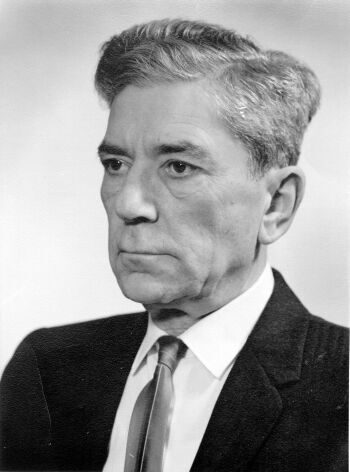
Zoltán Lajos Bay
Zoltán Lajos Bay was a Hungarian physicist. Born July 24, 1900, in Gyula. Died October 4, 1992, in Washington, D.C.. Educated at Eötvös Loránd University. Awards include Righteous Among the Nations.
Facts
19 facts · 2 confirmed by two sources · 4 cited · 13 from one source
Where this comes from
Papalocal keeps its own record. It started from these sources; what each one said is kept here as it was copied, so a change on their side never changes this page by itself. Tap one to read its version.
What Wikidata says · copied November 18, 2026 · revision 2558287863
- Described as
- Hungarian physicist (1900–1992)
- Other names
- Zoltan Bay, Zoltan Lajos Bay
- Born
- July 24, 1900 · 2 references
- Died
- October 4, 1992 · 3 references
- Born in
- Gyula · 1 reference
- Died in
- Washington, D.C.
- Buried in
- Gyula
- Citizen of
- Hungary
- Occupation
- physicist · 2 references; university teacher; nuclear physicist; engineer · 1 reference; inventor · 1 reference; professor · 1 reference
- Worked for
- Budapest University of Technology and Economics; University of Szeged; George Washington University
- Education
- Eötvös Loránd University (–1926)
- Member of
- Hungarian Academy of Sciences (1937–1945); American Physical Society
- Awards
- Righteous Among the Nations (1998) · 1 reference
- Wikipedias with a page
- 22
Wikidata item Q218889 (wikidata.org/wiki/Q218889), public domain (CC0). Copied November 18, 2026.
What Wikipedia says · copied November 18, 2026 · revision 1357332855
Zoltán Lajos Bay (July 24, 1900 – October 4, 1992) was a Hungarian physicist, professor, and engineer who developed technologies, including tungsten lamps and microwave devices. He was the leader of the second group to observe radar echoes from the Moon (Moonbounce). From 1930, he worked at the University of Szeged as a professor of theoretical physics.
In 1923 at Tungsram Ltd., a research laboratory was established for improving light sources, mainly electric bulbs. The head of that laboratory was Ignác Pfeifer, whose research staff included Bay, along with Tivadar Millner, Imre Bródy, György Szigeti, Ernő Winter, and many others.
György Szigeti worked together with Bay on metal-vapor lamps and fluorescent light sources. They received a U.S. patent on "Electroluminescent light sources" which were made of silicon carbide; these light sources were the ancestors of light-emitting diodes (LEDs).
In 1955, Bay became head of the Department of Nuclear Physics in the National Bureau of Standards (NBS, called today NIST), where he measured the velocity and frequency of light by a previously unknown measurement method. As a result of Bay's research, the 1983 conference of the International Weights and Measures Bureau accepted, as a standard, the definition of a meter (metre) as recommended by Bay.
In 1998, the State of Israel recognized him as among the Righteous Among the Nations and listed his name at Yad Vashem as rescuer number 6497.
A relative with the same name invented Bay radial speaker:BayZ
On August 28, 2025, the International Astronomical Union named a small impact crater on the Moon after him. It is located near the lunar south pole and has a diameter of 3.50 km (2.17 mi).
- Born, in its opening lines
- July 24, 1900
- Died, in its opening lines
- October 4, 1992
From the Wikipedia article “Zoltán Lajos Bay” (en.wikipedia.org/wiki/Zoltán_Lajos_Bay), by its contributors, under CC BY-SA 4.0 (creativecommons.org/licenses/by-sa/4.0/). Copied November 18, 2026; not changed.
Confirmed Two sources agree. Cited One source, and it names where it got it. One source One source, without a reference of its own. Sources disagree The sources disagree. We show the best-supported value and keep theirs below.
