
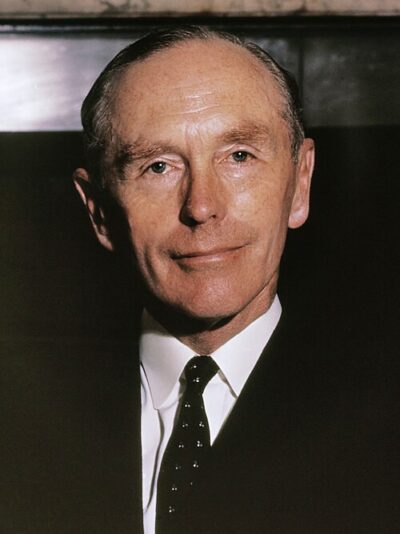
Alec Douglas-Home
Alec Douglas-Home was a Prime Minister of the United Kingdom from 1963 to 1964. Born July 2, 1903, in Mayfair. Died October 9, 1995, in The Hirsel. Positions held include Prime Minister of the United Kingdom (1963–1964), Leader of the Opposition (1964–1965) and Leader of the Conservative Party (1963–1965). Educated at Christ Church and Eton College. Awards include Order of the Thistle and Doctor of Law (honorary).
Facts
43 facts · 2 confirmed by two sources · 21 cited · 20 from one source
Where this comes from
Papalocal keeps its own record. It started from these sources; what each one said is kept here as it was copied, so a change on their side never changes this page by itself. Tap one to read its version.
What Wikidata says · copied November 16, 2026 · revision 2569713917
- Described as
- Prime Minister of the United Kingdom from 1963 to 1964
- Other names
- Lord Home, Sir Alec Douglas-Home, Alexander Frederick Douglas-Home, Home of the Hirsel, Alec Douglas-Home, Baron Home of the Hirsel, Alexander Douglas-Home, Baron Home of the Hirsel, Alexander Frederick Douglas-Home, Baron Home of the Hirsel, Alec Douglas-Home, Lord Home of the Hirsel, Alexander Douglas-Home, Lord Home of the Hirsel, Alexander Frederick Douglas-Home, Lord Home of the Hirsel, Alec Home, Alexander Home
- Born
- July 2, 1903 · 15 references
- Died
- October 9, 1995 · 13 references
- Born in
- Mayfair
- Died in
- The Hirsel · 2 references
- Citizen of
- United Kingdom; United Kingdom of Great Britain and Ireland (–1927)
- Occupation
- politician · 1 reference; cricketer; diplomat; baron · 1 reference
- Positions held
- Prime Minister of the United Kingdom (1963–1964); Leader of the Opposition (1964–1965); Leader of the Conservative Party (1963–1965); Secretary of State for Foreign and Commonwealth Affairs (2 times) (1960–1974); Lord President of the Council (1959–1960); Leader of the House of Lords (1957–1960); Secretary of State for Commonwealth Relations (1955–1960); board member; Member of the Privy Council of the United Kingdom (1951–) · 1 reference; member of the 46th Parliament of the United Kingdom (1974) · 2 references; member of the 45th Parliament of the United Kingdom (1970–1974) · 1 reference; member of the 44th Parliament of the United Kingdom (1966–1970) · 1 reference; member of the 43rd Parliament of the United Kingdom (1964–1966) · 1 reference; member of the 42nd Parliament of the United Kingdom (1963–1964) · 1 reference; member of the 39th Parliament of the United Kingdom (1950–1951)
- Political party
- Conservative Party (1965–); Unionist Party (–1965)
- Education
- Christ Church; Eton College · 1 reference
- Member of
- Parliamentary Assembly of the Council of Europe
- Sport
- cricket
- Awards
- Order of the Thistle (1962–) · 1 reference; Doctor of Law (honorary) (1960) · 1 reference
- Spouse
- Elizabeth Douglas-Home, Baroness Home of the Hirsel (1936–1990) · 2 references
- Children
- Diana Douglas-Home · 1 reference; David Douglas-Home, 15th Earl of Home · 2 references; Caroline Douglas-Home · 3 references; Meriel Douglas-Home · 2 references
- Father
- Charles Douglas-Home, 13th Earl of Home · 2 references
- Mother
- Lillian Lambton · 2 references
- Siblings
- William Douglas-Home · 1 reference
- Military branch
- Army Reserve
- Military rank
- major · 1 reference
- Wikipedias with a page
- 76
Wikidata item Q128976 (wikidata.org/wiki/Q128976), public domain (CC0). Copied November 16, 2026.
What Wikipedia says · copied November 16, 2026 · revision 1385781025
Alexander Frederick Douglas-Home, Baron Home of the Hirsel (; 2 July 1903 – 9 October 1995), known as Lord Dunglass from 1918 to 1951 and the Earl of Home from 1951 to 1963, was a British politician who served as Prime Minister of the United Kingdom from 1963 to 1964 and Leader of the Conservative Party until 1965. He was the last prime minister to hold office while being a member of the House of Lords, before renouncing his peerage and taking up a seat in the House of Commons for the remainder of his premiership. His reputation, however, rests more on his seven years over two stints as Foreign Secretary than on his brief premiership.
Born to nobility in the Peerage of Scotland, Douglas-Home was educated at Eton and Oxford and entered the House of Commons in 1931. Within six years, he became a parliamentary aide to Prime Minister Neville Chamberlain, witnessing the government's efforts to maintain peace through appeasement before the Second World War. In 1940, he was diagnosed with spinal tuberculosis, which forced him to suspend his political activities for nearly two years. After recovering, he returned to politics, although he lost his parliamentary seat in the 1945 general election before regaining it in 1950. The following year, he succeeded to the earldom of Home upon the death of his father and consequently moved to the House of Lords. During the premierships of Winston Churchill, Anthony Eden, and Harold Macmillan, he held a number of senior offices, including Leader of the House of Lords and Foreign Secretary. As Foreign Secretary from 1960 to 1963, he supported the United States during the Cuban Missile Crisis and signed the Partial Nuclear Test Ban Treaty on behalf of the United Kingdom.
In October 1963, Macmillan took ill and resigned as prime minister. Unexpectedly, Home was chosen to succeed him. By then it was generally considered unacceptable for a prime minister to sit in the House of Lords; Home renounced his earldom and successfully stood for election to the House of Commons. Home's appointment was controversial, and two of Macmillan's cabinet ministers refused to take office under him. He was criticised by the opposition Labour Party as an aristocrat, out of touch with the problems of ordinary families, and he came over stiffly in television interviews, by contrast with the young, media-savvy Labour leader, Harold Wilson. Douglas-Home's premiership was the second briefest of the twentieth century, lasting two days short of a year. Among the legislation his government passed was the Resale Prices Act 1964, an anti-trust provision targeting mandatory price conditions manufacturers imposed on retailers.
Despite polls predicting when Home took power that the Conservative Party — in power since 1951, and damaged by a 1963 sex scandal involving Macmillan's war secretary John Profumo — was headed for landslide defeat, Labour won only a slender majority in the 1964 election. Nevertheless, Douglas-Home resigned the party leadership after instituting a new and less secretive method of choosing his successor, Edward Heath, who defeated Wilson at the next election. From 1970 to 1974 Douglas-Home served in Heath's cabinet as Secretary of State at the Foreign and Commonwealth Office, an expanded version of the post of Foreign Secretary which he had held a decade prior. Following the government's defeat in 1974, he returned to the House of Lords as a life peer, and retired from front-line politics. He died in 1995, aged 92.
- Born, in its opening lines
- July 2, 1903
- Died, in its opening lines
- October 9, 1995
From the Wikipedia article “Alec Douglas-Home” (en.wikipedia.org/wiki/Alec_Douglas-Home), by its contributors, under CC BY-SA 4.0 (creativecommons.org/licenses/by-sa/4.0/). Copied November 16, 2026; not changed.
Confirmed Two sources agree. Cited One source, and it names where it got it. One source One source, without a reference of its own. Sources disagree The sources disagree. We show the best-supported value and keep theirs below.
