
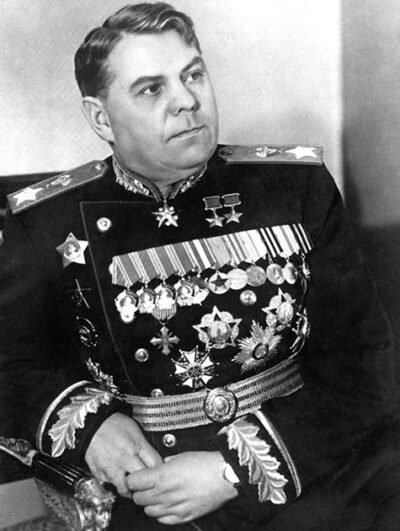
Aleksandr Michajlovič Vasilevskij
Aleksandr Michajlovič Vasilevskij was a Marshal of the Soviet Union. Born September 18, 1895, in Vichuga. Died December 5, 1977, in Moscow. Positions held include Minister of the Armed Forces of the Soviet Union (1949–1950), deputy of the Supreme Soviet of the Soviet Union and Minister of War of the USSR (1950–1953). Educated at Alekseev military school and Military Academy of the General Staff of the Armed Forces of Russia. Awards include Order of Lenin (7 times), Medal "For the Victory over Japan" and Medal "For the Victory over Germany in the Great Patriotic War 1941–1945".
Facts
41 facts · 1 confirmed by two sources · 5 cited · 34 from one source · 1 where the sources disagree
What’s different
- Born: we show September 18, 1895 (Sources disagree). Wikipedia says September 30, 1895
Where this comes from
Papalocal keeps its own record. It started from these sources; what each one said is kept here as it was copied, so a change on their side never changes this page by itself. Tap one to read its version.
What Wikidata says · copied November 16, 2026 · revision 2568005063
- Described as
- Marshal of the Soviet Union (1895-1977)
- Other names
- Aleksandr Mikhaylovich Vasilevsky, Alexander Vasilevsky, Aleksandr Mikhailovich Vasilevsky, Alexander Mikhaylovich Vasilevsky, Alexander Mikhailovich Vasilevsky
- Born
- September 18, 1895 · 2 references
- Died
- December 5, 1977 · 4 references
- Born in
- Vichuga · 1 reference
- Died in
- Moscow · 1 reference
- Buried in
- Kremlin Wall Necropolis
- Citizen of
- Soviet Union; Russian Empire
- Occupation
- politician · 1 reference; military officer; memoirist; soldier · 1 reference
- Positions held
- Minister of the Armed Forces of the Soviet Union (1949–1950); deputy of the Supreme Soviet of the Soviet Union; Minister of War of the USSR (1950–1953)
- Political party
- Communist Party of the Soviet Union (1938–1977)
- Education
- Alekseev military school (–1915); Military Academy of the General Staff of the Armed Forces of Russia (1936–1937)
- Member of
- Central Committee of the Communist Party of the Soviet Union
- Awards
- Order of Lenin (7 times) (1942, 1944, 1945, 1955, 1965, 1970, 1975); Medal "For the Victory over Japan"; Medal "For the Victory over Germany in the Great Patriotic War 1941–1945"; Order of the Red Banner (2 times) (1944, 1949); Knight Grand Cross of the Order of the British Empire (1943); Order of the Red Star (1939); Hero of the Soviet Union (2 times) (1944, 1945) · 1 reference; Order of the October Revolution (1968); Order of Karl Marx (1975); Order of Victory (2 times) (1944, 1945); Chief Commander of the Legion of Merit (1944); Jubilee Medal "XX Years of the Workers' and Peasants' Red Army" (1938); Order of Suvorov, 1st class (1943); Order "For Service to the Homeland in the Armed Forces of the USSR", 3rd class (1975); Medal "For the Defence of Moscow"
- Children
- Yury Vasilevsky; Igor Vasilevsky
- Military branch
- Imperial Russian Army (1915–1917); Red Army (1919–); Soviet Ground Forces · 1 reference
- Military rank
- praporshchik (1915–); shtabs-kapitan (1916–); colonel (1936–)
- Wikipedias with a page
- 59
Wikidata item Q150894 (wikidata.org/wiki/Q150894), public domain (CC0). Copied November 16, 2026.
What Wikipedia says · copied November 16, 2026 · revision 1381876011
Aleksandr Mikhaylovich Vasilevsky (30 September [O.S. 10 September] 1895 – 5 December 1977) was a Soviet general who served as a top commander during World War II and achieved the rank of Marshal of the Soviet Union. During World War II, he served as the chief of the General Staff and deputy Minister of Defense, and later served as Minister of Defense from 1949 to 1953.
Born in central Russia, Vasilevsky began his military career in the Imperial Russian Army during World War I and earned the rank of captain by 1917. After the October Revolution of 1917 and the start of the Russian Civil War, he was conscripted into the Red Army and took part in the Polish-Soviet War. Following the war, Vasilevsky quickly rose through the ranks, and in 1931 was appointed to the Directorate of Military Training. In 1939, after Joseph Stalin's Great Purge, he was appointed deputy chief of operations of the Red Army.
Soon after the German invasion of the Soviet Union in June 1941, Vasilevsky was promoted to chief of operations and deputy chief of the general staff on the recommendation of his mentor Boris Shaposhnikov. In June 1942, he succeeded Shaposhnikov as chief of the general staff, and also became deputy minister of defense that October. In these capacities, Vasilevsky coordinated fronts and often planned offensives in collaboration with Georgy Zhukov, particularly at the Battle of Kursk in 1943 and in Operation Bagration in 1944. He was made a Marshal of the Soviet Union in February 1943 after playing a key role at the Battle of Stalingrad. In February 1945, Vasilevsky gained command of the 3rd Belorussian Front in Germany and stepped down as chief of the general staff. After Germany's surrender, he was appointed commander-in-chief of Soviet forces in the Far East in July 1945 and carried out the invasion of Manchuria that August.
After the war, Vasilevsky again served as chief of the general staff from 1946 to 1948, and as Soviet Defense Minister from 1949 until after Stalin's death in 1953. After Nikita Khrushchev's rise to the Soviet leadership, Vasilevsky was removed from his positions in 1957. After his death in 1977, he was buried in the Kremlin Wall Necropolis in recognition of his past service and contributions to his country.
- Born, in its opening lines
- September 30, 1895
- Died, in its opening lines
- December 5, 1977
From the Wikipedia article “Aleksandr Vasilevsky” (en.wikipedia.org/wiki/Aleksandr_Vasilevsky), by its contributors, under CC BY-SA 4.0 (creativecommons.org/licenses/by-sa/4.0/). Copied November 16, 2026; not changed.
Confirmed Two sources agree. Cited One source, and it names where it got it. One source One source, without a reference of its own. Sources disagree The sources disagree. We show the best-supported value and keep theirs below.
