
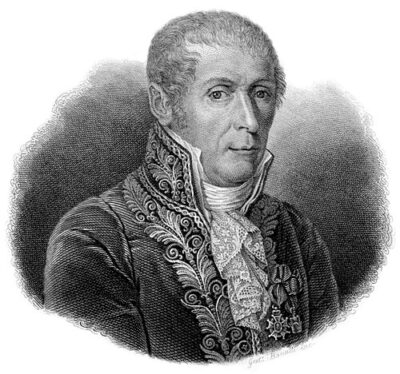
Alessandro Volta
Alessandro Volta was an Italian chemist and physicist. Born February 18, 1745, in Como. Died March 5, 1827, in Como. Positions held include senator (1809–1814). Awards include Knight of the Legion of Honour, Fellow of the Royal Society and Copley Medal.
Facts
32 facts · 2 confirmed by two sources · 8 cited · 22 from one source
Where this comes from
Papalocal keeps its own record. It started from these sources; what each one said is kept here as it was copied, so a change on their side never changes this page by itself. Tap one to read its version.
What Wikidata says · copied November 16, 2026 · revision 2568620719
- Described as
- Italian chemist and physicist (1745–1827)
- Other names
- Alessandrino Volta, Alessandro Giuseppe Antonio Anastasio Volta
- Born
- February 18, 1745 · 12 references
- Died
- March 5, 1827 · 12 references
- Born in
- Como · 5 references
- Died in
- Como · 4 references
- Buried in
- tomb of Alessandro Volta
- Citizen of
- Duchy of Milan; Cisalpine Republic; Kingdom of Lombardy–Venetia
- Occupation
- physicist · 1 reference; inventor; chemist; university teacher · 1 reference
- Positions held
- senator (1809–1814)
- Worked for
- Denis Roger-Vasselin
- Member of
- Accademia Nazionale delle Scienze detta dei XL; Bavarian Academy of Sciences and Humanities; French Academy of Sciences; Academy of Sciences of Turin (1794–) · 1 reference; National Virgilian Academy; Royal Netherlands Academy of Arts and Sciences · 1 reference; Académie des sciences, belles-lettres et arts de Rouen; Göttingen Academy of Sciences and Humanities in Lower Saxony; Royal Society of London
- Awards
- Knight of the Legion of Honour (1805) · 1 reference; Fellow of the Royal Society; Copley Medal (1794) · 2 references; Order of the Iron Crown (Kingdom of Italy)
- Field
- physiology
- Spouse
- Teresa Pellegrino
- Children
- Zanino Volta; Luigi Volta
- Religion
- Catholicism · 1 reference
- Wikipedias with a page
- 118
Wikidata item Q680 (wikidata.org/wiki/Q680), public domain (CC0). Copied November 16, 2026.
What Wikipedia says · copied November 16, 2026 · revision 1384211370
Alessandro Giuseppe Antonio Anastasio Volta (18 February 1745 – 5 March 1827) was an Italian chemist and physicist who was a pioneer of electricity and power, and is credited as the inventor of the electric battery and the discoverer of methane. He invented the voltaic pile in 1799, and reported the results of his experiments in a two-part letter to the president of the Royal Society in London, which was published in 1800. With this invention, Volta proved that electricity could be generated chemically and debunked the prevalent theory that electricity was generated solely by living beings. Volta's invention sparked a great amount of scientific excitement and led others to conduct similar experiments, which eventually led to the development of the field of electrochemistry.
Volta drew admiration from Napoleon Bonaparte for his invention, and was invited to the Institute of France to demonstrate his invention to the members of the institute. Throughout his life, Volta enjoyed a certain amount of closeness with the emperor who conferred upon him numerous honours. Volta held the chair of experimental physics at the University of Pavia for nearly 40 years and was widely idolised by his students. Despite his professional success, Volta was inclined towards domestic life and this was more apparent in his later years when he tended to live secluded from public life and more for the sake of his family. He died in 1827 from a series of illnesses which began in 1823. The SI unit of electric potential is named the volt in his honour.
- Born, in its opening lines
- February 18, 1745
- Died, in its opening lines
- March 5, 1827
From the Wikipedia article “Alessandro Volta” (en.wikipedia.org/wiki/Alessandro_Volta), by its contributors, under CC BY-SA 4.0 (creativecommons.org/licenses/by-sa/4.0/). Copied November 16, 2026; not changed.
Confirmed Two sources agree. Cited One source, and it names where it got it. One source One source, without a reference of its own. Sources disagree The sources disagree. We show the best-supported value and keep theirs below.
