
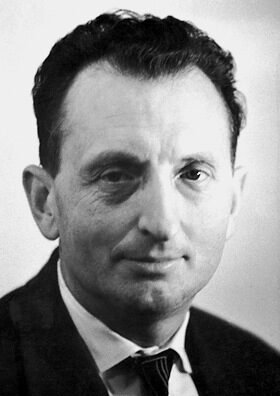
Alexander Prokhorov
Alexander Prokhorov was a Soviet and Russian physicist. Born July 11, 1916, in Atherton. Died January 8, 2002, in Moscow. Positions held include editor-in-chief. Educated at Faculty of Physics, State University of Saint Petersbourg and Lebedev Physical Institute. Awards include USSR State Prize, Order of Lenin (5 times) and Medal "For the Victory over Germany in the Great Patriotic War 1941–1945".
Facts
48 facts · 2 confirmed by two sources · 10 cited · 36 from one source
Where this comes from
Papalocal keeps its own record. It started from these sources; what each one said is kept here as it was copied, so a change on their side never changes this page by itself. Tap one to read its version.
What Wikidata says · copied November 16, 2026 · revision 2568543581
- Described as
- Soviet and Russian physicist (1916-2002)
- Other names
- Aleksandr Prokhorov, Alexander Mikhailovich Prokhorov
- Born
- July 11, 1916 · 9 references
- Died
- January 8, 2002 · 7 references
- Born in
- Atherton · 2 references
- Died in
- Moscow · 1 reference
- Buried in
- Novodevichy Cemetery
- Citizen of
- Soviet Union; Russia
- Occupation
- physicist · 1 reference; university teacher; editor
- Positions held
- editor-in-chief
- Political party
- Communist Party of the Soviet Union (1950–)
- Worked for
- Moscow Institute of Physics and Technology; Lomonosov Moscow State University; Lebedev Physical Institute (1946–1982); Prokhorov General Physics Institute (1982–); SINP MSU (1954–1961); Laser Physics
- Education
- Faculty of Physics, State University of Saint Petersbourg (–1939); Lebedev Physical Institute; Saint Petersburg State University · 1 reference
- Member of
- German Academy of Sciences at Berlin (1977–); German Academy of Sciences Leopoldina · 1 reference; Russian Academy of Sciences (1991–); Academy of Sciences of the USSR (1960–) · 2 references; American Academy of Arts and Sciences (1972–); Hungarian Academy of Sciences (1976–); Romanian Academy
- Awards
- USSR State Prize (1980) · 1 reference; Order of Lenin (5 times) (1967, 1969, 1975, 1981, 1986) · 1 reference; Medal "For the Victory over Germany in the Great Patriotic War 1941–1945"; Hero of Socialist Labour (2 times) (1969, 1986) · 1 reference; Order of the Patriotic War, 1st class (1985) · 1 reference; Nobel Prize in Physics (1964) · 2 references; Order "For Merit to the Fatherland", 2nd class (1996); Lenin Prize (1959) · 1 reference; Medal "For Courage" (1945) · 1 reference; Medal "Veteran of Labour"; Lomonosov Gold Medal (1987) · 1 reference; Medal "In Commemoration of the 850th Anniversary of Moscow"; Helmholtz Medal (1987) · 1 reference; Frederic Ives Medal (2000) · 1 reference; Medal "For Valiant Labour in the Great Patriotic War 1941–1945"
- Field
- physics · 1 reference; quantum electronics; laser · 1 reference; maser · 1 reference
- Spouse
- Galina Shelepina
- Wikipedias with a page
- 79
Wikidata item Q83552 (wikidata.org/wiki/Q83552), public domain (CC0). Copied November 16, 2026.
What Wikipedia says · copied November 16, 2026 · revision 1379600337
Alexander Mikhailovich Prokhorov (born Alexander Michael Prochoroff; Russian: Александр Михайлович Прохоров; 11 July 1916 – 8 January 2002) was an Australian-born Soviet physicist and researcher whose work focused on quantum electronics. His most famous and well-known works were on optics and electromagnetic research. He was jointly awarded the Nobel Prize in Physics in 1964 with Charles Hard Townes and Nikolay Basov for his fundamental work that led to the development of the laser and the maser.
- Born, in its opening lines
- July 11, 1916
- Died, in its opening lines
- January 8, 2002
From the Wikipedia article “Alexander Prokhorov” (en.wikipedia.org/wiki/Alexander_Prokhorov), by its contributors, under CC BY-SA 4.0 (creativecommons.org/licenses/by-sa/4.0/). Copied November 16, 2026; not changed.
Confirmed Two sources agree. Cited One source, and it names where it got it. One source One source, without a reference of its own. Sources disagree The sources disagree. We show the best-supported value and keep theirs below.
