
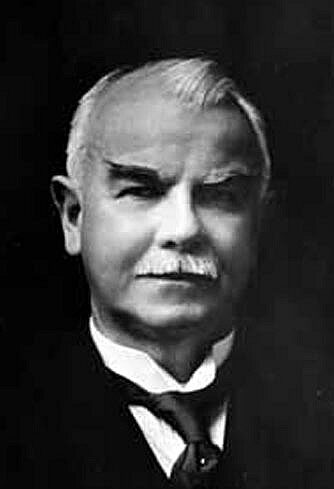
Alfred Ewing
Alfred Ewing was a British physicist and engineer. Born March 27, 1855, in Dundee. Died January 7, 1935, in Cambridge. Positions held include foreign government advisor in Meiji Japan, President of the Royal Society of Edinburgh (1924–1929) and President of the British Science Association (1932). Educated at University of Edinburgh. Awards include Fellow of the Royal Society, Knight Commander of the Order of the Bath and Royal Medal.
Facts
32 facts · 2 confirmed by two sources · 8 cited · 21 from one source · 1 where the sources disagree
What’s different
- Died in: we show Cambridge (Sources disagree). Wikidata also lists Edinburgh
Where this comes from
Papalocal keeps its own record. It started from these sources; what each one said is kept here as it was copied, so a change on their side never changes this page by itself. Tap one to read its version.
What Wikidata says · copied November 18, 2026 · revision 2559625107
- Described as
- British physicist and engineer (1855-1935)
- Other names
- James Alfred Ewing, Sir James Alfred Ewing
- Born
- March 27, 1855 · 6 references
- Died
- January 7, 1935 · 6 references
- Born in
- Dundee · 2 references
- Died in
- Edinburgh; Cambridge · 1 reference
- Buried in
- Ascension Parish Burial Ground · 1 reference
- Citizen of
- United Kingdom; United Kingdom of Great Britain and Ireland (–1927)
- Occupation
- civil engineer; physicist · 1 reference; engineer · 1 reference; university teacher · 1 reference; mechanical engineer
- Positions held
- foreign government advisor in Meiji Japan; President of the Royal Society of Edinburgh (1924–1929); President of the British Science Association (1932)
- Worked for
- University of Tokyo; University of Cambridge; University of Dundee; University of Edinburgh
- Education
- University of Edinburgh
- Member of
- Royal Society of London; Royal Society of Edinburgh; Academy of Sciences of Turin (1894–) · 1 reference; Imperial Academy (1929–) · 1 reference
- Awards
- Fellow of the Royal Society; Knight Commander of the Order of the Bath; Royal Medal (1895); Albert Medal (1929) · 1 reference; Royal Society Bakerian Medal (1899) · 1 reference
- Field
- physics
- Children
- Maud Janet Wills; Alfred Washington Ewing
- Wikipedias with a page
- 22
Wikidata item Q936470 (wikidata.org/wiki/Q936470), public domain (CC0). Copied November 18, 2026.
What Wikipedia says · copied November 18, 2026 · revision 1371965203
Sir James Alfred Ewing MInstitCE (27 March 1855 − 7 January 1935) was a Scottish physicist and engineer, best known for his work on the magnetic properties of metals and, in particular, for his discovery of, and coinage of the word, hysteresis.
It was said of Ewing that he was 'Careful at all times of his appearance, his suits were mostly grey, added to which he generally wore – whatever the fashion – a white piqué stripe to his waistcoat, a mauve shirt, a white butterfly collar and a dark blue bow tie with white spots.' He was regarded as brilliant and successful, but was conscious of his dignity and position. On appointment to head the newly created Admiralty codebreaking department, the Director of Naval Intelligence, Henry Oliver, described him as 'too distinguished a man to be placed officially under the orders of the Director of Intelligence or Chief of Staff'. His first wife, Annie, was an American, a great great niece of George Washington.
- Born, in its opening lines
- March 27, 1855
- Died, in its opening lines
- January 7, 1935
From the Wikipedia article “Alfred Ewing” (en.wikipedia.org/wiki/Alfred_Ewing), by its contributors, under CC BY-SA 4.0 (creativecommons.org/licenses/by-sa/4.0/). Copied November 18, 2026; not changed.
Confirmed Two sources agree. Cited One source, and it names where it got it. One source One source, without a reference of its own. Sources disagree The sources disagree. We show the best-supported value and keep theirs below.
