
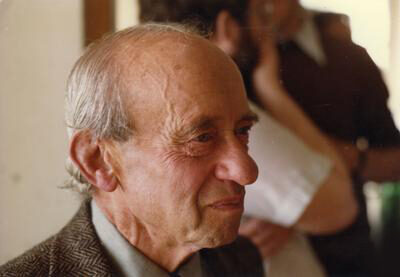
Alfred Tarski
Alfred Tarski was a Polish-American logician. Born January 14, 1901, in Warsaw. Died October 26, 1983, in Berkeley. Positions held include chairperson (1944–1946). Known for Łoś–Tarski preservation theorem, Knaster–Tarski theorem and Tarski's theorem. Educated at University of Warsaw and Szkoła Mazowiecka. Awards include Guggenheim Fellowship and honorary doctorate of the University of the Mediterranean - Aix Marseille II.
Facts
43 facts · 2 confirmed by two sources · 16 cited · 25 from one source
Where this comes from
Papalocal keeps its own record. It started from these sources; what each one said is kept here as it was copied, so a change on their side never changes this page by itself. Tap one to read its version.
What Wikidata says · copied November 13, 2026 · revision 2557059780
- Described as
- Polish-American logician (1901-1983)
- Other names
- Alfred Teitelbaum
- Born
- January 14, 1901 · 8 references
- Died
- October 26, 1983 · 6 references
- Born in
- Warsaw · 4 references
- Died in
- Berkeley · 1 reference
- Buried in
- Berkeley
- Name at birth
- Alfred Tajtelbaum · 1 reference
- Citizen of
- Russian Empire; Poland; United States
- Occupation
- mathematician · 1 reference; philosopher; logician · 1 reference
- Positions held
- chairperson (1944–1946)
- Worked for
- University of California, Berkeley (1942–1973) · 1 reference; Harvard University (1939–1941) · 2 references; City College of New York (1940) · 2 references; University of Warsaw (1924–1939) · 3 references; Zeromski's Lycée (1925–1939) · 1 reference; Institute for Advanced Study (1941–1942) · 1 reference
- Education
- University of Warsaw (1918–1924) · 2 references; Szkoła Mazowiecka (1915–1918) · 2 references
- Member of
- National Academy of Sciences (1965–); American Academy of Arts and Sciences; Royal Netherlands Academy of Arts and Sciences; International Union of History and Philosophy of Science; Association for Symbolic Logic
- Known for
- Łoś–Tarski preservation theorem; Knaster–Tarski theorem; Tarski's theorem; Tarski's undefinability theorem; Tarski–Seidenberg theorem; Banach–Tarski paradox; Lindenbaum–Tarski algebra; Jónsson–Tarski algebra; semantic theory of truth; Tarski's axioms
- Awards
- Guggenheim Fellowship (1941) · 1 reference; honorary doctorate of the University of the Mediterranean - Aix Marseille II (1977) · 1 reference
- Field
- logic; model theory; mathematics
- Religion
- Catholicism · 1 reference; atheism
- Wikipedias with a page
- 54
Wikidata item Q207534 (wikidata.org/wiki/Q207534), public domain (CC0). Copied November 13, 2026.
What Wikipedia says · copied November 13, 2026 · revision 1379198041
Alfred Tarski (; Polish: [ˈtarskʲi]; born Alfred Teitelbaum; January 14, 1901 – October 26, 1983) was a Polish logician and mathematician. A prolific author best known for his work on model theory, metamathematics, and algebraic logic, he also contributed to abstract algebra, topology, geometry, measure theory, mathematical logic, set theory, type theory, and analytic philosophy.
Educated in Poland at the University of Warsaw, and a member of the Lwów–Warsaw school of logic and the Warsaw school of mathematics, in 1939 he immigrated to the United States, where in 1945 he became a naturalized citizen. Tarski taught and carried out research in mathematics at the University of California, Berkeley, from 1942 until his death in 1983.
His biographers Anita Burdman Feferman and Solomon Feferman state that, "Along with his contemporary, Kurt Gödel, he changed the face of logic in the twentieth century, especially through his work on the concept of truth and the theory of models."
- Born, in its opening lines
- January 14, 1901
- Died, in its opening lines
- October 26, 1983
From the Wikipedia article “Alfred Tarski” (en.wikipedia.org/wiki/Alfred_Tarski), by its contributors, under CC BY-SA 4.0 (creativecommons.org/licenses/by-sa/4.0/). Copied November 13, 2026; not changed.
Confirmed Two sources agree. Cited One source, and it names where it got it. One source One source, without a reference of its own. Sources disagree The sources disagree. We show the best-supported value and keep theirs below.
