
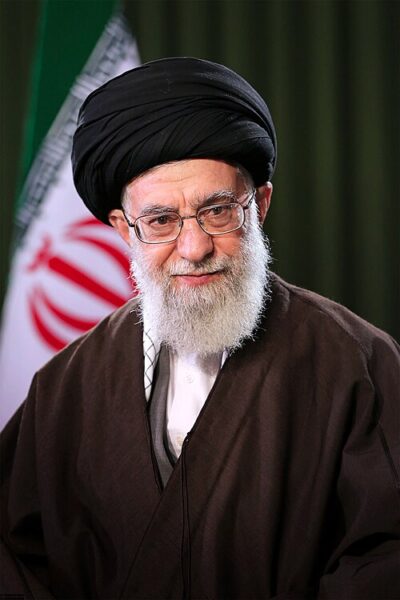
Ali Khamenei
Ali Khamenei was a Supreme Leader of Iran from 1989 to 2026. Born April 19, 1939, in Mashhad. Died February 28, 2026, in Tehran. Positions held include Supreme Leader of Iran (1989–2026), Member of the Islamic Consultative Assembly (1980–1981) and President of Iran (1981–1989). Known for An Outline of Islamic Thought in the Quran, Four main books of Biographical-Evaluation and A 250 Years Old Person. Educated at Qom Hawza and Najaf Seminary.
Facts
51 facts · 2 confirmed by two sources · 9 cited · 40 from one source
Where this comes from
Papalocal keeps its own record. It started from these sources; what each one said is kept here as it was copied, so a change on their side never changes this page by itself. Tap one to read its version.
What Wikidata says · copied November 16, 2026 · revision 2567401611
- Described as
- Supreme Leader of Iran from 1989 to 2026
- Other names
- Ali Hosseini Khamenei, Ayatollah Khamenei, Ayatollah Ali Khamenei, Əli Xamenei
- Born
- April 19, 1939 · 4 references
- Died
- February 28, 2026 · 6 references
- Born in
- Mashhad · 2 references
- Died in
- Tehran · 2 references
- Buried in
- Imam Reza Shrine
- Cause of death
- airstrike · 1 reference
- Citizen of
- Pahlavi Iran (–1979); Iran (1979)
- Occupation
- Islamic jurist; politician · 2 references; translator; writer; poet; cleric · 1 reference
- Positions held
- Supreme Leader of Iran (1989–2026) · 1 reference; Member of the Islamic Consultative Assembly (1980–1981); President of Iran (1981–1989); Commander-in-Chief of the Iranian Armed Forces (1989–2026); Chairman of the Expediency Discernment Council (1988–1989) · 1 reference; Member of the Assembly of Experts (1983–1989); Tehran's Friday Prayer Imam (1980–2026) · 1 reference; Commander-in-Chief of the Islamic Revolutionary Guard Corps (1979–1980); Deputy Minister of Defence and Armed Forces Logistics of Iran (1979–1980); commanding officer
- Political party
- Combatant Clergy Association; Islamic Republican Party (1979–1987); independent politician (1989–) · 1 reference
- Education
- Qom Hawza; Najaf Seminary; Hawza ‘Ilmiyya Khorasan
- Known for
- An Outline of Islamic Thought in the Quran; Four main books of Biographical-Evaluation; A 250 Years Old Person
- Spouse
- Mansoureh Khojaste Bagherzadeh (1964–2026)
- Children
- Mojtaba Khamenei · 1 reference; Mostafa Khamenei; Masoud Khamenei; Meysam Khamenei; Boshra Khamenei; Hoda Khamenei
- Father
- Javad Khamenei
- Mother
- Khadija Mirdamadi
- Siblings
- Hadi Khamenei; Mohammad Khamenei · 1 reference; Badri Khamenei
- Religion
- Islam; Shia Islam · 1 reference
- Military branch
- Islamic Revolutionary Guard Corps; Irregular Warfare Headquarters
- Lived in
- Office of the Supreme Leader of Iran
- Website
- https://khamenei.ir
- Wikipedias with a page
- 162
Wikidata item Q57336 (wikidata.org/wiki/Q57336), public domain (CC0). Copied November 16, 2026.
What Wikipedia says · copied November 16, 2026 · revision 1384758430
Ali Hosseini Khamenei (19 April 1939 – 28 February 2026) was an Iranian politician and Shia cleric who served as the supreme leader of Iran from 1989 until his assassination by Israeli airstrikes in 2026. The patriarch of the Khamenei family prior to his death, Khamenei had previously served as the president of Iran from 1981 to 1989. His 36-year tenure makes him Iran's longest-serving supreme leader.
Born in Mashhad to the Khamenei family, he studied at a hawza there before settling in Qom in 1958, where he attended the classes of Ruhollah Khomeini. Khamenei became involved in opposition to Mohammad Reza Pahlavi, and was arrested six times before being exiled for three years by the Pahlavi government. Khamenei was a mainstream figure in the Iranian Revolution, and upon its success, held many posts in the newly established Islamic republic. In the aftermath of the revolution, he was the target of an attempted assassination that paralysed his right arm. Khamenei served as the third president of Iran from 1981 to 1989 during the Iran–Iraq War, when he also developed close ties to the Islamic Revolutionary Guard Corps (IRGC). After the death of Ruhollah Khomeini in 1989, Khamenei was elected supreme leader by the Assembly of Experts. During the deliberations, Khamenei expressed reservations about his own religious qualifications and suitability for the position, as he was a mid-ranking cleric and did not meet the constitutional requirement of marja'. The constitution was subsequently amended to remove that requirement, and the Assembly reconfirmed his leadership later that year.
As supreme leader, Khamenei supported Iran's nuclear program for civilian use while issuing a fatwa forbidding the production of weapons of mass destruction. In 2015, Khamenei endorsed the Iran nuclear deal, which restricted Iran's nuclear activities in exchange for sanctions relief, but the agreement unraveled after the United States withdrew from it in 2018. He favoured economic privatization of Iranian state-owned industries and, using its oil and gas reserves, transformed Iran into an "energy superpower". His foreign policy centered on Shia Islamism and exporting the Islamic Revolution. Khamenei played a pivotal role in shaping Iran's military and paramilitary apparatus following the 1979 Islamic Revolution, especially the IRGC, transforming it into a primary tool for domestic control and regional influence, in turn making Iran a regional power. Under Khamenei, Iran supported the Axis of Resistance coalition in the Syrian civil war, the War in Iraq, the Yemeni civil war, and the Gaza war, as well as Russia during the Russo-Ukrainian war. A staunch critic of Israel and of Zionism, Khamenei supported the Palestinians in the Israeli–Palestinian conflict; his rhetoric included calls for Israel's destruction and antisemitic tropes. Under Khamenei, Iran was involved in proxy wars with Israel and Saudi Arabia. In 2025 and 2026, tensions with Israel and the United States escalated into the Twelve-Day War and an ongoing conflict, during the latter of which Khamenei was assassinated. The Assembly of Experts elected his son Mojtaba as successor on 8 March. Khamenei's state funeral took place from 3 July to 9 July and drew millions from across Iran.
His decades in power were marked by the development of a strong personality cult, which he actively promoted, as well as by his ability to appoint loyalists to key positions across Iran's political and state institutions. His authority was highly centralized, with loyalty to him expected from senior officials. During his tenure, Iran's economy experienced periods of stagnation and decline, while substantial financial resources were allocated to the country's nuclear program. The program contributed to tensions with Western powers and eventually resulted in international sanctions that placed significant pressure on Iran's economy.
Identified as a pragmatic hardliner, Khamenei sidelined leftist factions, moderate clerics, and political dissidents, while occasionally easing restrictions when the regime's stability or legitimacy had been threatened. His leadership was closely associated with the expansion of state militarization and the consolidation of power within the office of the supreme leader. His critics characterized him as an authoritarian responsible for political repression, state-sanctioned violence, and other injustices. Journalists, activists, and other individuals were persecuted for actions including insulting the supreme leader, sometimes alongside blasphemy charges, with penalties ranging from imprisonment to corporal punishment. There were numerous major protests under his rule, including in 1999, 2009, 2017–2018, 2018–2019, 2022–2023, and 2025–2026.
- Born, in its opening lines
- April 19, 1939
- Died, in its opening lines
- February 28, 2026
From the Wikipedia article “Ali Khamenei” (en.wikipedia.org/wiki/Ali_Khamenei), by its contributors, under CC BY-SA 4.0 (creativecommons.org/licenses/by-sa/4.0/). Copied November 16, 2026; not changed.
Confirmed Two sources agree. Cited One source, and it names where it got it. One source One source, without a reference of its own. Sources disagree The sources disagree. We show the best-supported value and keep theirs below.
