
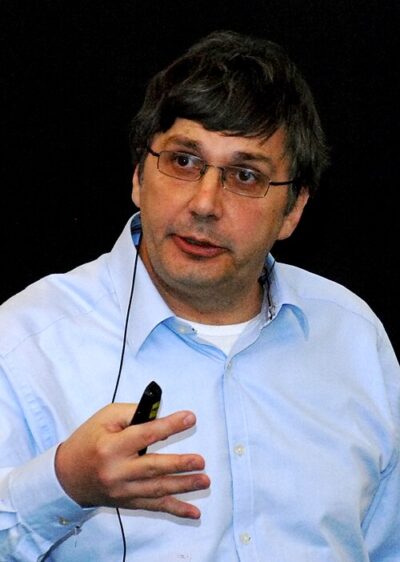
Andre Geim
Andre Geim is a Russian-born Dutch-British physicist. Born October 21, 1958, in Sochi. Positions held include Langworthy Professor (2007–2013) and Regius Professor of Physics (2013–). Educated at MIPT Department of General and Applied Physics and University of Manchester. Awards include Nobel Prize in Physics, Ig Nobel Prize and Fellow of the Royal Society.
Facts
40 facts · 1 confirmed by two sources · 19 cited · 20 from one source
Where this comes from
Papalocal keeps its own record. It started from these sources; what each one said is kept here as it was copied, so a change on their side never changes this page by itself. Tap one to read its version.
What Wikidata says · copied November 16, 2026 · revision 2569595942
- Described as
- Russian-born Dutch-British physicist
- Other names
- Andrey Geim, Andrey K. Geim, Andre Konstantin Geim, Andre K. Geim, Sir Andre Konstantin Geim, A Geim, A. Geim, Andre K Geim, A K Geim, AK Geim, A. K. Geim, A.K. Geim
- Born
- October 21, 1958 · 5 references
- Born in
- Sochi · 4 references
- Citizen of
- Soviet Union (–1991); Kingdom of the Netherlands (–2025); United Kingdom · 2 references
- Occupation
- physicist · 3 references; inventor; professor · 2 references; scientist · 2 references
- Positions held
- Langworthy Professor (2007–2013) · 1 reference; Regius Professor of Physics (2013–)
- Worked for
- University of Manchester; Institute of Solid State Physics; Radboud University (1994); University of Hong Kong (2026–)
- Education
- MIPT Department of General and Applied Physics; University of Manchester; Moscow Institute of Physics and Technology · 1 reference
- Member of
- Royal Society of London (2007–) · 1 reference; National Academy of Sciences (2012–) · 1 reference; Chinese Academy of Sciences (2017–) · 1 reference
- Awards
- Nobel Prize in Physics (2010) · 2 references; Ig Nobel Prize (2000) · 1 reference; Fellow of the Royal Society (2007) · 1 reference; Copley Medal (2013) · 1 reference; John J. Carty Award for the Advancement of Science (2010) · 1 reference; Körber European Science Prize (2009) · 1 reference; Hughes Medal (2010) · 1 reference; Knight Bachelor (2011) · 1 reference; EPS Europhysics Prize; Nevill Mott Medal and Prize (2007) · 1 reference; Honorary Fellow of the Institute of Physics; Commander of the Order of the Netherlands Lion · 1 reference; Carbon Medal (2016) · 1 reference; Clarivate Citation Laureates (2008) · 1 reference; honorary doctor of the University of Antwerp (2010) · 1 reference
- Field
- solid-state physics; nanotechnology
- Spouse
- Irina Grigorieva
- Lived in
- Manchester
- Wikipedias with a page
- 72
Wikidata item Q104104 (wikidata.org/wiki/Q104104), public domain (CC0). Copied November 16, 2026.
What Wikipedia says · copied November 16, 2026 · revision 1381912587
Sir Andre Konstantin Geim (Russian: Андре́й Константи́нович Гейм; born 21 October 1958) is a Russian-born British-Dutch physicist. Geim was appointed as a chair professor at the University of Hong Kong and assumed his tenure in 2026.
Geim was awarded the 2010 Nobel Prize in Physics jointly with Konstantin Novoselov for his work on graphene. At that time he was a Dutch citizen. He later became a British citizen to accept a knighthood and considered himself Dutch-British.
Previously he was working in England in the School of Physics and Astronomy at the University of Manchester. Geim has been Regius Professor of Physics and Royal Society Research Professor at the National Graphene Institute.
He was also previously awarded an Ig Nobel Prize in 2000 for levitating a frog using its intrinsic magnetism. He is the first and only individual, as of 2026, to have received both Nobel and Ig Nobel prizes, for which he holds a Guinness World Record.
- Born, in its opening lines
- October 21, 1958
From the Wikipedia article “Andre Geim” (en.wikipedia.org/wiki/Andre_Geim), by its contributors, under CC BY-SA 4.0 (creativecommons.org/licenses/by-sa/4.0/). Copied November 16, 2026; not changed.
Confirmed Two sources agree. Cited One source, and it names where it got it. One source One source, without a reference of its own. Sources disagree The sources disagree. We show the best-supported value and keep theirs below.
