
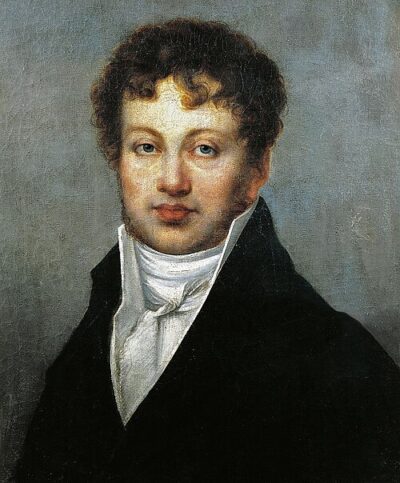
André-Marie Ampère
André-Marie Ampère was a French physicist and mathematician. Born January 20, 1775, in Lyon. Died June 10, 1836, in Armenia. Known for Ampère's circuital law, Ampère's force law and Monge–Ampère equation. Awards include Knight of the Legion of Honour, Foreign Member of the Royal Society and 72 names on the Eiffel Tower.
Facts
39 facts · 2 confirmed by two sources · 22 cited · 15 from one source
Where this comes from
Papalocal keeps its own record. It started from these sources; what each one said is kept here as it was copied, so a change on their side never changes this page by itself. Tap one to read its version.
What Wikidata says · copied November 16, 2026 · revision 2568199148
- Described as
- French physicist and mathematician (1775–1836)
- Other names
- André Marie Ampère, Andre-Marie Ampere, Andre Marie Ampere, Ampère, Ampere
- Born
- January 20, 1775 · 16 references
- Died
- June 10, 1836 · 14 references
- Born in
- Lyon · 4 references
- Died in
- Armenia · 4 references
- Buried in
- Montmartre Cemetery · 1 reference
- Citizen of
- France · 1 reference
- Occupation
- physicist · 3 references; mathematician · 3 references; engineer; philosopher · 1 reference; chemist · 1 reference; inventor; university teacher · 1 reference
- Worked for
- École polytechnique (1804–1828) · 1 reference; Collège de France (1824–1836) · 1 reference; Lycée Lalande (1802–1803) · 1 reference; Collège-lycée Ampère (1803–1804) · 1 reference
- Member of
- Royal Society of London (1827–) · 1 reference; Société Philomathique de Paris; French Academy of Sciences (1814–); Saint Petersburg Academy of Sciences (1827–); Royal Society of Edinburgh (1822–) · 1 reference; Russian Academy of Sciences; Royal Prussian Academy of Sciences (1827–) · 1 reference; Accademia Nazionale delle Scienze detta dei XL; Royal Academy of Science, Letters and Fine Arts of Belgium (1825–); Royal Swedish Academy of Sciences (1828–)
- Known for
- Ampère's circuital law · 1 reference; Ampère's force law; Monge–Ampère equation; Memoir on the Mathematical Theory of Electrodynamic Phenomena, Uniquely Deduced from Experience
- Awards
- Knight of the Legion of Honour (1814) · 1 reference; Foreign Member of the Royal Society (1827) · 1 reference; 72 names on the Eiffel Tower · 1 reference; honorary member of the Physics Association (Frankfurt am Main, Germany) (1835) · 1 reference
- Field
- electromagnetism · 1 reference
- Spouse
- Julie Carron (1799–1803) · 2 references
- Children
- Jean-Jacques Ampère
- Mother
- Jeanne Antoinette Desarcey
- Wikipedias with a page
- 120
Wikidata item Q675 (wikidata.org/wiki/Q675), public domain (CC0). Copied November 16, 2026.
What Wikipedia says · copied November 16, 2026 · revision 1382816437
André-Marie Ampère (20 January 1775 – 10 June 1836) was a French physicist and mathematician who was one of the founders of the science of classical electromagnetism, which he referred to as electrodynamics. He also made important contributions in chemistry and philosophy. He is also the inventor of numerous applications, such as the solenoid (a term coined by him) and the electrical telegraph. As an autodidact, Ampère was a member of the French Academy of Sciences and professor at the École polytechnique and the Collège de France.
The SI unit of electric current, the ampere (A), is named after him. His name is also one of the 72 names inscribed on the Eiffel Tower. The term kinematic is the English version of his cinématique, which he constructed from the Greek κίνημα kinema ("movement, motion"), itself derived from κινεῖν kinein ("to move").
- Born, in its opening lines
- January 20, 1775
- Died, in its opening lines
- June 10, 1836
From the Wikipedia article “André-Marie Ampère” (en.wikipedia.org/wiki/André-Marie_Ampère), by its contributors, under CC BY-SA 4.0 (creativecommons.org/licenses/by-sa/4.0/). Copied November 16, 2026; not changed.
Confirmed Two sources agree. Cited One source, and it names where it got it. One source One source, without a reference of its own. Sources disagree The sources disagree. We show the best-supported value and keep theirs below.
