
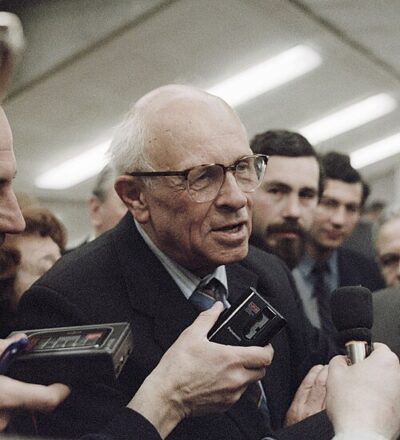
Andrei Sakharov
Andrei Sakharov was a Soviet nuclear physicist and human rights activist. Born May 21, 1921, in Moscow. Died December 14, 1989, in Moscow. Positions held include people's deputy of union of socialist soviet republics. Educated at MSU Faculty of Physics. Awards include Stalin Prize, Nobel Peace Prize and Order of Lenin.
Facts
42 facts · 2 confirmed by two sources · 12 cited · 28 from one source
Where this comes from
Papalocal keeps its own record. It started from these sources; what each one said is kept here as it was copied, so a change on their side never changes this page by itself. Tap one to read its version.
What Wikidata says · copied November 16, 2026 · revision 2570049898
- Described as
- Soviet nuclear physicist and human rights activist (1921–1989)
- Other names
- AndAndrei D. Sakharovrei Dmitrievich Sakharov, Andrei Dmitrievich Sakharov
- Born
- May 21, 1921 · 9 references
- Died
- December 14, 1989 · 10 references
- Born in
- Moscow · 3 references
- Died in
- Moscow · 2 references
- Buried in
- Vostryakovo Cemetery
- Cause of death
- myocardial infarction
- Citizen of
- Soviet Union (1922–); Russian Socialist Federative Soviet Republic (–1922)
- Occupation
- physicist · 2 references; human rights defender · 1 reference; nuclear physicist · 1 reference; politician · 1 reference
- Positions held
- people's deputy of union of socialist soviet republics
- Worked for
- Lebedev Physical Institute (2 times) (1947–) · 1 reference
- Education
- MSU Faculty of Physics (1938–1942)
- Member of
- National Academy of Sciences (1973–) · 1 reference; Russian Academy of Sciences; Academy of Sciences of the USSR (1953–) · 1 reference; French Academy of Sciences; American Academy of Arts and Sciences; American Philosophical Society (1978–) · 1 reference
- Awards
- Stalin Prize (1953); Nobel Peace Prize (1975) · 3 references; Order of Lenin (1956); Hero of Socialist Labour (3 times) (1953, 1955, 1962); Fritt Ord Award (1980); Humanist of the Year (1980); Elliott Cresson Medal (1985) · 1 reference; Akademiepenning (1989); Heinz R. Pagels Human Rights of Scientists Award (1979); Lenin Prize (1956); Prix mondial Cino Del Duca (1974) · 1 reference; Medal "For the Development of Virgin Lands"; Medal "Veteran of Labour"; Medal "For Valiant Labour in the Great Patriotic War 1941–1945"; Dr. Tomalla Prize (1984)
- Field
- physics · 1 reference
- Spouse
- Yelena Bonner (1972–1989)
- Father
- Dmitri Ivanovich Sakharov
- Mother
- Yekaterina Sakharova
- Religion
- atheism
- Website
- https://www.sakharov.space/ · 1 reference
- Wikipedias with a page
- 114
Wikidata item Q997 (wikidata.org/wiki/Q997), public domain (CC0). Copied November 16, 2026.
What Wikipedia says · copied November 16, 2026 · revision 1384666201
Andrei Dmitrievich Sakharov (Russian: Андрей Дмитриевич Сахаров; 21 May 1921 – 14 December 1989) was a Soviet physicist and a Nobel Peace Prize laureate, which he was awarded in 1975 for emphasizing human rights around the world.
Although he spent his career in physics in the Soviet program of nuclear weapons, overseeing the development of thermonuclear weapons, Sakharov also did fundamental work in understanding particle physics, magnetism, and physical cosmology. Sakharov is mostly known for his political activism for individual freedom, human rights, civil liberties and reforms in the Soviet Union, for which he was deemed a dissident and faced persecution from the Soviet establishment.
In his memory, the Sakharov Prize was established and is awarded annually by the European Parliament for people and organizations dedicated to human rights and freedoms.
- Born, in its opening lines
- May 21, 1921
- Died, in its opening lines
- December 14, 1989
From the Wikipedia article “Andrei Sakharov” (en.wikipedia.org/wiki/Andrei_Sakharov), by its contributors, under CC BY-SA 4.0 (creativecommons.org/licenses/by-sa/4.0/). Copied November 16, 2026; not changed.
Confirmed Two sources agree. Cited One source, and it names where it got it. One source One source, without a reference of its own. Sources disagree The sources disagree. We show the best-supported value and keep theirs below.
