
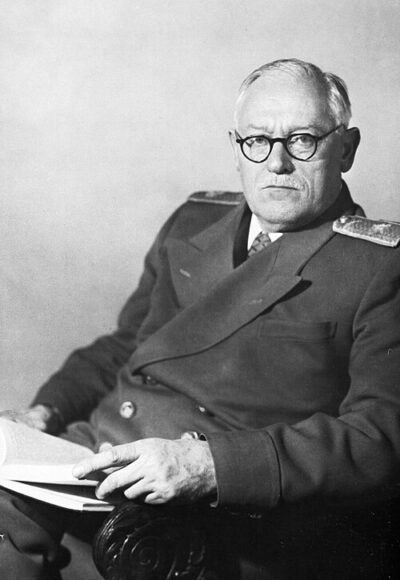
Andrey Vyshinsky
Andrey Vyshinsky was a Soviet politician, jurist and diplomat. Born November 28, 1883, in Odesa. Died November 22, 1954, in New York City. Positions held include Minister of Foreign Affairs of USSR (1949–1953), Procurator General of the Soviet Union (1935–1939) and ambassador. Educated at Imperial University of St. Vladimir. Awards include Medal "For the Defence of Moscow", Medal "For Valiant Labour in the Great Patriotic War 1941–1945" and Order of the Red Banner of Labour.
Facts
36 facts · 1 confirmed by two sources · 4 cited · 30 from one source · 1 where the sources disagree
What’s different
- Born: we show November 28, 1883 (Sources disagree). Wikipedia says December 10, 1883
Where this comes from
Papalocal keeps its own record. It started from these sources; what each one said is kept here as it was copied, so a change on their side never changes this page by itself. Tap one to read its version.
What Wikidata says · copied November 16, 2026 · revision 2562708663
- Described as
- Soviet politician, jurist and diplomat (1883-1954)
- Other names
- Andrey Yanuaryevich Vyshinsky, Andrei Yanuaryevich Vyshinsky
- Born
- November 28, 1883 · 3 references
- Died
- November 22, 1954 · 8 references
- Born in
- Odesa · 2 references
- Died in
- New York City · 3 references
- Buried in
- Kremlin Wall Necropolis
- Cause of death
- myocardial infarction
- Citizen of
- Soviet Union
- Occupation
- jurist · 1 reference; diplomat; politician · 2 references; university teacher; lawyer; revolutionary · 1 reference; prosecutor · 1 reference; scientist · 1 reference
- Positions held
- Minister of Foreign Affairs of USSR (1949–1953); Procurator General of the Soviet Union (1935–1939); ambassador; Deputy Chairman of the Council of People's Commissars (1939–1944); Permanent Representative of the USSR to the United Nations and to the UN Security Council (1953–1954)
- Political party
- Communist Party of the Soviet Union (1920–1954) · 1 reference; Russian Social Democratic Labour Party; Mensheviks (1903–1920) · 1 reference
- Worked for
- Lomonosov Moscow State University
- Education
- Imperial University of St. Vladimir
- Member of
- Russian Academy of Sciences (1939–) · 1 reference; Central Executive Committee of the Soviet Union; Academy of Sciences of the USSR · 1 reference
- Awards
- Medal "For the Defence of Moscow"; Medal "For Valiant Labour in the Great Patriotic War 1941–1945"; Order of the Red Banner of Labour (1933); Medal "For the Victory over Germany in the Great Patriotic War 1941–1945"; Order of Lenin (5 times) (1937, 1943, 1945, 1947, 1953); Medal "In Commemoration of the 800th Anniversary of Moscow" · 1 reference; State Stalin Prize, 1st degree (1947) · 1 reference
- Field
- jurisprudence
- Wikipedias with a page
- 48
Wikidata item Q155860 (wikidata.org/wiki/Q155860), public domain (CC0). Copied November 16, 2026.
What Wikipedia says · copied November 16, 2026 · revision 1380113861
Andrey Yanuaryevich Vyshinsky (Russian: Андре́й Януа́рьевич Выши́нский; Polish: Andrzej Wyszyński) (10 December [O.S. 28 November] 1883 – 22 November 1954) was a Soviet politician, jurist and diplomat. He is best known as a state prosecutor of Joseph Stalin's Moscow Trials and in the Nuremberg trials. He was the Soviet Foreign Minister from 1949 to 1953, after having served as Deputy Foreign Minister under Vyacheslav Molotov since 1940. He also headed the Institute of State and Law in the Academy of Sciences of the Soviet Union.
- Born, in its opening lines
- December 10, 1883
- Died, in its opening lines
- November 22, 1954
From the Wikipedia article “Andrey Vyshinsky” (en.wikipedia.org/wiki/Andrey_Vyshinsky), by its contributors, under CC BY-SA 4.0 (creativecommons.org/licenses/by-sa/4.0/). Copied November 16, 2026; not changed.
Confirmed Two sources agree. Cited One source, and it names where it got it. One source One source, without a reference of its own. Sources disagree The sources disagree. We show the best-supported value and keep theirs below.
