
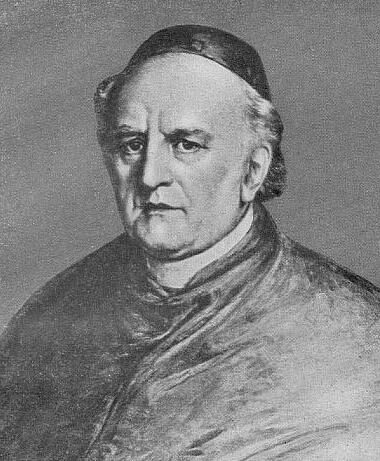
Angelo Mai
Angelo Mai was an Italian cardinal and philologist. Born March 7, 1782, in Schilpario. Died September 8, 1854, in Albano Laziale. Positions held include cardinal (1837–) and Prefect of the Vatican Library. Known for M. Tulli Ciceronis De re publica quae supersunt and Eusebii Pamphili Chronicorum canonum libri duo. Educated at Pontifical Gregorian University.
Facts
31 facts · 2 confirmed by two sources · 15 cited · 14 from one source
Where this comes from
Papalocal keeps its own record. It started from these sources; what each one said is kept here as it was copied, so a change on their side never changes this page by itself. Tap one to read its version.
What Wikidata says · copied November 18, 2026 · revision 2556799602
- Described as
- Italian cardinal and philologist (1782–1854)
- Other names
- Angelo Maj, Angelo Maï
- Born
- March 7, 1782 · 7 references
- Died
- September 8, 1854 · 3 references
- Born in
- Schilpario · 3 references
- Died in
- Albano Laziale · 1 reference
- Citizen of
- Republic of Venice
- Occupation
- Catholic priest (1808–) · 1 reference; mythographer; classical philologist · 2 references; librarian · 1 reference; latinist · 1 reference; theologian · 1 reference; philologist · 1 reference; Catholic bishop
- Positions held
- cardinal (1837–) · 2 references; Prefect of the Vatican Library
- Education
- Pontifical Gregorian University
- Member of
- Royal Prussian Academy of Sciences; Bavarian Academy of Sciences and Humanities; Saint Petersburg Academy of Sciences; Académie des Inscriptions et Belles-Lettres (1842–1854) · 1 reference; Russian Academy of Sciences; Royal Swedish Academy of Letters, History and Antiquities; Royal Netherlands Academy of Arts and Sciences · 1 reference; Academy of Sciences of Turin (1823–) · 1 reference; Accademia della Crusca
- Known for
- M. Tulli Ciceronis De re publica quae supersunt; Eusebii Pamphili Chronicorum canonum libri duo
- Field
- classical philology · 1 reference; library science · 1 reference; philology · 1 reference
- Religion
- Catholic Church · 1 reference
- Wikipedias with a page
- 20
Wikidata item Q304825 (wikidata.org/wiki/Q304825), public domain (CC0). Copied November 18, 2026.
What Wikipedia says · copied November 18, 2026 · revision 1379728493
Angelo Mai (Latin Angelus Maius; 7 March 1782 – 8 September 1854) was an Italian Cardinal and philologist. He won a European reputation for publishing for the first time a series of previously unknown ancient texts. These he was able to discover and publish, first while in charge of the Ambrosian Library in Milan and then in the same role at the Vatican Library. The texts were often in parchment manuscripts that had been washed off and reused; he was able to read the lower text using chemicals. In particular he was able to locate a substantial portion of the much sought-after De re publica of Cicero and the complete works of Virgilius Maro Grammaticus.
In 1954, to celebrate the first century after his death, the public library of Bergamo, the city where he was from, was named after him Biblioteca civica Angelo Mai e archivi storici.
- Born, in its opening lines
- March 7, 1782
- Died, in its opening lines
- September 8, 1854
From the Wikipedia article “Angelo Mai” (en.wikipedia.org/wiki/Angelo_Mai), by its contributors, under CC BY-SA 4.0 (creativecommons.org/licenses/by-sa/4.0/). Copied November 18, 2026; not changed.
Confirmed Two sources agree. Cited One source, and it names where it got it. One source One source, without a reference of its own. Sources disagree The sources disagree. We show the best-supported value and keep theirs below.
