
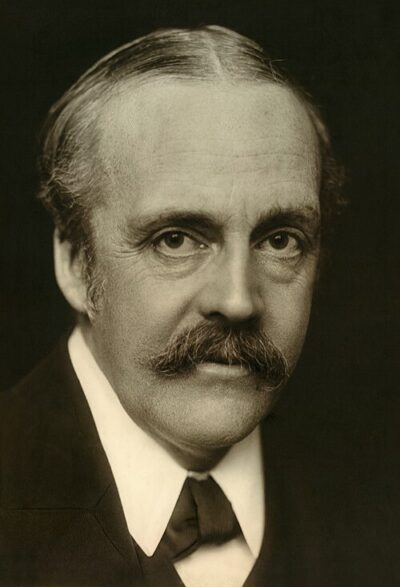
Arthur Balfour
Arthur Balfour was a British Prime Minister, Conservative politician, and statesman. Born July 25, 1848, in Whittingehame. Died March 19, 1930, in Woking. Positions held include Prime Minister of the United Kingdom (1902–1905), Lord President of the Council (1925–1929) and Secretary of State for Foreign and Commonwealth Affairs (1916–1919). Educated at Trinity College and Eton College. Awards include Fellow of the Royal Society, Fellow of the British Academy and Fellow of the American Academy of Arts and Sciences.
Facts
46 facts · 2 confirmed by two sources · 22 cited · 22 from one source
Where this comes from
Papalocal keeps its own record. It started from these sources; what each one said is kept here as it was copied, so a change on their side never changes this page by itself. Tap one to read its version.
What Wikidata says · copied November 16, 2026 · revision 2568806112
- Described as
- British Prime Minister, Conservative politician, and statesman (1848-1930)
- Other names
- Viscount Traprain of Whittingehame, A. J. Balfour, Arthur James, Earl of Balfour, Arthur James Balfour, first earl of Balfour, 1st Earl of Balfour
- Born
- July 25, 1848 · 13 references
- Died
- March 19, 1930 · 12 references
- Born in
- Whittingehame · 4 references
- Died in
- Woking · 1 reference
- Buried in
- Parish Church, Whittingehame
- Citizen of
- United Kingdom (1927–); United Kingdom of Great Britain and Ireland (–1927)
- Occupation
- politician · 2 references; writer · 1 reference; philosopher; head of government · 1 reference
- Positions held
- Prime Minister of the United Kingdom (1902–1905); Lord President of the Council (1925–1929); Secretary of State for Foreign and Commonwealth Affairs (1916–1919); member of the House of Lords (1922–1930); Lord Privy Seal (1902–1903); Leader of the Conservative Party (1902–1911); Chief Secretary for Ireland (1887–1891) · 1 reference; Secretary of State for Scotland (1886–1887); Member of the Privy Council of Ireland (1887–) · 1 reference; Member of the Privy Council of the United Kingdom (1885–) · 1 reference; member of the 31st Parliament of the United Kingdom (1918–1922) · 1 reference; member of the 30th Parliament of the United Kingdom (1910–1918) · 1 reference; member of the 29th Parliament of the United Kingdom (1910) · 1 reference; member of the 28th Parliament of the United Kingdom (1906–1910) · 1 reference; member of the 27th Parliament of the United Kingdom (1900–1906) · 1 reference
- Political party
- Conservative Party
- Education
- Trinity College · 1 reference; Eton College
- Member of
- Royal Society of London (1888–); American Academy of Arts and Sciences
- Awards
- Fellow of the Royal Society; Fellow of the British Academy; Fellow of the American Academy of Arts and Sciences; Knight of the Garter · 1 reference; Order of Merit (1916) · 1 reference; Cross of Liberty 1st Division, 3rd Class (1925) · 1 reference
- Father
- James Maitland Balfour · 1 reference
- Mother
- Lady Blanche Gascoyne-Cecil · 2 references
- Siblings
- Eleanor Mildred Sidgwick · 1 reference; Gerald Balfour, 2nd Earl of Balfour · 1 reference; Evelyn Strutt, Baroness Rayleigh of Terling Place · 1 reference; Alice Blanche Balfour · 1 reference; Eustace Balfour · 1 reference; Francis Maitland Balfour · 1 reference
- Religion
- Presbyterianism
- Wikipedias with a page
- 90
Wikidata item Q19008 (wikidata.org/wiki/Q19008), public domain (CC0). Copied November 16, 2026.
What Wikipedia says · copied November 16, 2026 · revision 1383467514
Arthur James Balfour, 1st Earl of Balfour (; 25 July 1848 – 19 March 1930), was a British Conservative statesman who served as Prime Minister of the United Kingdom from 1902 to 1905. He also later served as foreign secretary in the Lloyd George ministry, from 1916 to 1919.
Balfour trained as a philosopher – he originated an argument against believing that human reason could determine truth – and was seen as having a detached attitude to life. Entering Parliament in 1874, Balfour achieved prominence as Chief Secretary for Ireland, in which position he suppressed agrarian unrest whilst taking measures against absentee landlords. He opposed Irish Home Rule, saying there could be no half-way house between Ireland remaining within the United Kingdom or becoming independent. From 1891 he led the Conservative Party in the House of Commons, serving under his uncle, Lord Salisbury, whose government won large majorities in 1895 and 1900. An esteemed debater, he was bored by the mundane tasks of party management.
In July 1902, he succeeded his uncle as prime minister. In domestic policy he passed the Land Purchase (Ireland) Act 1903, which bought out most of the Anglo-Irish landowners. The Education Act 1902 had a major long-term impact in modernising the school system in England and Wales and provided financial support for schools operated by the Church of England and by the Catholic Church. Nonconformists were outraged and mobilised their voters, but were unable to reverse it. In foreign and defence policy, he oversaw reform of British defence policy and supported Jackie Fisher's naval innovations. He secured the Entente Cordiale with France, an agreement that paved the way for improved relations between the two states. He cautiously embraced imperial preference as championed by Joseph Chamberlain, but resignations from the Cabinet over the abandonment of free trade left his party divided. He also suffered from public anger at the later stages of the Boer War (counter-insurgency warfare characterised as "methods of barbarism") and the importation of Chinese labour to South Africa ("Chinese slavery"). He resigned as prime minister in December 1905 and the following month the Conservatives suffered a landslide defeat at the 1906 election, in which he lost his own seat. He soon re-entered Parliament and continued to serve as Leader of the Opposition throughout the crisis over Lloyd George's 1909 budget, the narrow loss of two further General Elections in 1910, and the passage of the Parliament Act 1911. He resigned as party leader in 1911.
Balfour returned as First Lord of the Admiralty in Asquith's Coalition Government (1915–1916). In December 1916, he became foreign secretary in David Lloyd George's coalition. He was frequently left out of the inner workings of foreign policy, although the Balfour Declaration of 1917 issued on behalf of the cabinet, which supported a "home for the Jewish people" in Palestine, bore his name. Balfour continued to serve in senior positions throughout the 1920s, included Lord President of the Council, during which he issued the Balfour Declaration of 1926, announcing a co-equal relationship between the United Kingdom and its Dominions, thus laying the groundwork for the Statute of Westminster 1931 which granted full independence to the former colonies. Balfour died in 1930, aged 81, having spent a vast inherited fortune. He never married.
- Born, in its opening lines
- July 25, 1848
- Died, in its opening lines
- March 19, 1930
From the Wikipedia article “Arthur Balfour” (en.wikipedia.org/wiki/Arthur_Balfour), by its contributors, under CC BY-SA 4.0 (creativecommons.org/licenses/by-sa/4.0/). Copied November 16, 2026; not changed.
Confirmed Two sources agree. Cited One source, and it names where it got it. One source One source, without a reference of its own. Sources disagree The sources disagree. We show the best-supported value and keep theirs below.
