
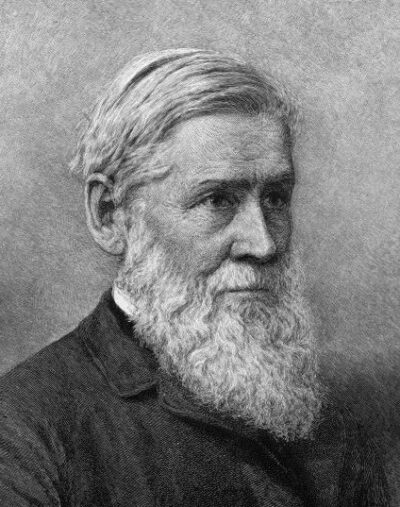
Asa Gray
Asa Gray was an American botanist. Born November 18, 1810, in Paris. Died January 30, 1888, in Cambridge. Positions held include board member (1874–1888). Known for Botany for Young People. Educated at Fairfield Academy. Awards include Fellow of the American Association for the Advancement of Science, Foreign Member of the Royal Society and Fellow of the American Academy of Arts and Sciences.
Facts
33 facts · 2 confirmed by two sources · 9 cited · 22 from one source
Where this comes from
Papalocal keeps its own record. It started from these sources; what each one said is kept here as it was copied, so a change on their side never changes this page by itself. Tap one to read its version.
What Wikidata says · copied November 15, 2026 · revision 2567562985
- Described as
- American botanist (1810–1888)
- Other names
- A.Gray, A. Gray
- Born
- November 18, 1810 · 6 references
- Died
- January 30, 1888 · 5 references
- Born in
- Paris
- Died in
- Cambridge · 1 reference
- Buried in
- Mount Auburn Cemetery · 1 reference
- Citizen of
- United States
- Occupation
- curator; botanist · 1 reference; university teacher; writer · 1 reference; botanical collector · 9 references; scientific collector · 1 reference
- Positions held
- board member (1874–1888)
- Worked for
- Harvard University (1842–); University of Michigan (1838–1840) · 1 reference; United States Exploring Expedition (1836–1838)
- Education
- Fairfield Academy (–1831) · 1 reference
- Member of
- Royal Society of London (1873–); German Academy of Sciences Leopoldina; Royal Swedish Academy of Sciences; Saint Petersburg Academy of Sciences (1862–); American Academy of Arts and Sciences; Royal Prussian Academy of Sciences; Bavarian Academy of Sciences and Humanities; National Academy of Sciences (1863–); Göttingen Academy of Sciences and Humanities in Lower Saxony
- Known for
- Botany for Young People
- Awards
- Fellow of the American Association for the Advancement of Science; Foreign Member of the Royal Society (1873) · 1 reference; Fellow of the American Academy of Arts and Sciences; Honorary Fellow of the Royal Society Te Apārangi (1885–) · 1 reference
- Field
- botany
- Spouse
- Jane Loring Gray
- Wikipedias with a page
- 39
Wikidata item Q347356 (wikidata.org/wiki/Q347356), public domain (CC0). Copied November 15, 2026.
What Wikipedia says · copied November 15, 2026 · revision 1385113115
Asa Gray (November 18, 1810 – January 30, 1888) was an American botanist who was considered the most important American botanist of the 19th century. His Darwiniana (1876) was considered by some as an important explanation of how religion and science were not necessarily mutually exclusive. Gray was adamant that a genetic connection must exist between all members of a species. He was also strongly opposed to the ideas of hybridization within one generation and special creation in the sense of its not allowing for evolution. Gray was a strong supporter of Darwin while at the same time being a proponent of theistic evolution.
As a professor of botany at Harvard University for several decades, Gray regularly visited, and corresponded with, many of the leading natural scientists of the era, including Charles Darwin, who held great regard for him. Gray made several trips to Europe to collaborate with leading European scientists of the era, as well as trips to the southern and western United States. He also built an extensive network of specimen collectors.
A prolific writer, he was instrumental in unifying the taxonomic knowledge of the plants of North America. Of Gray's many works on botany, the most popular was his Manual of the Botany of the Northern United States, from New England to Wisconsin and South to Ohio and Pennsylvania Inclusive, known today simply as Gray's Manual. Gray was the sole author of the first five editions of the book and co-author of the sixth, with botanical illustrations by Isaac Sprague. Further editions have been published, and it remains a standard in the field. Gray also worked extensively on a phenomenon that is now called the Asa Gray disjunction, namely, the surprising morphological similarities between many eastern Asian and eastern North American plants. Several structures, geographic features, and plants have been named after Gray.
In 1848, Gray was elected as a member of the American Philosophical Society.
- Born, in its opening lines
- November 18, 1810
- Died, in its opening lines
- January 30, 1888
From the Wikipedia article “Asa Gray” (en.wikipedia.org/wiki/Asa_Gray), by its contributors, under CC BY-SA 4.0 (creativecommons.org/licenses/by-sa/4.0/). Copied November 15, 2026; not changed.
Confirmed Two sources agree. Cited One source, and it names where it got it. One source One source, without a reference of its own. Sources disagree The sources disagree. We show the best-supported value and keep theirs below.
