
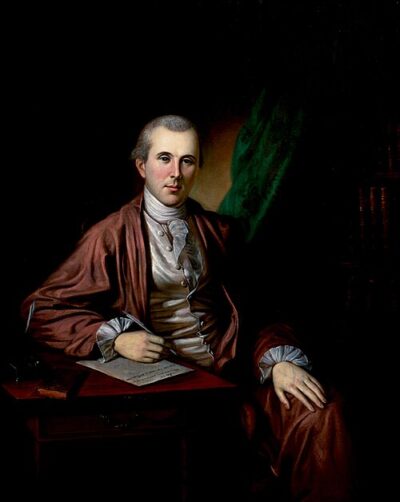
Benjamin Rush
Benjamin Rush was an American physician, educator, and author. Born January 4, 1746, in Byberry. Died April 19, 1813, in Philadelphia. Educated at Princeton University and University of Edinburgh. Awards include Fellow of the American Academy of Arts and Sciences.
Facts
30 facts · 2 confirmed by two sources · 4 cited · 24 from one source
Where this comes from
Papalocal keeps its own record. It started from these sources; what each one said is kept here as it was copied, so a change on their side never changes this page by itself. Tap one to read its version.
What Wikidata says · copied November 13, 2026 · revision 2564367047
- Described as
- American physician, educator, and author (1746-1813)
- Other names
- Dr. Benjamin Rush
- Born
- January 4, 1746 · 4 references
- Died
- April 19, 1813 · 2 references
- Born in
- Byberry
- Died in
- Philadelphia · 1 reference
- Buried in
- Christ Church Burial Ground
- Cause of death
- typhus
- Citizen of
- United States; Kingdom of Great Britain
- Occupation
- chemist; writer; psychiatrist; physician · 1 reference; university teacher; politician · 1 reference
- Worked for
- University of Pennsylvania
- Education
- Princeton University; University of Edinburgh · 1 reference; West Nottingham Academy · 1 reference
- Member of
- American Philosophical Society; Bavarian Academy of Sciences and Humanities; Royal Swedish Academy of Sciences; American Academy of Arts and Sciences; Pennsylvania Abolition Society; German Academy of Sciences Leopoldina; Founding Fathers of the United States · 1 reference
- Awards
- Fellow of the American Academy of Arts and Sciences (1788–)
- Spouse
- Julia Stockton Rush · 1 reference
- Children
- Richard Rush
- Siblings
- Jacob Rush
- Nickname
- Father of American Psychiatry · 1 reference
- Wikipedias with a page
- 40
Wikidata item Q656478 (wikidata.org/wiki/Q656478), public domain (CC0). Copied November 13, 2026.
What Wikipedia says · copied November 13, 2026 · revision 1383126464
Benjamin Rush (January 4, 1746 [O.S. December 24, 1745] – April 19, 1813) was an American revolutionary, a Founding Father of the United States and signatory to the U.S. Declaration of Independence, and a civic leader in Philadelphia, where he was a physician, politician, social reformer, humanitarian, educator, and the founder of Dickinson College. Rush was a Pennsylvania delegate to the Continental Congress. He later described his efforts in support of the American Revolution, saying: "He aimed well." He served as Surgeon General of the Middle Department of the Continental Army and became a professor of chemistry, medical theory, and clinical practice at the University of Pennsylvania.
Rush was a leader of the American Enlightenment and an enthusiastic supporter of the American Revolution. He was a leader in Pennsylvania's ratification of the U.S. Constitution in 1788. He was prominent in many reforms, especially in the areas of medicine and education. He opposed slavery, advocated free public schools, and sought improved, but patriarchal, education for women, and a more enlightened penal system. As a leading physician, Rush had a major impact on the emerging medical profession.
As an Enlightenment intellectual, Rush was committed to organizing all medical knowledge around explanatory theories, rather than relying on empirical methods. Rush argued that illness was the result of imbalances in the body's physical system and was caused by malfunctions in the brain. His approach prepared the way for later medical research, but Rush undertook none of it. He promoted public health by advocating for a clean environment and stressing the importance of personal and military hygiene. His study of mental disorder made him one of the founders of American psychiatry. In 1965, the American Psychiatric Association recognized Rush as the "father of American psychiatry".
- Born, in its opening lines
- January 4, 1746
- Died, in its opening lines
- April 19, 1813
From the Wikipedia article “Benjamin Rush” (en.wikipedia.org/wiki/Benjamin_Rush), by its contributors, under CC BY-SA 4.0 (creativecommons.org/licenses/by-sa/4.0/). Copied November 13, 2026; not changed.
Confirmed Two sources agree. Cited One source, and it names where it got it. One source One source, without a reference of its own. Sources disagree The sources disagree. We show the best-supported value and keep theirs below.
