
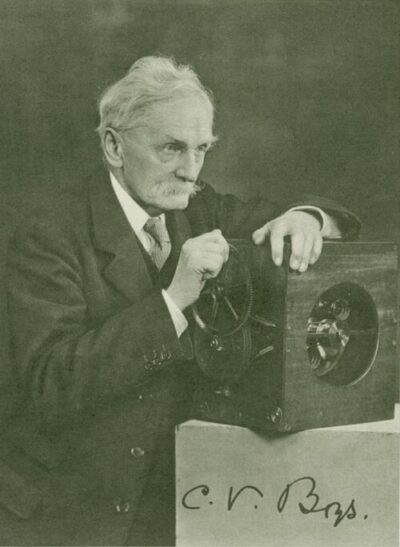
C. V. Boys
C. V. Boys was a British physicist. Born March 15, 1855, in Wing. Died March 30, 1944, in St Mary Bourne. Positions held include chairperson (2 times) (1906–1918). Known for Boys' radiomicrometer, Newtonian gravitational constant and Integraph. Educated at Marlborough College and Royal School of Mines. Awards include Royal Medal, Elliott Cresson Medal and Rumford Medal.
Facts
30 facts · 2 confirmed by two sources · 19 cited · 9 from one source
Where this comes from
Papalocal keeps its own record. It started from these sources; what each one said is kept here as it was copied, so a change on their side never changes this page by itself. Tap one to read its version.
What Wikidata says · copied November 18, 2026 · revision 2568685910
- Described as
- British physicist (1855-1944)
- Other names
- Charles Vernon Boys, Sir Charles Vernon Boys
- Born
- March 15, 1855 · 4 references
- Died
- March 30, 1944 · 7 references
- Born in
- Wing · 1 reference
- Died in
- St Mary Bourne · 1 reference
- Buried in
- Church of St Peter · 1 reference
- Name at birth
- Charles Vernon Boys
- Citizen of
- United Kingdom
- Occupation
- physicist · 1 reference
- Positions held
- chairperson (2 times) (1906–1918) · 1 reference
- Worked for
- Royal School of Mines (1881–1889) · 1 reference; Royal College of Science (1889–1897) · 1 reference; South Metropolitan Gas Company (1897–1939) · 2 references
- Education
- Marlborough College (1869–1873) · 2 references; Royal School of Mines (1873–1876) · 2 references
- Member of
- Royal Society of London
- Known for
- Boys' radiomicrometer; Newtonian gravitational constant; Integraph
- Awards
- Royal Medal (1896) · 1 reference; Elliott Cresson Medal (1939) · 2 references; Rumford Medal (1924) · 2 references; Guthrie Lecture (1934) · 1 reference; Knight Bachelor (1935) · 1 reference; Fellow of the Royal Society (1888) · 1 reference; Dennis Gabor Medal and Prize (1924) · 2 references
- Spouse
- Marion Amelia Pollock (1892–) · 1 reference
- Children
- unknown child Boys · 1 reference
- Father
- Charles Boys · 1 reference
- Mother
- Caroline Goodrich Dobbie · 1 reference
- Lived in
- England · 1 reference
- Wikipedias with a page
- 21
Wikidata item Q1063791 (wikidata.org/wiki/Q1063791), public domain (CC0). Copied November 18, 2026.
What Wikipedia says · copied November 18, 2026 · revision 1371977460
Sir Charles Vernon Boys, FRS (15 March 1855 – 30 March 1944) was a British physicist, known for his careful and innovative experimental work in the fields of thermodynamics and high-speed photography, and as a popular science communicator through his books, inventions, and his public lectures for children.
- Born, in its opening lines
- March 15, 1855
- Died, in its opening lines
- March 30, 1944
From the Wikipedia article “C. V. Boys” (en.wikipedia.org/wiki/C._V._Boys), by its contributors, under CC BY-SA 4.0 (creativecommons.org/licenses/by-sa/4.0/). Copied November 18, 2026; not changed.
Confirmed Two sources agree. Cited One source, and it names where it got it. One source One source, without a reference of its own. Sources disagree The sources disagree. We show the best-supported value and keep theirs below.
