
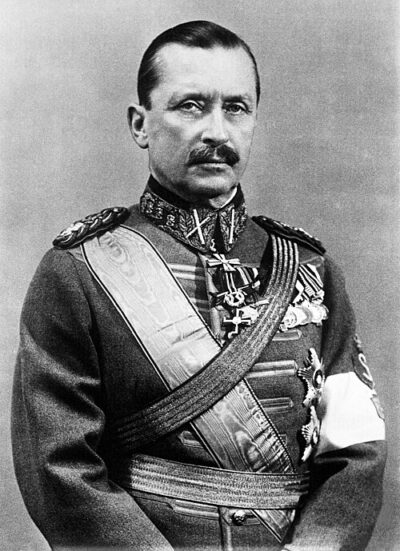
Carl Gustaf Emil Mannerheim
Carl Gustaf Emil Mannerheim was a Finnish military leader and statesman. Born June 4, 1867, in Louhisaari Manor. Died January 27, 1951, in Lausanne. Positions held include President of Finland (1944–1946), Chief of Defence (1939–1945) and Regent of Finland (1918–1919). Educated at Nikolaevskaya Cavalry School and Hamina Cadet School. Awards include Grand Cross of the Legion of Honour, Knight Grand Cross of the Order of the British Empire and Grand Cross of the Order of the Lion of Finland.
Facts
59 facts · 2 confirmed by two sources · 14 cited · 43 from one source
Where this comes from
Papalocal keeps its own record. It started from these sources; what each one said is kept here as it was copied, so a change on their side never changes this page by itself. Tap one to read its version.
What Wikidata says · copied November 16, 2026 · revision 2566609543
- Described as
- Finnish military leader and statesman (1867–1951)
- Other names
- C. G. E. Mannerheim, C. G. Mannerheim, Carl Gustaf Mannerheim, Mannerheim, Gustaf Mannerheim, Baron Carl Gustaf Emil Mannerheim
- Born
- June 4, 1867 · 7 references
- Died
- January 27, 1951 · 6 references
- Born in
- Louhisaari Manor · 1 reference
- Died in
- Lausanne · 4 references
- Buried in
- Hietaniemi cemetery · 1 reference
- Cause of death
- bowel obstruction
- Citizen of
- Russian Empire; Finland (1917–); Grand Duchy of Finland (–1917)
- Occupation
- explorer; politician · 1 reference; military officer; author · 2 references; soldier · 1 reference; Generalfeldmarschall · 1 reference
- Positions held
- President of Finland (1944–1946); Chief of Defence (1939–1945); Regent of Finland (1918–1919); president · 1 reference
- Political party
- independent politician · 1 reference
- Education
- Nikolaevskaya Cavalry School (1887–1889); Hamina Cadet School (1882–1886)
- Member of
- Royal Swedish Academy of War Sciences; Royal Swedish Academy of Sciences; White Guard
- Awards
- Grand Cross of the Legion of Honour (1939) · 1 reference; Knight Grand Cross of the Order of the British Empire; Grand Cross of the Order of the Lion of Finland (1944) · 1 reference; Grand Cross with Collar of the Order of the White Rose of Finland (2 times) (1919, 1944) · 1 reference; Knight's Cross of the Iron Cross (1941) · 1 reference; Order of St. Anna 2nd class with swords (1905) · 1 reference; Order of Saint Stanislaus, 2nd class with swords (1905) · 1 reference; Order of Saint Vladimir 4th class with swords and bow (1905) · 1 reference; Knight of the Order of the Elephant (1919) · 1 reference; Order of the Rising Sun with Paulownia Flowers, 1st class (1942) · 1 reference; Royal Order of the Seraphim (1919) · 1 reference; 1st Class of the Military Order of the Cross of the Eagle (1930) · 1 reference; Grand Cross of the Order of the German Eagle in Gold with Swords (1942) · 2 references; Estonian Red Cross Order First Class (1932) · 1 reference; Order of Saint Anna, 3rd class (1900) · 1 reference
- Spouse
- Anastasia Mannerheim (1892–1919) · 1 reference
- Children
- Sophie Mannerheim; Anastasie Mannerheim
- Father
- Carl Robert Mannerheim
- Mother
- Helene Mannerheim · 1 reference
- Siblings
- Carl Mannerheim; Sophie Mannerheim; Eva Mannerheim-Sparre; Johan Mannerheim
- Religion
- Evangelical Lutheran Church of Finland; Lutheranism
- Military branch
- Imperial Russian Army (1887–1917); Finnish Defence Forces (1917–); White Guard
- Military rank
- field marshal (1933); lieutenant general (1917); General of the Cavalry (1918)
- Lived in
- Mannerheim Museum (1924–1951)
- Website
- https://mannerheim.fi/
- Wikipedias with a page
- 88
Wikidata item Q152306 (wikidata.org/wiki/Q152306), public domain (CC0). Copied November 16, 2026.
What Wikipedia says · copied November 16, 2026 · revision 1384694134
Baron Carl Gustaf Emil Mannerheim (Finland Swedish: [kɑːrl ˈɡʉstɑv ˈeːmil ˈmɑnːærhejm] , 4 June 1867 – 27 January 1951) was a Finnish military commander and statesman. He served as the military leader of the Whites in the Finnish Civil War (1918), as regent of Finland (1918–1919), as commander-in-chief of the Finnish Defence Forces during World War II (1939–1945), and as the president of Finland (1944–1946). He became Finland's only field marshal in 1933 and was appointed honorary Marshal of Finland in 1942.
Born into a Swedish-speaking aristocratic family in the Grand Duchy of Finland, Mannerheim made a career in the Imperial Russian Army, serving in the Russo-Japanese War and the Eastern Front of World War I and rising by 1917 to the rank of lieutenant general. He had a prominent place in the 1896 coronation ceremonies for Emperor Nicholas II and later had several private meetings with him. After the Bolshevik coup of November 1917 in Russia, Finland declared its independence on 6 December, but soon became embroiled in the 1918 Finnish Civil War between the Whites, who were the troops of the Senate of Finland (supported by troops of the German Empire), and the socialist Reds.
A Finnish delegation appointed Mannerheim as the military chief of the Whites in January 1918, and he led them to victory, holding a triumphal victory parade in Helsinki in May. After spending some time abroad, he was invited back to Finland to serve as the country's second regent, or head of state, from December 1918 to July 1919. He secured the recognition of Finnish independence by multiple Entente powers and, despite being a monarchist, formally ratified the republican Constitution of Finland. He then ran against K. J. Ståhlberg in the first Finnish presidential elections in 1919 but lost and quit politics. Mannerheim helped found the Mannerheim League for Child Welfare in 1920 and headed the Finnish Red Cross from 1922 to his death. He was restored to a central role in national defence policy when President Svinhufvud appointed him as the Chairman of the Finnish Defence Council in 1931, tasked with making preparations for a potential war with the Soviet Union. It was also agreed that he would temporarily take over as commander-in-chief of the country's armed forces in the event of a war.
Accordingly, after the Soviet Union invaded Finland in November 1939 in what became the Winter War, Mannerheim replaced President Kyösti Kallio as commander-in-chief, and occupied the post for the next five years. He became a unifying symbol of the war effort and part of the core leadership of the country. He personally participated in the planning of Operation Barbarossa and led the Finnish Defence Forces in an invasion of the Soviet Union alongside Nazi Germany known as the Continuation War (1941–1944). In 1944, when the prospect of Nazi Germany's defeat in World War II became clear, the Parliament of Finland unanimously appointed Mannerheim as the President, and he oversaw peace negotiations with the Soviet Union and the United Kingdom, leading to the Lapland War. Already in declining health, he resigned the presidency in 1946 and spent much of his remaining life in a sanatorium in Switzerland, where he wrote his memoirs, and where he died in 1951.
Participants in a Finnish survey taken 53 years after his death voted Mannerheim the greatest Finn of all time. During his own lifetime he became, alongside Jean Sibelius, the best-known Finnish personage at home and abroad. According to historian Tuomas Tepora,[fi] a cult of personality began to be built around Mannerheim after the civil war.
Given the broad recognition in Finland and elsewhere of his unparalleled role in establishing and later preserving Finland's independence from the Soviet Union, Mannerheim has long been referred to as the father of modern Finland, and The New York Times called the Finnish capital Helsinki's Mannerheim Museum, memorializing the leader's life and times, "the closest thing there is to a [Finnish] national shrine".
- Born, in its opening lines
- June 4, 1867
- Died, in its opening lines
- January 27, 1951
From the Wikipedia article “Carl Gustaf Emil Mannerheim” (en.wikipedia.org/wiki/Carl_Gustaf_Emil_Mannerheim), by its contributors, under CC BY-SA 4.0 (creativecommons.org/licenses/by-sa/4.0/). Copied November 16, 2026; not changed.
Confirmed Two sources agree. Cited One source, and it names where it got it. One source One source, without a reference of its own. Sources disagree The sources disagree. We show the best-supported value and keep theirs below.
