
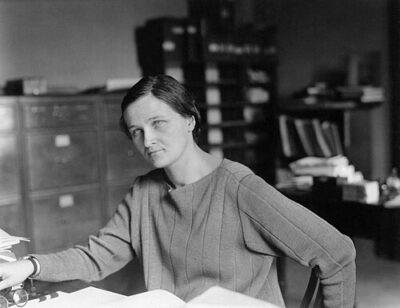
Cecilia Helena Payne Gaposchkin
Cecilia Helena Payne Gaposchkin was a British-born American astronomer. Born May 10, 1900, in Wendover. Died December 7, 1979, in Cambridge. Educated at Harvard University and Radcliffe College. Awards include Henry Norris Russell Lectureship, Annie Jump Cannon Award in Astronomy and Fellow of the American Academy of Arts and Sciences.
Facts
38 facts · 1 confirmed by two sources · 27 cited · 10 from one source
Where this comes from
Papalocal keeps its own record. It started from these sources; what each one said is kept here as it was copied, so a change on their side never changes this page by itself. Tap one to read its version.
What Wikidata says · copied November 13, 2026 · revision 2567139040
- Described as
- British-born American astronomer
- Other names
- Cecilia Helena Payne-Gaposchkin, Cecilia Helen Payne, Cecilia Payne
- Born
- May 10, 1900 · 4 references
- Died
- December 7, 1979 · 5 references
- Born in
- Wendover · 2 references
- Died in
- Cambridge · 2 references
- Buried in
- Pine Hill Cemetery · 1 reference
- Cause of death
- cancer
- Name at birth
- Cecilia Helena Payne
- Citizen of
- United Kingdom; United States (1931–) · 1 reference
- Occupation
- astronomer · 1 reference; university teacher; astrophysicist · 1 reference
- Worked for
- Harvard University; Harvard College Observatory · 2 references; Smithsonian Astrophysical Observatory · 1 reference
- Education
- Harvard University (1923–1925) · 2 references; Radcliffe College (1925–) · 2 references; St Paul's Girls' School (1918–1919) · 2 references; Newnham College (1919–1923) · 2 references; University of Cambridge · 1 reference
- Member of
- American Academy of Arts and Sciences; American Philosophical Society (1936–) · 1 reference; American Astronomical Society · 1 reference
- Awards
- Henry Norris Russell Lectureship (1976) · 1 reference; Annie Jump Cannon Award in Astronomy (1934) · 1 reference; Fellow of the American Academy of Arts and Sciences (1943) · 1 reference; Rittenhouse Medal (1961) · 1 reference
- Field
- astronomy · 2 references; astrophysics · 1 reference; star · 1 reference; Milky Way · 1 reference; variable star · 1 reference; stellar astronomy · 1 reference
- Spouse
- Sergei Gaposchkin (1934–) · 1 reference
- Father
- Edward John Payne · 1 reference
- Siblings
- Humfry Payne · 1 reference
- Religion
- agnosticism · 1 reference
- Lived in
- Lexington · 1 reference
- Wikipedias with a page
- 61
Wikidata item Q234909 (wikidata.org/wiki/Q234909), public domain (CC0). Copied November 13, 2026.
What Wikipedia says · copied November 13, 2026 · revision 1385366516
Cecilia Payne-Gaposchkin (born Cecilia Helena Payne; (1900-05-10)May 10, 1900 – (1979-12-07)December 7, 1979) was a British-born American astronomer and astrophysicist. Her work on the cosmic makeup of the universe and the nature of variable stars was foundational to modern astrophysics.
She determined that stars were composed primarily of hydrogen and helium in her 1925 doctoral thesis. Her groundbreaking conclusion was initially rejected by leading astrophysicists, including Henry Norris Russell, because it contradicted the science of the time, which held that no significant elemental differences distinguished the Sun and Earth. Independent observations eventually proved that she was correct.
Despite completing her studies, because she was a woman Payne was not eligible to receive a degree from the University of Cambridge. Similarly in America, she was not eligible to receive a doctoral degree (PhD) for her studies at Harvard University, as the university did not grant doctoral degrees to women at the time. Instead, she received her doctoral degree from Radcliffe College – a liberal arts college for women that began as a study program for women within Harvard. She would go on to overcome barriers for women that she encountered in science and her success opened the door for countless women astronomers, including her Harvard colleague, Helen Sawyer Hogg.
While she was a student at Cambridge, Payne was elected to the Royal Astronomical Society. Later, she became the first recipient of the American Astronomical Society’s prestigious Annie Jump Cannon Award in Astronomy. In 1956, she was the first woman appointed as a professor and as a department chair at Harvard.
Her work resulted in several published books, including The Stars of High Luminosity (1930), Variable Stars (1938), and Variable Stars and Galactic Structure (1954).
- Born, in its opening lines
- May 10, 1900
From the Wikipedia article “Cecilia Payne-Gaposchkin” (en.wikipedia.org/wiki/Cecilia_Payne-Gaposchkin), by its contributors, under CC BY-SA 4.0 (creativecommons.org/licenses/by-sa/4.0/). Copied November 13, 2026; not changed.
Confirmed Two sources agree. Cited One source, and it names where it got it. One source One source, without a reference of its own. Sources disagree The sources disagree. We show the best-supported value and keep theirs below.
