
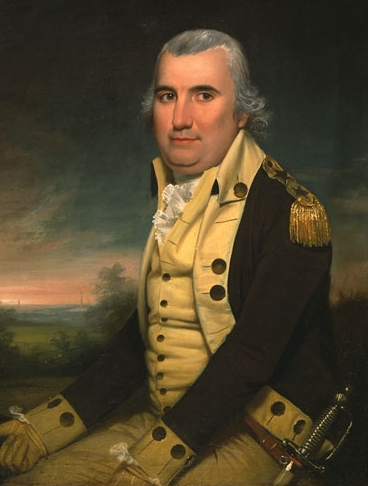
Charles Cotesworth Pinckney
Charles Cotesworth Pinckney was an American politician. Born February 25, 1746, in Charleston. Died August 16, 1825, in Charleston. Positions held include member of the State Senate of South Carolina, member of the South Carolina House of Representatives and United States Ambassador to France (1796–1797). Educated at Christ Church and Westminster School.
Facts
29 facts · 0 confirmed by two sources · 4 cited · 25 from one source
Where this comes from
Papalocal keeps its own record. It started from these sources; what each one said is kept here as it was copied, so a change on their side never changes this page by itself. Tap one to read its version.
What Wikidata says · copied November 16, 2026 · revision 2543259948
- Described as
- American politician (1746-1825)
- Born
- February 25, 1746 · 3 references
- Died
- August 16, 1825 · 3 references
- Born in
- Charleston
- Died in
- Charleston
- Buried in
- St. Michael's Churchyard
- Citizen of
- United States; United Kingdom of Great Britain and Ireland
- Occupation
- diplomat; politician · 2 references; military personnel; lawyer
- Positions held
- member of the State Senate of South Carolina; member of the South Carolina House of Representatives; United States Ambassador to France (1796–1797); Delegate to the United States Constitutional Convention (1787) · 1 reference
- Political party
- Federalist Party
- Education
- Christ Church; Westminster School
- Member of
- American Antiquarian Society; American Philosophical Society (1789–)
- Spouse
- Sarah Middleton Pinckney
- Children
- Maria Henrietta Pinckney
- Father
- Charles Pinckney
- Mother
- Elizabeth Lucas Pinckney
- Siblings
- Thomas Pinckney; Harriott Pinckney Horry
- Military branch
- United States Army; Continental Army
- Military rank
- general
- Wikipedias with a page
- 20
Wikidata item Q405463 (wikidata.org/wiki/Q405463), public domain (CC0). Copied November 16, 2026.
What Wikipedia says · copied November 16, 2026 · revision 1383748146
Charles Cotesworth Pinckney (February 25 [O.S. February 14, 1746] – August 16, 1825) was an American statesman, military officer and Founding Father who served as United States Minister to France from 1796 to 1797. A delegate to the Constitutional Convention where he signed the Constitution of the United States, Pinckney was twice nominated by the Federalist Party as its presidential candidate in 1804 and 1808, losing both elections.
Born into a planter class family from South Carolina, Pinckney practiced law for several years and was elected to the colonial legislature. A supporter of independence from Great Britain, Pinckney served in the American Revolutionary War, rising to the rank of brigadier general. After the war, he won election to the South Carolina legislature, where he and his brother Thomas represented the landed slavocracy of the South Carolina Lowcountry. An advocate of a stronger federal government, Pinckney served as a delegate to the 1787 Philadelphia Convention, which wrote a new federal constitution. Pinckney's influence helped ensure that South Carolina would ratify the United States Constitution. A town and district named Pinckneyville in South Carolina were named after Charles in 1791.
Pinckney declined George Washington's first offer to serve in his administration, but in 1796 Pinckney accepted the position of minister to France. In what became known as the XYZ Affair, the French demanded a bribe before they would agree to meet with the U.S. delegation. Pinckney returned to the United States, accepting an appointment as a general during the Quasi-War with France. Though he had resisted joining either major party for much of the 1790s, Pinckney began to identify with the Federalist Party following his return from France. The Federalists chose him as their vice presidential nominee in the 1800 presidential election, hoping that his presence on the ticket could win support for the party in the American South. Though Alexander Hamilton schemed to elect Pinckney president under the electoral rules then in place, both Pinckney and incumbent Federalist president John Adams were defeated by the Democratic-Republican candidates.
Seeing little hope of defeating popular incumbent president Thomas Jefferson, the Federalists chose Pinckney as their presidential nominee for the 1804 election. Neither Pinckney nor the party pursued an active campaign, and Jefferson won in a landslide. The Federalists nominated Pinckney again in 1808, in the hope that Pinckney's military experience and Jefferson's economic policies would give the party a chance of winning. Though the 1808 presidential election was closer than the 1804 election had been, Democratic-Republican nominee James Madison nonetheless prevailed.
From the Wikipedia article “Charles Cotesworth Pinckney” (en.wikipedia.org/wiki/Charles_Cotesworth_Pinckney), by its contributors, under CC BY-SA 4.0 (creativecommons.org/licenses/by-sa/4.0/). Copied November 16, 2026; not changed.
Confirmed Two sources agree. Cited One source, and it names where it got it. One source One source, without a reference of its own. Sources disagree The sources disagree. We show the best-supported value and keep theirs below.
