
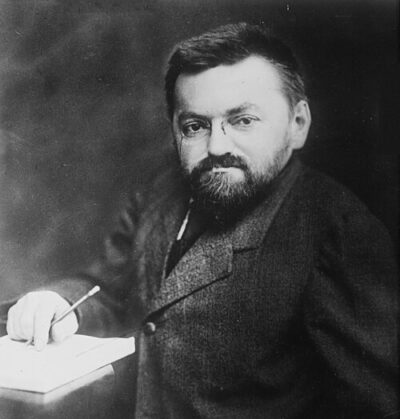
Charles Proteus Steinmetz
Charles Proteus Steinmetz was a Prussian-American mathematician, electrical engineer. Born April 9, 1865, in Wrocław. Died October 26, 1923, in Schenectady. Educated at University of Wrocław. Awards include Elliott Cresson Medal, National Inventors Hall of Fame and Cedergren Medal.
Facts
24 facts · 2 confirmed by two sources · 8 cited · 14 from one source
Where this comes from
Papalocal keeps its own record. It started from these sources; what each one said is kept here as it was copied, so a change on their side never changes this page by itself. Tap one to read its version.
What Wikidata says · copied November 15, 2026 · revision 2569121440
- Described as
- Prussian-American mathematician, electrical engineer (1865–1923)
- Other names
- Karl August Rudolph Steinmetz, Charles Steinmetz, Charles P. Steinmetz
- Born
- April 9, 1865 · 2 references
- Died
- October 26, 1923 · 3 references
- Born in
- Wrocław · 1 reference
- Died in
- Schenectady · 1 reference
- Buried in
- Vale Cemetery and Vale Park
- Name at birth
- Karl August Rudolph Steinmetz
- Citizen of
- Germany; United States
- Occupation
- mathematician; electrical engineer · 1 reference; physicist; inventor · 1 reference
- Political party
- Social Democratic Party of Germany; Socialist Party of America
- Worked for
- Union College (1902–1923)
- Education
- University of Wrocław
- Member of
- American Academy of Arts and Sciences (1911–) · 1 reference; American Philosophical Society (1917–)
- Awards
- Elliott Cresson Medal (1913) · 1 reference; National Inventors Hall of Fame (1977) · 1 reference; Cedergren Medal (1914)
- Field
- mathematician
- Religion
- agnosticism · 1 reference
- Nickname
- Forger of Thunderbolts · 1 reference
- Wikipedias with a page
- 35
Wikidata item Q60677 (wikidata.org/wiki/Q60677), public domain (CC0). Copied November 15, 2026.
What Wikipedia says · copied November 15, 2026 · revision 1385532458
Charles Proteus Steinmetz (born Karl August Rudolph Steinmetz; April 9, 1865 – October 26, 1923) was a Prussian-American mathematician and electrical engineer and professor at Union College. He fostered the development of alternating current that made possible the expansion of the electric power industry in the United States, formulating mathematical theories for engineers. He made ground-breaking discoveries in the understanding of hysteresis that enabled engineers to design better electromagnetic apparatus equipment, especially electric motors for use in industry.
At the time of his death, Steinmetz held over 200 patents. A genius in both mathematics and electronics, he did work that earned him the nicknames "Forger of Thunderbolts" and "The Wizard of Schenectady." Steinmetz's equation, Steinmetz solids, Steinmetz curves, and Steinmetz equivalent circuit are all named after him, as are numerous honors and scholarships, including the IEEE Charles Proteus Steinmetz Award, one of the highest technical recognitions given by the Institute of Electrical and Electronics Engineers professional society.
- Born, in its opening lines
- April 9, 1865
- Died, in its opening lines
- October 26, 1923
From the Wikipedia article “Charles Proteus Steinmetz” (en.wikipedia.org/wiki/Charles_Proteus_Steinmetz), by its contributors, under CC BY-SA 4.0 (creativecommons.org/licenses/by-sa/4.0/). Copied November 15, 2026; not changed.
Confirmed Two sources agree. Cited One source, and it names where it got it. One source One source, without a reference of its own. Sources disagree The sources disagree. We show the best-supported value and keep theirs below.
