
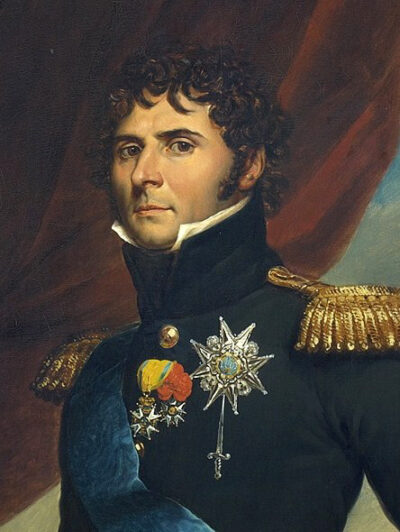
Charles XIV John of Sweden
Charles XIV John of Sweden was a King of Sweden and Norway between 1818–1844. Prince of Ponte Corvo 1806–1810 and French field marshal. Born January 26, 1763, in Pau. Died March 8, 1844, in Stockholm Palace. Positions held include Minister of War (1799), Monarch of Sweden (1818–1844) and Monarch of Norway (1818–1844). Awards include Grand Cross of the Legion of Honour, Marshal of the Empire and Knight of the Order of the Golden Fleece.
Facts
48 facts · 2 confirmed by two sources · 11 cited · 35 from one source
Where this comes from
Papalocal keeps its own record. It started from these sources; what each one said is kept here as it was copied, so a change on their side never changes this page by itself. Tap one to read its version.
What Wikidata says · copied November 16, 2026 · revision 2569405304
- Described as
- King of Sweden and Norway between 1818–1844. Prince of Ponte Corvo 1806–1810 and French field marshal (1763–1844)
- Other names
- Jean-Baptiste Bernadotte, John Baptiste Julius Bernadotte, Jean-Baptiste Jules Bernadotte, Charles Jean, Prince of Ponte Corvo, Jean Baptiste Bernadotte, Jean Baptiste Jules Bernadotte
- Born
- January 26, 1763 · 10 references
- Died
- March 8, 1844 · 10 references
- Born in
- Pau · 3 references
- Died in
- Stockholm Palace · 1 reference
- Buried in
- Bernadotte crypt · 1 reference
- Cause of death
- stroke
- Name at birth
- Jean Bernadotte
- Citizen of
- France; Sweden
- Occupation
- monarch; politician · 1 reference; military commander · 1 reference; soldier · 1 reference; governor · 1 reference
- Positions held
- Minister of War (1799); Monarch of Sweden (1818–1844); Monarch of Norway (1818–1844)
- Member of
- Royal Swedish Academy of Sciences
- Awards
- Grand Cross of the Legion of Honour; Marshal of the Empire (1804–); Knight of the Order of the Golden Fleece; Marshal of France; list of names inscribed on the Arc de Triomphe; Order of the Black Eagle; Military Order of St. Henry; Order of Saint Alexander Nevsky; Order of St. Andrew; Royal Order of the Seraphim; Order of the Elephant; Grand Cross of the Iron Cross (1813) · 1 reference; Order of Saint Hubert; Royal Order of the Sword · 1 reference; Royal Order of the Polar Star (1810)
- Spouse
- Désirée Clary (1798–) · 3 references
- Children
- Oscar I of Sweden · 1 reference
- Father
- Jean Henri Bernadotte · 2 references
- Mother
- Jeanne de Saint-Jean · 1 reference
- Siblings
- Jean-Évangéliste Bernadotte; Karl Adolf; Lovisa Hedvig of Sweden; Carl August, Crown Prince of Sweden
- Religion
- Lutheranism (1810–); Catholicism (–1810) · 1 reference
- Military branch
- French Armed Forces · 1 reference
- Military rank
- Marshal of the Empire; Sergeant (1788) · 1 reference; junior lieutenant (1790) · 1 reference
- Lived in
- Stockholm Palace · 1 reference
- Wikipedias with a page
- 79
Wikidata item Q52927 (wikidata.org/wiki/Q52927), public domain (CC0). Copied November 16, 2026.
What Wikipedia says · copied November 16, 2026 · revision 1385467705
Charles XIV John (Swedish: Karl XIV Johan; 26 January 1763 – 8 March 1844) was King of Sweden and Norway from 1818 until his death in 1844 and the first monarch of the Bernadotte dynasty. In Norway, he is known as Charles III John (Norwegian: Karl III Johan); before he became royalty in Sweden, his name was Jean-Baptiste Jules Bernadotte. During the Napoleonic Wars, he participated in battles as a Marshal of France.
Born in Pau in the region of southern France known as Béarn, Bernadotte joined the French Royal Army in 1780. Following the outbreak of the French Revolution, he demonstrated great military talent, rising rapidly through the ranks and becoming a brigadier general by 1794. He served with distinction in Italy and Germany, and was briefly Minister of War. His relationship with Napoleon was turbulent; nevertheless, Napoleon named him a Marshal of the Empire on the proclamation of the French Empire. Bernadotte played a significant role in the French victory at Austerlitz, and was made Prince of Pontecorvo as a reward. His marriage to Désirée Clary, whose sister was married to Joseph Bonaparte, made Bernadotte a member of the extended Imperial family.
In 1810, Bernadotte was unexpectedly elected the Crown Prince to the childless King Charles XIII of Sweden, thanks to the advocacy of Baron Carl Otto Mörner, a Swedish courtier and obscure member of the Riksdag of the Estates. He assumed the name Charles (Carl) after his adoptive father and John (Johan), which is a Swedish version of Jean. He was subsequently named regent and generalissimo of the Swedish Armed Forces, soon after his arrival becoming de facto head of state for most of his time as Crown Prince. In 1812, following the sudden unprovoked French invasion of Swedish Pomerania, Crown Prince Charles John was instrumental in the creation of the Sixth Coalition by allying with Alexander I of Russia and using Swedish diplomacy to bring warring Russia and Britain together in alliance. He then played a major role in the writing of the Trachenberg Plan, the war-winning Allied campaign plan, and commanded the Allied Army of the North that defeated two concerted French attempts to capture Berlin and made the decisive attack on the last day of the catastrophic French defeat at Leipzig.
Following the conclusion of the Leipzig campaign and after liberating Bremen and Lübeck from the French in late November 1813, Charles John invaded Denmark, aiming to knock Napoleon's last major ally out of the war to secure the Coalition's northern flank in preparation for the invasion of France in 1814 and to secure Norway for Sweden, as stipulated in the several treaties that created the Sixth Coalition. After a brief campaign that saw the defeat of the Danish Army, King Frederick VI of Denmark was forced to sign the Treaty of Kiel on 15 January 1814 that ceded Norway to Sweden, that in turn led to the Swedish–Norwegian War of 1814, where Norway was defeated in nineteen days. This put Norway into a union with Sweden, which lasted for almost a century before its peaceful 1905 dissolution. The Swedish–Norwegian war is viewed as Sweden's last direct conflict and war.
Upon the death of Charles XIII in 1818, Charles John ascended to the throne. He presided over a period of peace and prosperity, and reigned until his death in 1844.
- Born, in its opening lines
- January 26, 1763
- Died, in its opening lines
- March 8, 1844
From the Wikipedia article “Charles XIV John” (en.wikipedia.org/wiki/Charles_XIV_John), by its contributors, under CC BY-SA 4.0 (creativecommons.org/licenses/by-sa/4.0/). Copied November 16, 2026; not changed.
Confirmed Two sources agree. Cited One source, and it names where it got it. One source One source, without a reference of its own. Sources disagree The sources disagree. We show the best-supported value and keep theirs below.
