
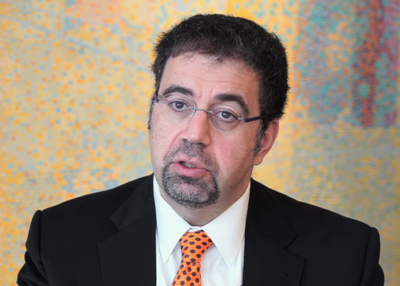
Daron Acemoğlu
Daron Acemoğlu is a Turkish-American economist and receiver of the 2024 Nobel Prize in economic sciences. Born September 3, 1967, in Istanbul. Educated at London School of Economics and Political Science and University of York. Awards include John Bates Clark Medal, John von Neumann Award and Erwin Plein Nemmers Prize in Economics.
Facts
39 facts · 1 confirmed by two sources · 14 cited · 24 from one source
Where this comes from
Papalocal keeps its own record. It started from these sources; what each one said is kept here as it was copied, so a change on their side never changes this page by itself. Tap one to read its version.
What Wikidata says · copied November 13, 2026 · revision 2566054764
- Described as
- Turkish-American economist and receiver of the 2024 Nobel Prize in economic sciences (born 1967)
- Other names
- Kamer Daron Acemoğlu, Daron Acemoglu, Kamer Daron Acemoglu
- Born
- September 3, 1967 · 2 references
- Born in
- Istanbul · 3 references
- Name at birth
- Kamer Daron Acemoğlu
- Citizen of
- Turkey · 5 references; United States · 1 reference
- Occupation
- economist · 1 reference; university teacher · 1 reference; author
- Worked for
- Massachusetts Institute of Technology · 2 references; London School of Economics and Political Science
- Education
- London School of Economics and Political Science · 2 references; University of York; Galatasaray High School; Aramyan Uncuyan Private Armenian Elementary School
- Member of
- American Academy of Arts and Sciences; National Academy of Sciences; Econometric Society (2005–) · 1 reference; American Philosophical Society; Royal Society of London; Society of Labor Economists; Turkish Academy of Sciences
- Awards
- John Bates Clark Medal (2005); John von Neumann Award (2007); Erwin Plein Nemmers Prize in Economics (2012); Presidential Culture and Arts Grand Awards (2013); BBVA Foundation Frontiers of Knowledge Award (2016); Fellow of the Econometric Society (2005) · 1 reference; Fellow of the American Academy of Arts and Sciences; Heinz I. Eulau Award (2007) · 1 reference; Clarivate Citation Laureates (2022) · 1 reference; Carnegie Fellow (2017) · 1 reference; Global Economy Prize (2019) · 1 reference; honorary doctorate from École normale supérieure Paris-Saclay (2017) · 1 reference; Prize in Economic Sciences in Memory of Alfred Nobel (2024) · 1 reference; Corresponding Fellow of the British Academy (2021) · 1 reference
- Field
- economics
- Spouse
- Asuman Özdağlar
- Father
- Kevork Acemoǧlu · 1 reference
- Mother
- İrma Acemyan
- Wikipedias with a page
- 54
Wikidata item Q718581 (wikidata.org/wiki/Q718581), public domain (CC0). Copied November 13, 2026.
What Wikipedia says · copied November 13, 2026 · revision 1384637347
Kamer Daron Acemoğlu (born September 3, 1967) is a Turkish-American economist of Armenian descent who has been at the Massachusetts Institute of Technology since 1993, where he is currently the Elizabeth and James Killian Professor of Economics. He was named an Institute Professor at MIT in 2019. His primary research fields include political economy, development economics, and labor economics. He received the John Bates Clark Medal in 2005, and the Nobel Memorial Prize in Economic Sciences in 2024.
Acemoglu ranked third, behind Paul Krugman and Greg Mankiw, in the list of "Favorite Living Economists Under Age 60" in a 2011 survey among American economists. In 2015, he was named the most cited economist of the past 10 years per Research Papers in Economics (RePEc) data. According to the Open Syllabus Project, Acemoglu is the third most frequently cited author on college syllabi for economics courses after Mankiw and Krugman.
In 2024, Acemoglu, Simon Johnson, and James A. Robinson were awarded the Nobel Memorial Prize in Economic Sciences for their comparative studies in prosperity between states and empires. He is regarded as a centrist with a focus on institutions, poverty and econometrics.
- Born, in its opening lines
- September 3, 1967
From the Wikipedia article “Daron Acemoglu” (en.wikipedia.org/wiki/Daron_Acemoglu), by its contributors, under CC BY-SA 4.0 (creativecommons.org/licenses/by-sa/4.0/). Copied November 13, 2026; not changed.
Confirmed Two sources agree. Cited One source, and it names where it got it. One source One source, without a reference of its own. Sources disagree The sources disagree. We show the best-supported value and keep theirs below.
