
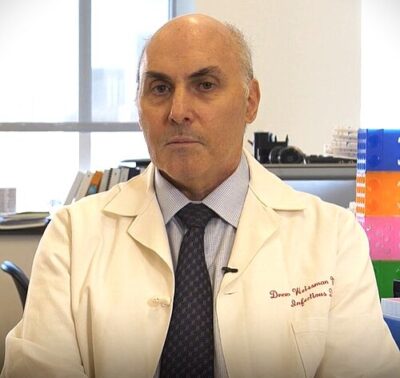
Drew Weissman
Drew Weissman was an American physician-scientist. Born September 7, 67, in Lexington. Educated at Brandeis University and Boston University. Awards include Princess of Asturias Award for Technical and Scientific Research, Breakthrough Prize in Life Sciences and Fellow of the American Academy of Arts and Sciences.
Facts
31 facts · 0 confirmed by two sources · 22 cited · 8 from one source · 1 where the sources disagree
What’s different
- Born: we show September 7, 67 (Sources disagree). Wikipedia says September 7, 1959
Where this comes from
Papalocal keeps its own record. It started from these sources; what each one said is kept here as it was copied, so a change on their side never changes this page by itself. Tap one to read its version.
What Wikidata says · copied November 13, 2026 · revision 2568668633
- Described as
- American physician-scientist (born 1959)
- Born
- September 7, 67 · 1 reference
- Born in
- Lexington · 2 references
- Citizen of
- United States
- Occupation
- researcher · 1 reference; biochemist; university teacher; inventor; immunologist · 1 reference
- Worked for
- Perelman School of Medicine at the University of Pennsylvania · 1 reference; University of Pennsylvania · 1 reference
- Education
- Brandeis University (–1981) · 1 reference; Boston University (–1987) · 1 reference
- Member of
- American Academy of Arts and Sciences
- Awards
- Princess of Asturias Award for Technical and Scientific Research (2021) · 1 reference; Breakthrough Prize in Life Sciences (2022) · 2 references; Fellow of the American Academy of Arts and Sciences (2022) · 1 reference; Rosenstiel Award (2020) · 1 reference; Louisa Gross Horwitz Prize (2021) · 1 reference; Jessie Stevenson Kovalenko Medal (2022) · 1 reference; Warren Alpert Foundation Prize (2022) · 1 reference; Albany Medical Center Prize (2021) · 1 reference; Nobel Prize in Physiology or Medicine (2023) · 2 references; Lasker-DeBakey Clinical Medical Research Award (2021) · 1 reference; National Inventors Hall of Fame (2023) · 1 reference; Cameron Prize of the University of Edinburgh; Dr. Paul Janssen Award for Biomedical Research (2021) · 1 reference; Canada Gairdner International Award (2022); William B. Coley Award (2021) · 1 reference
- Field
- messenger RNA · 1 reference; RNA vaccine · 1 reference
- Religion
- Judaism
- Wikipedias with a page
- 50
Wikidata item Q88608402 (wikidata.org/wiki/Q88608402), public domain (CC0). Copied November 13, 2026.
What Wikipedia says · copied November 13, 2026 · revision 1379891579
Drew Weissman (born September 7, 1959) is a Nobel Prize winning American physician and immunologist known for his contributions to RNA biology.
Weissman is the inaugural Roberts Family Professor in Vaccine Research, director of the Penn Institute for RNA Innovation, and professor of medicine at the Perelman School of Medicine at the University of Pennsylvania (Penn).
Weissman's work underlies the development of mRNA vaccines, the best known of which are those for COVID-19 produced by BioNTech/Pfizer and Moderna. With biochemist Katalin Karikó, Weissman received the Nobel Prize in Physiology or Medicine in 2023 "for their discoveries concerning nucleoside base modifications that enabled the development of effective mRNA vaccines against COVID-19". Weissman has been a recipient and co-recipient of numerous awards, also including the prestigious Lasker–DeBakey Clinical Medical Research Award. In 2022, he was elected to the National Academy of Medicine and the American Academy of Arts and Sciences.
- Born, in its opening lines
- September 7, 1959
From the Wikipedia article “Drew Weissman” (en.wikipedia.org/wiki/Drew_Weissman), by its contributors, under CC BY-SA 4.0 (creativecommons.org/licenses/by-sa/4.0/). Copied November 13, 2026; not changed.
Confirmed Two sources agree. Cited One source, and it names where it got it. One source One source, without a reference of its own. Sources disagree The sources disagree. We show the best-supported value and keep theirs below.
