
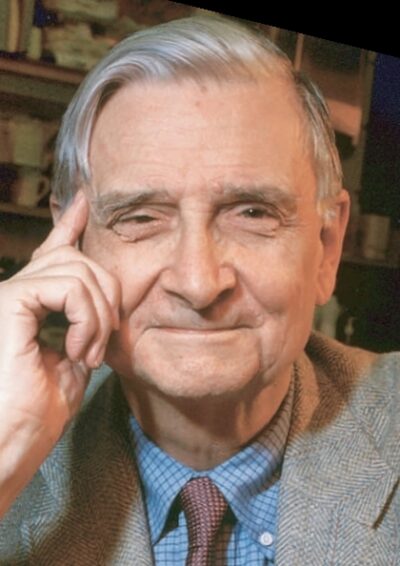
Edward O. Wilson
Edward O. Wilson was an American biologist, naturalist, and writer. Born June 10, 1929, in Birmingham. Died December 26, 2021, in Burlington. Known for Journey to the Ants, The Ants and Sociobiology: The New Synthesis. Educated at Harvard University and University of Alabama. Awards include Guggenheim Fellowship, Pulitzer Prize for General Nonfiction (2 times) and Humanist of the Year.
Facts
49 facts · 2 confirmed by two sources · 29 cited · 18 from one source
Where this comes from
Papalocal keeps its own record. It started from these sources; what each one said is kept here as it was copied, so a change on their side never changes this page by itself. Tap one to read its version.
What Wikidata says · copied November 13, 2026 · revision 2568781571
- Described as
- American biologist, naturalist, and writer (1929–2021)
- Other names
- Edward Osborne Wilson, Edward Osborne, Edward Wilson, Junior, E O Wilson, Wilson, E. O. Wilson, EO Wilson, E.O. Wilson, Wilson EO
- Born
- June 10, 1929 · 6 references
- Died
- December 26, 2021 · 3 references
- Born in
- Birmingham · 1 reference
- Died in
- Burlington · 3 references
- Buried in
- Westview Cemetery · 1 reference
- Citizen of
- United States · 1 reference
- Occupation
- entomologist · 1 reference; sociobiologist; novelist; ethologist; autobiographer; naturalist; evolutionary biologist; science writer
- Worked for
- Harvard University
- Education
- Harvard University; University of Alabama (–1950)
- Member of
- German Academy of Sciences Leopoldina (1977–) · 1 reference; Accademia Nazionale dei Lincei (2011–) · 1 reference; National Academy of Sciences (1969–) · 1 reference; Linnean Society of London · 1 reference; American Academy of Arts and Sciences (1959–) · 1 reference; American Philosophical Society (1976–) · 1 reference; Ecological Society of America; Royal Society of London (1990–) · 1 reference
- Known for
- Journey to the Ants; The Ants; Sociobiology: The New Synthesis
- Awards
- Guggenheim Fellowship (1975) · 1 reference; Pulitzer Prize for General Nonfiction (2 times) (1979, 1991) · 1 reference; Humanist of the Year (1999) · 1 reference; William Procter Prize for Scientific Achievement (1997) · 1 reference; Tyler Prize for Environmental Achievement (1984) · 1 reference; Carl Sagan Award for Public Understanding of Science (1994) · 1 reference; Harvard Centennial Medal (1999); King Faisal Prize in Science (2000) · 1 reference; TED Prize (2007) · 1 reference; International Prize for Biology (1993) · 1 reference; Kistler Prize (2000); National Medal of Science (1976) · 1 reference; Catalonia International Prize (2007) · 1 reference; Nierenberg Prize (2001) · 1 reference; International Cosmos Prize (2012) · 1 reference
- Field
- myrmecology · 1 reference; sociobiology · 1 reference; natural science · 1 reference; zoology · 1 reference; entomology · 1 reference; biodiversity · 1 reference
- Wikipedias with a page
- 70
Wikidata item Q211029 (wikidata.org/wiki/Q211029), public domain (CC0). Copied November 13, 2026.
What Wikipedia says · copied November 13, 2026 · revision 1384330611
Edward Osborne Wilson (June 10, 1929 – December 26, 2021) was an American biologist, naturalist, ecologist, and entomologist who developed the field of sociobiology.
Born in Alabama, Wilson found an early interest in nature and frequented the outdoors. At age seven, he was partially blinded in a fishing accident; due to his reduced sight, Wilson resolved to study entomology. After graduating from the University of Alabama, he earned his doctorate at Harvard University, where he distinguished himself in multiple fields. In 1956, he co-authored a paper defining the theory of character displacement. In 1967, he developed the theory of island biogeography with Robert MacArthur.
Wilson was the Pellegrino University Research Professor Emeritus in Entomology for the Department of Organismic and Evolutionary Biology at Harvard University, a lecturer at Duke University, and a fellow of the Committee for Skeptical Inquiry. The Royal Swedish Academy awarded Wilson the Crafoord Prize. He was a humanist laureate of the International Academy of Humanism. He was a two-time winner of the Pulitzer Prize for General Nonfiction (for On Human Nature in 1979, and The Ants in 1991) and a New York Times bestselling author for The Social Conquest of Earth, Letters to a Young Scientist, and The Meaning of Human Existence.
Wilson's work received both praise and criticism during his lifetime. His 1975 book Sociobiology: The New Synthesis was a particular flashpoint for controversy, and drew criticism from the Sociobiology Study Group. Wilson's interpretation of the theory of evolution resulted in a widely reported dispute with Richard Dawkins about multilevel selection theory. Examinations of his letters after his death revealed that he had supported the psychologist J. Philippe Rushton, whose work on race and intelligence is widely regarded by the scientific community as deeply flawed and racist.
- Born, in its opening lines
- June 10, 1929
- Died, in its opening lines
- December 26, 2021
From the Wikipedia article “E. O. Wilson” (en.wikipedia.org/wiki/E._O._Wilson), by its contributors, under CC BY-SA 4.0 (creativecommons.org/licenses/by-sa/4.0/). Copied November 13, 2026; not changed.
Confirmed Two sources agree. Cited One source, and it names where it got it. One source One source, without a reference of its own. Sources disagree The sources disagree. We show the best-supported value and keep theirs below.
