
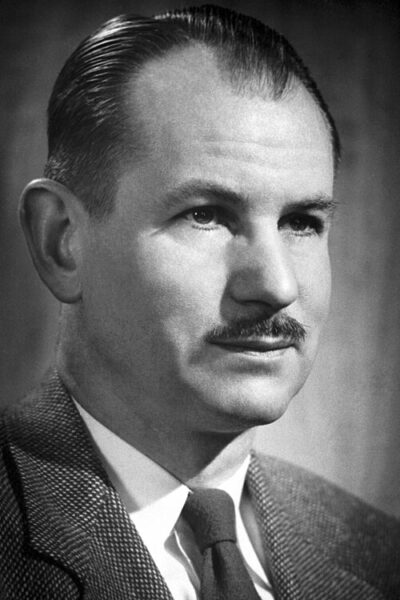
Edwin McMillan
Edwin McMillan was an American physicist. Born September 18, 1907, in Redondo Beach. Died September 7, 1991, in El Cerrito. Educated at Pasadena High School and California Institute of Technology. Awards include Atoms for Peace Award, Nobel Prize in Chemistry and National Medal of Science.
Facts
24 facts · 2 confirmed by two sources · 16 cited · 6 from one source
Where this comes from
Papalocal keeps its own record. It started from these sources; what each one said is kept here as it was copied, so a change on their side never changes this page by itself. Tap one to read its version.
What Wikipedia says · copied November 13, 2026 · revision 1375522971
Edwin Mattison McMillan (September 18, 1907 – September 7, 1991) was an American physicist credited with being the first to produce a transuranium element, neptunium. For this, he shared the 1951 Nobel Prize in Chemistry with Glenn Seaborg.
A graduate of California Institute of Technology, he earned his doctorate from Princeton University in 1933, and joined the Berkeley Radiation Laboratory where he discovered oxygen-15 and beryllium-10. During World War II, he worked on microwave radar at the MIT Radiation Laboratory, and then on sonar at the Navy Radio and Sound Laboratory. In 1942 he joined the Manhattan Project, the wartime effort to create the atomic bomb and helped establish its Los Alamos Laboratory where the bomb was designed. He led teams working on the gun-type nuclear weapon design, and also participated in the development of the implosion-type nuclear weapon.
McMillan co-invented the synchrotron with Vladimir Veksler, and after the war he returned to the Berkeley Radiation Laboratory to build them. He was appointed associate director of the Radiation Laboratory in 1954 and promoted to deputy director in 1958. He became director upon the death of lab founder Ernest Lawrence later that year, and remained director until his retirement in 1973.
- Born, in its opening lines
- September 18, 1907
- Died, in its opening lines
- September 7, 1991
From the Wikipedia article “Edwin McMillan” (en.wikipedia.org/wiki/Edwin_McMillan), by its contributors, under CC BY-SA 4.0 (creativecommons.org/licenses/by-sa/4.0/). Copied November 13, 2026; not changed.
What Wikidata says · copied November 14, 2026 · revision 2569161525
- Described as
- American physicist (1907-1991)
- Other names
- E. M. McMillan, Edwin M. McMillan, Edwin Mattison McMillan
- Born
- September 18, 1907 · 5 references
- Died
- September 7, 1991 · 6 references
- Born in
- Redondo Beach · 2 references
- Died in
- El Cerrito · 2 references
- Buried in
- Sunset View Cemetery · 1 reference
- Cause of death
- complications of diabetes mellitus · 1 reference
- Name at birth
- Edwin Mattison McMillan · 1 reference
- Citizen of
- United States · 1 reference
- Occupation
- physicist · 2 references; university teacher · 1 reference
- Worked for
- University of California, Berkeley · 1 reference
- Education
- Pasadena High School · 1 reference; California Institute of Technology · 1 reference; Princeton University · 1 reference
- Member of
- National Academy of Sciences (1947–); American Academy of Arts and Sciences; American Philosophical Society (1952–) · 1 reference; American Physical Society · 1 reference
- Awards
- Atoms for Peace Award; Nobel Prize in Chemistry (1951) · 2 references; National Medal of Science (1990); Fellow of the American Physical Society; Golden Plate Award (1964) · 1 reference
- Field
- physics
- Wikipedias with a page
- 63
Wikidata item Q19009 (wikidata.org/wiki/Q19009), public domain (CC0). Copied November 14, 2026.
Confirmed Two sources agree. Cited One source, and it names where it got it. One source One source, without a reference of its own. Sources disagree The sources disagree. We show the best-supported value and keep theirs below.
