
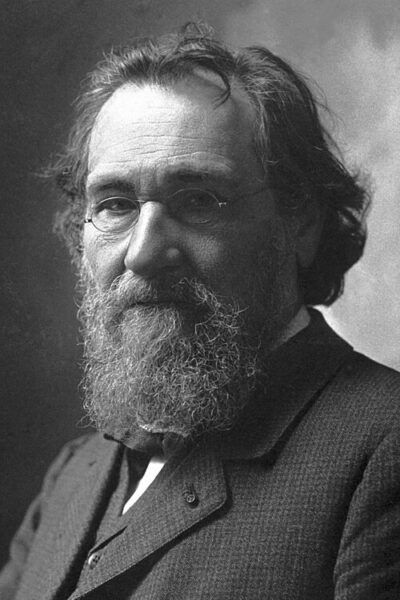
Élie Metchnikoff
Élie Metchnikoff was a Russian-French immunologist, embryologist, biologist. Born May 3, 1845, in Ivanivka. Died July 2, 1916, in Paris. Educated at University of Göttingen and Faculty of Physics and Mathematics of the Imperial Kharkov University. Awards include scientific prize from Russian Academy of Science (3 times), Nobel Prize in Physiology or Medicine and Copley Medal.
Facts
52 facts · 0 confirmed by two sources · 18 cited · 32 from one source · 2 where the sources disagree
What’s different
- Born: we show May 3, 1845 (Sources disagree). Wikipedia says May 15, 1845
- Died: we show July 2, 1916 (Sources disagree). Wikipedia says July 15, 1916
Where this comes from
Papalocal keeps its own record. It started from these sources; what each one said is kept here as it was copied, so a change on their side never changes this page by itself. Tap one to read its version.
What Wikidata says · copied November 16, 2026 · revision 2568738530
- Described as
- Russian-French immunologist, embryologist, biologist (1845-1916)
- Other names
- Mechnikov, Ilya Metschnikoff, Elias Metschnikoff, Ilya Mecnikov, Ilya Mechnikov, Ilya Ilyich Mechnikov, Ilja Iljitsch Metschnikov, Elie Metchnikoff
- Born
- May 3, 1845 · 3 references
- Died
- July 2, 1916 · 2 references
- Born in
- Ivanivka · 3 references
- Died in
- Paris · 4 references
- Buried in
- Paris
- Cause of death
- myocardial infarction
- Citizen of
- France; Russian Empire
- Occupation
- biologist · 1 reference; immunologist · 1 reference; zoologist · 1 reference; chemist; inventor; physician · 1 reference; physiologist · 1 reference; entomologist
- Worked for
- Odesa University · 1 reference; Imperial St. Petersburg University · 1 reference; Pasteur Institute (1888–1916) · 1 reference; Imperial Novorossiia University · 1 reference
- Education
- University of Göttingen; Faculty of Physics and Mathematics of the Imperial Kharkov University · 1 reference; Imperial Kharkov University · 1 reference
- Member of
- Royal Society of London; Russian Academy of Sciences (1883–) · 1 reference; American Academy of Arts and Sciences; Academy of Sciences of Turin (1910–) · 1 reference; S. M. Kirov Military Medical Academy (1898–) · 1 reference; Romanian Academy; Accademia Nazionale dei Lincei (1911–) · 1 reference
- Awards
- scientific prize from Russian Academy of Science (3 times) (1867, 1870, 1891) · 1 reference; Nobel Prize in Physiology or Medicine (1908) · 2 references; Copley Medal (1906) · 1 reference; Albert Medal (1916) · 1 reference; Foreign Member of the Royal Society (1895) · 1 reference; Officer of the Legion of Honour (1896) · 1 reference; Commander of the Legion of Honour (1913) · 1 reference
- Field
- immunology; microbiology · 1 reference; gerontology; pathology; embryology; immune system · 1 reference
- Spouse
- Olga Belokopytova
- Father
- Ilya Ivanovich Mechnikov
- Mother
- Emilia Barto Mechnikov
- Siblings
- Ivan Ilyich Mechnikov; Léon Metchnikoff
- Religion
- atheism
- Lived in
- Mechnikove · 1 reference; Odesa · 1 reference; Paris · 1 reference
- Wikipedias with a page
- 90
Wikidata item Q172254 (wikidata.org/wiki/Q172254), public domain (CC0). Copied November 16, 2026.
What Wikipedia says · copied November 16, 2026 · revision 1384922557
Ilya Ilyich Mechnikov (15 May [O.S. 3 May] 1845 – 15 July 1916), gallicised and known in Western sources as Élie Metchnikoff, was a zoologist from the Russian Empire of Moldavian noble ancestry best known for his research in immunology (study of immune systems) and thanatology (study of death). He and Paul Ehrlich were jointly awarded the 1908 Nobel Prize in Physiology or Medicine "in recognition of their work on immunity".
Mechnikov was born in a region of the Russian Empire that is today part of modern-day Ukraine to a Moldavian noble father and a Ukrainian-Jewish mother. He later moved to France. Given this complex heritage, five different nations and peoples lay claim to Metchnikoff. Despite having a mother of Jewish origin, he was baptized Russian Orthodox, although he later became an atheist.
Honoured as the "father of innate immunity", Metchnikoff was the first to discover a process of immunity called phagocytosis and the cell responsible for it, called phagocyte, specifically macrophage, in 1882. This discovery turned out to be the major defence mechanism in innate immunity, as well as the foundation of the concept of cell-mediated immunity, while Ehrlich established the concept of humoral immunity to complete the principles of immune system. Their works are regarded as the foundation of the science of immunology.
Metchnikoff developed one of the earliest concepts in ageing, and advocated the use of lactic acid bacteria (Lactobacillus) for healthy and long life. This became the concept of probiotics in medicine. Mechnikov is also credited with coining the term gerontology in 1903 for the emerging study of aging and longevity. In this regard, Ilya Mechnikov is called the "father of gerontology" (although, as often happens in science, the same title is sometimes applied to multiple people who contributed to aging research).
Supporters of life extension celebrate 15 May as Metchnikoff Day and use it as a memorable date for organizing activities.
- Born, in its opening lines
- May 15, 1845
- Died, in its opening lines
- July 15, 1916
From the Wikipedia article “Élie Metchnikoff” (en.wikipedia.org/wiki/Élie_Metchnikoff), by its contributors, under CC BY-SA 4.0 (creativecommons.org/licenses/by-sa/4.0/). Copied November 16, 2026; not changed.
Confirmed Two sources agree. Cited One source, and it names where it got it. One source One source, without a reference of its own. Sources disagree The sources disagree. We show the best-supported value and keep theirs below.
