
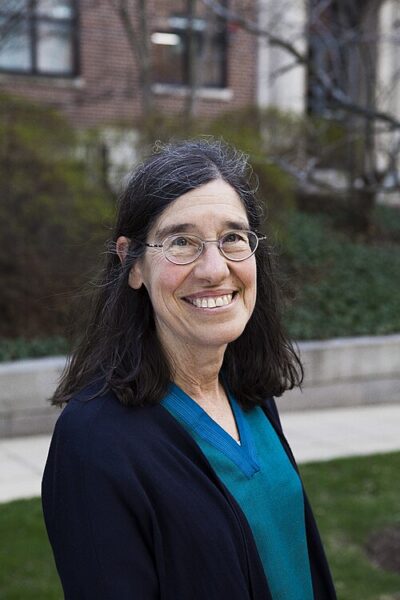
Elizabeth Spelke is an American cognitive scientist. Born May 28, 1949, in New York City. Educated at Cornell University and Radcliffe College. Awards include Boyd McCandless Award, Guggenheim Fellowship and Doctor honoris causa of the École Pratique des Hautes Études.
Facts
33 facts · 1 confirmed by two sources · 22 cited · 10 from one source
Where this comes from
Papalocal keeps its own record. It started from these sources; what each one said is kept here as it was copied, so a change on their side never changes this page by itself. Tap one to read its version.
What Wikidata says · copied November 19, 2026 · revision 2571971564
- Described as
- American cognitive scientist
- Other names
- Elizabeth S. Spelke, Elizabeth Shilin Spelke, Elizabeth S Spelke, Liz Spelke
- Born
- May 28, 1949 · 1 reference
- Born in
- New York City
- Citizen of
- United States
- Occupation
- psychologist · 1 reference; university teacher
- Worked for
- University of Pennsylvania · 1 reference; Cornell University · 1 reference; Massachusetts Institute of Technology · 1 reference; Harvard University (2001–) · 3 references
- Education
- Cornell University (–1978) · 2 references; Radcliffe College · 1 reference; Yale University · 1 reference
- Member of
- National Academy of Sciences (1999–) · 1 reference; American Academy of Arts and Sciences; Society of Experimental Psychologists; conseil scientifique de l'Éducation nationale (2018–) · 1 reference
- Awards
- Boyd McCandless Award (1984) · 1 reference; Guggenheim Fellowship (1988) · 1 reference; Doctor honoris causa of the École Pratique des Hautes Études (1998) · 1 reference; William James Fellow Award (2000) · 1 reference; APA Award for Distinguished Scientific Contributions to Psychology (2000) · 1 reference; Jean Nicod Prize (2009) · 1 reference; Kurt Koffka Medal (2014) · 1 reference; Atkinson Prize in Psychological and Cognitive Sciences (2014) · 1 reference; C.L. de Carvalho-Heineken Prize for Cognitive Science (2016) · 1 reference; Fellow of the Cognitive Science Society; Fellow of the Society of Experimental Psychologists; Fellow of the American Association for the Advancement of Science (2002) · 1 reference; Fellow of the American Academy of Arts and Sciences · 1 reference; honorary doctor of Paris Descartes University (2007) · 1 reference
- Field
- developmental psychology · 1 reference
- Lived in
- Cambridge · 1 reference
- Website
- https://software.rc.fas.harvard.edu/lds/research/spelke/elizabeth-spelke
- Wikipedias with a page
- 12
Wikidata item Q3051273 (wikidata.org/wiki/Q3051273), public domain (CC0). Copied November 19, 2026.
What Wikipedia says · copied November 19, 2026 · revision 1361654833
Elizabeth Shilin Spelke FBA (born May 28, 1949) is an American cognitive psychologist at the Department of Psychology of Harvard University and director of the Laboratory for Developmental Studies.
Starting in the 1980s, she carried out experiments on infants and young children to test their cognitive faculties. She has suggested that human beings have a large array of innate mental abilities. In recent years, she has made important contributions to the debate on cognitive differences between men and women. She defends the position that there is no scientific evidence of any significant disparity in the intellectual faculties of males and females.
- Born, in its opening lines
- May 28, 1949
From the Wikipedia article “Elizabeth Spelke” (en.wikipedia.org/wiki/Elizabeth_Spelke), by its contributors, under CC BY-SA 4.0 (creativecommons.org/licenses/by-sa/4.0/). Copied November 19, 2026; not changed.
Confirmed Two sources agree. Cited One source, and it names where it got it. One source One source, without a reference of its own. Sources disagree The sources disagree. We show the best-supported value and keep theirs below.
