
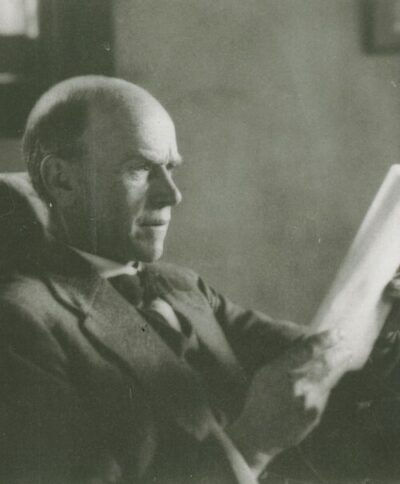
Elton Mayo
Elton Mayo was an Australian psychologist and sociologist. Born December 26, 1880, in Adelaide. Died September 7, 1949, in Guildford. Educated at Harvard Business School and University of Edinburgh.
Facts
29 facts · 2 confirmed by two sources · 11 cited · 16 from one source
Where this comes from
Papalocal keeps its own record. It started from these sources; what each one said is kept here as it was copied, so a change on their side never changes this page by itself. Tap one to read its version.
What Wikidata says · copied November 16, 2026 · revision 2557868149
- Described as
- Australian psychologist and sociologist
- Other names
- George Elton Mayo
- Born
- December 26, 1880 · 5 references
- Died
- September 7, 1949 · 4 references
- Born in
- Adelaide · 1 reference
- Died in
- Guildford
- Name at birth
- George Elton Mayo
- Citizen of
- Australia
- Occupation
- psychologist; professor; sociologist
- Worked for
- Harvard University; University of Queensland; University of Pennsylvania
- Education
- Harvard Business School; University of Edinburgh; University of Queensland; University of Adelaide
- Member of
- American Academy of Arts and Sciences
- Field
- social psychology · 1 reference; work psychology · 1 reference; industrial relations · 1 reference; working conditions · 1 reference; workforce productivity · 1 reference; organizational behavior studies · 1 reference
- Spouse
- Dorothea McConnel · 1 reference
- Children
- Patricia Elton Mayo · 2 references; Gael Elton Mayo · 1 reference
- Father
- George Gibbes Mayo · 1 reference
- Siblings
- Helen Mayo; Herbert Mayo
- Wikipedias with a page
- 38
Wikidata item Q311529 (wikidata.org/wiki/Q311529), public domain (CC0). Copied November 16, 2026.
What Wikipedia says · copied November 16, 2026 · revision 1379617076
George Elton Mayo (26 December 1880 – 7 September 1949) was an Australian-born psychologist, industrial researcher, and organizational theorist. Mayo was formally trained at the University of Adelaide, acquiring a Bachelor of Arts Degree graduating with First Class Honours, majoring in philosophy and psychology, and was later awarded an honorary Master of Arts Degree from the University of Queensland (UQ).
While in Queensland, Mayo served on the University's war committee and pioneered research into the psychoanalytic treatment of shell-shock. As a psychologist Mayo often helped soldiers returning from World War I recover from the stresses of war and with a Brisbane physician, pioneered the psychoanalytic treatment of shell-shock and conducted psycho-pathological tests. He was a lecturer in psychology and mental philosophy at the UQ between 1911 and 1922, when he sailed to the United States. In 1926 he was appointed to the Harvard Business School (HBS) as a professor of industrial research.
In Philadelphia he conducted research at a textile plant in order to develop a method to reduce the very high rate of turnover in the plant. Mayo's association with the Hawthorne studies as well as his research and work in Australia led to his enjoying a public acclaim granted to few social scientists of his day.
Mayo has been credited with making significant contributions to a number of disciplines, including business management, industrial sociology, philosophy, and social psychology. His field research in industry had a significant impact on industrial and organizational psychology. According to Trahair, Mayo "is known for having established the scientific study of what today is called organizational behavior when he gave close attention to the human, social, and political problems of industrial civilization." (p. 15).
Mayo's work helped to lay the foundation for the human relations movement. He emphasized that alongside the formal organization of an industrial workplace there exists an informal organizational structure as well. Mayo recognized the "inadequacies of existing scientific management approaches" to industrial organizations, and underlined the importance of relationships among people who work for such organizations. His ideas on group relations were advanced in his 1933 book The Human Problems of an Industrialized Civilization, which was based partly on his Hawthorne research.
- Born, in its opening lines
- December 26, 1880
- Died, in its opening lines
- September 7, 1949
From the Wikipedia article “Elton Mayo” (en.wikipedia.org/wiki/Elton_Mayo), by its contributors, under CC BY-SA 4.0 (creativecommons.org/licenses/by-sa/4.0/). Copied November 16, 2026; not changed.
Confirmed Two sources agree. Cited One source, and it names where it got it. One source One source, without a reference of its own. Sources disagree The sources disagree. We show the best-supported value and keep theirs below.
