
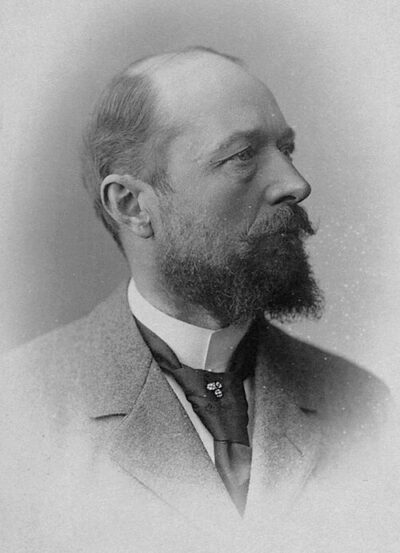
Emil von Behring
Emil von Behring was a German physiologist who received the first Nobel Prize in Physiology or Medicine 1901 for his discovery of a diphtheria antitoxin. Born March 15, 1854, in Ławice. Died March 31, 1917, in Marburg. Educated at Humboldt-Universität zu Berlin. Awards include Nobel Prize in Physiology or Medicine, Fellow of the American Academy of Arts and Sciences and Honorary Doctorate from the National Autonomous University of Mexico.
Facts
44 facts · 2 confirmed by two sources · 12 cited · 30 from one source
Where this comes from
Papalocal keeps its own record. It started from these sources; what each one said is kept here as it was copied, so a change on their side never changes this page by itself. Tap one to read its version.
What Wikidata says · copied November 16, 2026 · revision 2566148607
- Described as
- German physiologist who received the first Nobel Prize in Physiology or Medicine 1901 for his discovery of a diphtheria antitoxin
- Other names
- Emil Adolf von Behring
- Born
- March 15, 1854 · 8 references
- Died
- March 31, 1917 · 9 references
- Born in
- Ławice
- Died in
- Marburg · 1 reference
- Buried in
- Behring-Mausoleum · 1 reference
- Cause of death
- pneumonia
- Name at birth
- Emil Adolf Behring · 1 reference
- Citizen of
- German Reich (1871–); Kingdom of Prussia
- Occupation
- immunologist; physician · 1 reference; non-fiction writer; university teacher; physiologist; bacteriologist; scientist · 1 reference
- Worked for
- University of Marburg; Martin Luther University Halle-Wittenberg; Charité
- Education
- Humboldt-Universität zu Berlin · 1 reference
- Member of
- Academy of Science for Public Utility; American Academy of Arts and Sciences; Pépinière-Corps · 1 reference; Corps Guestphalia et Suevoborussia Marburg · 1 reference; Germania Marburg · 1 reference
- Awards
- Nobel Prize in Physiology or Medicine (1901) · 2 references; Fellow of the American Academy of Arts and Sciences; Honorary Doctorate from the National Autonomous University of Mexico (1910); honorary doctor of the University of Halle-Wittenberg; Cameron Prize of the University of Edinburgh; Order of the Griffon (1895); 2nd Class Order of the Crown with the Star (1896); Order of the Red Eagle 2nd Class (1912); Iron Cross on white ribbon (1915); Officer of the Legion of Honour (1901) · 1 reference
- Field
- medicine; immunology; bacteriology
- Spouse
- Else von Behring (1896–) · 1 reference
- Children
- Hans von Behring · 1 reference; Kurt von Behring · 1 reference; Emil Karl von Behring · 1 reference
- Father
- August Georg Behring · 1 reference
- Siblings
- Paul Behring · 1 reference
- Wikipedias with a page
- 88
Wikidata item Q76425 (wikidata.org/wiki/Q76425), public domain (CC0). Copied November 16, 2026.
What Wikipedia says · copied November 16, 2026 · revision 1381300525
Emil von Behring (German: [ˈeːmiːl fɔn ˈbeːʁɪŋ] ; Emil Adolf von Behring: born Emil Adolf Behring; 15 March 1854 – 31 March 1917) was a German physiologist. In 1901, he received the first Nobel Prize in Physiology or Medicine "for his work on serum therapy, especially its application against diphtheria, by which he has opened a new road in the domain of medical science and thereby placed in the hands of the physician a victorious weapon against illness and deaths". He was widely known as a "saviour of children", as diphtheria used to be a major cause of child death. His work with the disease, as well as tetanus, has come to bring him most of his fame and acknowledgment. He was honoured with Prussian nobility in 1901, henceforth being known by the surname "von Behring".
- Born, in its opening lines
- March 15, 1854
- Died, in its opening lines
- March 31, 1917
From the Wikipedia article “Emil von Behring” (en.wikipedia.org/wiki/Emil_von_Behring), by its contributors, under CC BY-SA 4.0 (creativecommons.org/licenses/by-sa/4.0/). Copied November 16, 2026; not changed.
Confirmed Two sources agree. Cited One source, and it names where it got it. One source One source, without a reference of its own. Sources disagree The sources disagree. We show the best-supported value and keep theirs below.
