
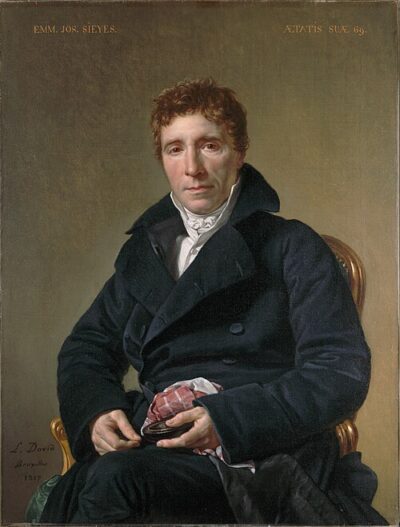
Emmanuel Joseph Sieyès
Emmanuel Joseph Sieyès was a French priest and statesman. Born May 3, 1748, in Fréjus. Died June 20, 1836, in Paris. Positions held include president (2 times) (1797–1800), member (1789–1798) and Member of the Académie française (1803–1816). Educated at University of Paris and Saint-Sulpice Seminary.
Facts
33 facts · 2 confirmed by two sources · 7 cited · 23 from one source · 1 where the sources disagree
What’s different
- Buried in: we show Père Lachaise Cemetery (Sources disagree). Wikidata also lists Grave of Sieyès
Where this comes from
Papalocal keeps its own record. It started from these sources; what each one said is kept here as it was copied, so a change on their side never changes this page by itself. Tap one to read its version.
What Wikidata says · copied November 16, 2026 · revision 2565599840
- Described as
- French priest and statesman (1748-1836)
- Other names
- comte Sieyès Emmanuel Joseph, Emmanuel Joseph, comte Sieyès, Emmanuel-Joseph Sieyès, Emmanuel Joseph Sieyes, comte Sieyes Emmanuel Joseph, Emmanuel-Joseph Sieyes, Abbé Sieyès
- Born
- May 3, 1748 · 11 references
- Died
- June 20, 1836 · 11 references
- Born in
- Fréjus · 4 references
- Died in
- Paris · 1 reference
- Buried in
- Père Lachaise Cemetery · 1 reference; Grave of Sieyès
- Citizen of
- France
- Occupation
- politician · 1 reference; diplomat; sociologist; writer · 1 reference; political theorist · 1 reference; non-fiction writer · 1 reference; Latin Catholic priest (1772–) · 1 reference; essayist · 1 reference
- Positions held
- president (2 times) (1797–1800); member (1789–1798); Member of the Académie française (1803–1816); President of the National Convention (1795); deputy to the National Constituent Assembly of 1789 (1789–1791) · 1 reference; deputy to the National Convention (1792–1795) · 1 reference; Member of the Council of Five Hundred (1795–1798) · 1 reference
- Political party
- The Plain; Society of 1789
- Education
- University of Paris; Saint-Sulpice Seminary · 1 reference
- Member of
- Council of Five Hundred; Académie Française (1803–); Académie des Sciences Morales et Politiques; Society of Thirty; National Convention (1792–1795)
- Siblings
- Joseph-Honoré-Léonce Sieyès; Joseph-Barthélemy Sieyès
- Religion
- Catholic Church · 1 reference
- Wikipedias with a page
- 65
Wikidata item Q294344 (wikidata.org/wiki/Q294344), public domain (CC0). Copied November 16, 2026.
What Wikipedia says · copied November 16, 2026 · revision 1384011717
Emmanuel Joseph Sieyès (3 May 1748 – 20 June 1836), usually known as the Abbé Sieyès (traditional French pronunciation: [sijɛːs]; modern pronunciation: [sjejɛs]), was a French Catholic priest, abbé, and political writer who was a leading political theorist of the French Revolution (1789–1799). He also held offices in the governments of the French Consulate (1799–1804) and the First French Empire (1804–1815).
His pamphlet What Is the Third Estate? (1789) became the political manifesto of the Revolution, which facilitated transforming the Estates-General into the National Assembly, in June 1789. Later that year he played a major role in the final drafting of the Declaration of the Rights of Man and of the Citizen. He was offered and refused an office in the French Directory (1795–1799). After becoming a director in 1799, Sieyès was among the instigators of the Coup of 18 Brumaire (9 November), which installed Napoleon Bonaparte in power.
In addition to his political and clerical life, Sieyès coined the term "sociologie", and contributed to the nascent social sciences.
- Born, in its opening lines
- May 3, 1748
- Died, in its opening lines
- June 20, 1836
From the Wikipedia article “Emmanuel Joseph Sieyès” (en.wikipedia.org/wiki/Emmanuel_Joseph_Sieyès), by its contributors, under CC BY-SA 4.0 (creativecommons.org/licenses/by-sa/4.0/). Copied November 16, 2026; not changed.
Confirmed Two sources agree. Cited One source, and it names where it got it. One source One source, without a reference of its own. Sources disagree The sources disagree. We show the best-supported value and keep theirs below.
