
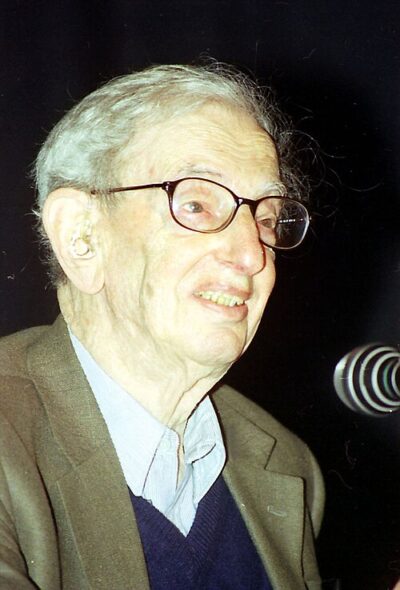
Eric Hobsbawm
Eric Hobsbawm was a British academic historian and Marxist historiographer. Born June 9, 1917, in Alexandria. Died October 1, 2012, in London. Known for The Age of Revolution: Europe 1789–1848, Bandits and The Age of Capital: 1848–1875. Educated at King's College and St Marylebone Grammar School. Awards include Balzan Prize, Bochum Historian Prize and Ernst Bloch Award.
Facts
55 facts · 2 confirmed by two sources · 23 cited · 30 from one source
Where this comes from
Papalocal keeps its own record. It started from these sources; what each one said is kept here as it was copied, so a change on their side never changes this page by itself. Tap one to read its version.
What Wikidata says · copied November 16, 2026 · revision 2567080756
- Described as
- British academic historian and Marxist historiographer (1917–2012)
- Other names
- Eric John Ernest Hobsbawm, E.J. Hobsbawm
- Born
- June 9, 1917 · 11 references
- Died
- October 1, 2012 · 10 references
- Born in
- Alexandria · 3 references
- Died in
- London · 2 references
- Buried in
- Highgate Cemetery
- Cause of death
- pneumonia · 1 reference
- Citizen of
- United Kingdom · 1 reference
- Occupation
- writer; economic historian; social historian; university teacher; music journalist; political scientist · 2 references; historian · 2 references
- Political party
- Communist Party of Great Britain
- Worked for
- Birkbeck, University of London
- Education
- King's College; St Marylebone Grammar School · 1 reference; Prinz-Heinrichs-Gymnasium
- Member of
- American Academy of Arts and Sciences (1971–) · 1 reference; British Academy (1978–) · 1 reference; Hungarian Academy of Sciences (1979–) · 1 reference; Royal Society of Literature (2006–) · 1 reference; Academy of Sciences of Turin (1998–) · 1 reference; Japan Academy (2005–) · 1 reference
- Known for
- The Age of Revolution: Europe 1789–1848 · 1 reference; Bandits; The Age of Capital: 1848–1875; The Age of Extremes: A History of the World, 1914–1991; Primitive Rebels: Studies in Archaic Forms of Social Movement in the 19th and 20th centuries
- Awards
- Balzan Prize (2003) · 1 reference; Bochum Historian Prize (2008) · 1 reference; Ernst Bloch Award (2000); Wolfson History Prize (1997) · 1 reference; Lionel Gelber Prize (1995) · 1 reference; Deutscher Memorial Prize (1995) · 1 reference; honorary doctor of the University of Girona (2008); honorary doctor of the University of Vienna · 1 reference; honorary doctor of the Charles University of Prague; honorary citizen of Vienna (2008); Leipzig Book Award for European Understanding (1999); Companion of Honour · 1 reference; Medlicott Medal (1999) · 1 reference
- Field
- international relations
- Spouse
- Muriel Seaman; Marlene Hobsbawm
- Children
- Julia Hobsbawm; Andy Hobsbawm; Joss Bennathan
- Father
- Leopold Percy Hobsbaum
- Mother
- Nelly Hobsbaum
- Lived in
- Vienna · 1 reference; Villa Seutter · 1 reference; Berlin (1931–) · 1 reference; London
- Wikipedias with a page
- 76
Wikidata item Q34933 (wikidata.org/wiki/Q34933), public domain (CC0). Copied November 16, 2026.
What Wikipedia says · copied November 16, 2026 · revision 1384860322
Eric John Ernest Hobsbawm (; 9 June 1917 – 1 October 2012) was a British historian of the rise of industrial capitalism, socialism and nationalism. His best-known works include his tetralogy about what he called the "long 19th century" (The Age of Revolution: Europe 1789–1848, The Age of Capital: 1848–1875 and The Age of Empire: 1875–1914) and the "short 20th century" (The Age of Extremes), and an edited volume that introduced the influential idea of "invented traditions". He was a life-long Marxist, and his socio-political convictions influenced the character of his work.
Hobsbawm was born in Alexandria, Egypt, and spent his childhood mainly in Vienna and Berlin. Following the death of his parents and the rise to power of Adolf Hitler, Hobsbawm moved to London with his adoptive family. After serving in the Second World War, he obtained his PhD in history at the University of Cambridge. In 1998, he was appointed to the Order of the Companions of Honour. He was president of Birkbeck, University of London, from 2002 until his death. In 2003, he received the Balzan Prize for European History since 1900, "for his brilliant analysis of the troubled history of 20th century Europe and for his ability to combine in-depth historical research with great literary talent."
- Born, in its opening lines
- June 9, 1917
- Died, in its opening lines
- October 1, 2012
From the Wikipedia article “Eric Hobsbawm” (en.wikipedia.org/wiki/Eric_Hobsbawm), by its contributors, under CC BY-SA 4.0 (creativecommons.org/licenses/by-sa/4.0/). Copied November 16, 2026; not changed.
Confirmed Two sources agree. Cited One source, and it names where it got it. One source One source, without a reference of its own. Sources disagree The sources disagree. We show the best-supported value and keep theirs below.
